Last Updated: November 14, 2026
Quick Summary
To verify towing company insurance, ask for the certificate of insurance before you agree to the tow, then call the agent listed on it to confirm the policy is active today. Check that the named insured matches the company you called and that today falls between the effective and expiration dates.
- A certificate of insurance proves coverage existed on the date it was issued, not that it is active now.
- Use the agent contact information printed on the certificate, not a number the driver texts you.
- Ask the agent which coverage types apply: commercial auto, on-hook, garagekeepers, or general liability.
- An agent generally cannot confirm a specific driver or truck is covered, so ask for the declarations page.
- Record the date, time, and who you spoke with in case a claim ever comes up.
Table of Contents
- Why Towing Company Insurance Matters Before You Hire
- Requesting a Towing Company Certificate of Insurance
- How to Confirm Active Coverage with the Insurer
- Questions to Ask a Towing Company Before a Tow
- Does Car Insurance Cover Towing? What Your Policy Includes
- How to File a Claim for Towing Damage
- Why Towing Company Insurance Matters Before You Hire
- Why Towing Company Insurance Matters Before You Hire
- Call Neptune Towing for Licensed, Insured Service in Tulsa
- Frequently Asked Questions
Why Towing Company Insurance Matters Before You Hire
Your car is already damaged or stranded. The last thing you need is a second problem: a tow operator who damages it further and has no way to pay for the repair. Learning how to verify towing company insurance coverage before the truck arrives is the single best protection you have, and it takes about five minutes.
Here’s the uncomfortable truth. Anyone can print a certificate that looks official. A real policy is what stands between you and a repair bill nobody will cover. At Neptune Towing, we are a licensed operator and we are glad to share our Oklahoma DPS wrecker license number when you ask for it.
What a Certificate of Insurance Actually Proves
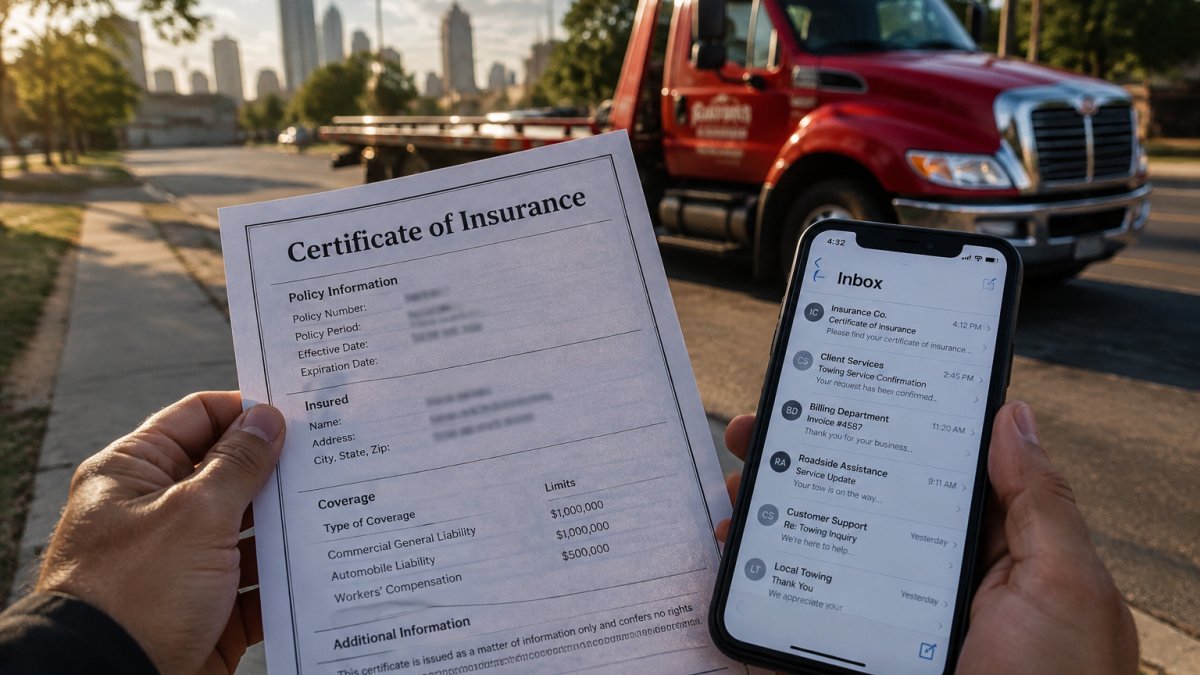
A certificate of insurance is a one-page summary from an insurer or agent showing that a policy exists, who it covers, and when it runs. It proves coverage was in place on the date it was issued. It is not the policy itself, and it does not guarantee the policy is still active today. That’s why you confirm it directly with the insurance carrier.
Requesting a Towing Company Certificate of Insurance
Ask for the certificate before you agree to the tow, not after. A legitimate company should be able to send it to you quickly.
Watch out: a company that stalls, changes the subject, or promises to “send it later” is telling you something. Move on.
What to Look for on the COI
Read the certificate like a checklist, not a formality. Five details matter most:
- Named insured: the business name should match the company you called
- Policy number and insurance carrier: both should be clearly printed
- Effective and expiration dates: today’s date must fall between them
- Policy limits: the maximum the insurer pays per claim
- Certificate holder: your name, if you asked to be listed
If the named insured is a different company than the one showing up, ask why before you sign anything.
How to Confirm Active Coverage with the Insurer
A certificate is evidence that coverage was reported on the date it was issued. It is not the policy, and it is not a guarantee that the policy is still in force when the truck shows up at your curb on a Tuesday night. The only way to close that gap is to confirm the policy directly with the insurance carrier or the issuing agency.
Here is the sequence that works, whether you are standing in a parking lot on Peoria or waiting on the shoulder of the Broken Arrow Expressway.
Step 1: Get the agent’s contact information from the certificate
Every certificate lists the producer, the agency or agent that issued it, along with a phone number and often an email. Use that contact information, not a number the towing company texts you separately. If the only number you have came from the driver, you cannot be sure it reaches the insurer.
Step 2: Call the agency and identify yourself as a customer
You do not need to be a policyholder to ask a coverage question. Tell the person who answers that you are hiring the named insured for a tow and want to confirm the policy is active today. Have the certificate in front of you so you can read the policy number, named insured, and effective dates exactly as printed.
Step 3: Ask these questions, in this order
- Is the policy number on this certificate active as of today’s date?
- Does the named insured on the policy match the business name on the certificate?
- What coverage types are on the policy, commercial auto, on-hook, garagekeepers, general liability?
- Are there any exclusions or endorsements that would limit coverage for a vehicle being towed for hire?
- Is the certificate holder listed correctly, if I asked to be added?
A cooperative agent will answer the first three without hesitation. The fourth question is where a real conversation starts, because exclusions are where claims actually get denied.
Step 4: Ask what the agent cannot confirm
This is the part most guides skip. An agent can confirm that a policy exists, who it covers, and whether it is active. An agent generally cannot confirm that a specific driver is on the policy, that a specific truck is scheduled, or that a particular tow will be covered. Those are underwriting details that live in the policy itself, not the certificate. If the agent tells you the driver or truck is “probably” covered, treat that as unconfirmed and ask the towing company to produce the policy declarations page.
Step 5: Watch for the patterns that signal a problem
A certificate that lists a different named insured than the company you called is the most common red flag. So is a certificate with an expiration date that has already passed, a policy number that the agent cannot find, or a producer phone number that rings to a disconnected line. Altered certificates can often be spotted on close inspection, which is why confirming with the agent matters.
Watch out: if the agent confirms the policy is active but cannot confirm the coverage type you asked about, do not assume it is included. Ask the towing company for the declarations page and read the coverage schedule yourself.
Step 6: Save what you confirmed
Write down the date, the time, the name of the person you spoke with, and what they told you. If a claim ever comes up, that record is worth more than the certificate itself. A short email to the agency summarizing the call works just as well and creates a paper trail without any extra effort.
This step takes about five minutes on the phone. It is the difference between trusting a piece of paper and knowing the coverage is real.
Questions to Ask a Towing Company Before a Tow
Good operators expect these questions. Here’s what to ask, and why each one matters:
- Are you licensed and insured? Ask for the Oklahoma DPS wrecker license number.
- Does your policy cover my vehicle while it’s loaded, moved, and unloaded?
- Which coverage applies if my car is damaged during the tow?
- What does your quote include, and what could change it?
- Do you follow the manufacturer’s towing procedure for my vehicle?
Give them your year, make, and model too. Mention if it’s electric, AWD, lowered, or won’t roll. That one detail helps the driver arrive with the right equipment. For a closer look at how quotes are built, see our guide to towing service pricing.
Towing company insurance only protects you if the right coverage exists. The four types below are the ones worth naming on the phone:
| Coverage Type | What It Covers | Why You Ask |
|---|---|---|
| Commercial auto | The tow truck and its operation | Basic proof the business is insured |
| On-hook coverage | Your vehicle while hooked or loaded | Direct protection during the tow |
| Garagekeepers | Vehicles in the company’s care | Covers storage and holding periods |
| General liability | Property damage and injuries | Covers damage beyond the vehicle |
Ask which of these the company carries. A serious operator can answer without checking.
Does Car Insurance Cover Towing? What Your Policy Includes
Maybe. Many policies include towing and labor coverage, but the amount and terms vary widely. Some reimburse a flat amount per tow. Others only cover a tow to the nearest shop. Call your agent and ask three things: whether you have towing coverage, your limit per incident, and whether you must use a specific provider.
If your policy covers it, you may still prefer to call a local company directly. Our comparison of towing company versus insurance dispatch explains the difference in response time and cost.
How to File a Claim for Towing Damage
Report damage the moment you see it, before the truck leaves. Photograph every angle, note the driver’s name and the company, and keep your receipt. Then call the towing company’s insurer, not just the company, and file a claim with the policy number from the certificate. Save all repair estimates and correspondence.
Prevention beats paperwork. Our guide on how to prevent towing damage covers the prep steps that protect your vehicle before it’s loaded.
Why Towing Company Insurance Matters Before You Hire
Insurance is a promise, and promises are only as good as the company behind them. That’s why we tell every customer to check our license and coverage first. As an owner-operated company, Neptune Towing is accountable to the local customers it serves.
Why Towing Company Insurance Matters Before You Hire
Vetting a company goes beyond one certificate. Look for a local business with a real address, a phone number you can reach, and a track record you can check. Our guide to choosing a towing company in Tulsa walks through the full list of things to confirm before you hire.
Call Neptune Towing for Licensed, Insured Service in Tulsa
Neptune Towing is licensed under Oklahoma DPS wrecker license DPS-53547-W, and we’re happy to walk you through our coverage. We’re owner-operated, we use flatbed trucks, skates, and dollies for low-clearance, damaged, AWD, and electric vehicles, and we do not impound cars. If your vehicle is stuck, damaged, or won’t shift into gear, call us and we’ll tell you what to expect. You can contact Neptune Towing any time, day or night.
Your car deserves an operator who can prove coverage and answer a straight question. Call Neptune Towing at (539) 292-3074 for licensed, insured towing and roadside assistance across Tulsa, Jenks, Bixby, Broken Arrow, and Glenpool. We’ll confirm our credentials, explain the quote, and get your vehicle moved without damage.
Frequently Asked Questions
Can I verify a towing company’s insurance before they arrive?
Yes. Ask the dispatcher for a certificate of insurance (COI) and have it emailed or texted to you before the truck is dispatched. The COI should list the company’s legal name, policy number, insurer, and effective and expiration dates. Then call the insurer’s agent to confirm the policy is active and covers the type of towing you need. A legitimate towing company will provide this without hesitation.
What should I check on a towing company’s certificate of insurance?
Look for the named insured matching the company you hired, a policy number, the insurance carrier, and current effective and expiration dates. Confirm the COI includes commercial auto liability and, if offered, on-hook or garagekeepers coverage, which protects your vehicle while it is being loaded, transported, and unloaded. Also check that the certificate holder section is filled out if you requested it.
Does my auto insurance cover the cost of towing?
It depends on your policy. Many auto insurance policies include roadside assistance or towing coverage as an add-on, while others require a separate membership. Check your declarations page or call your agent to see if towing is included and what limits apply. If you do not have coverage, ask the towing company for a written quote before dispatch so you know what the service will cost.
What should I do if my vehicle is damaged during a tow?
Document the damage immediately with photos and notes, and keep a copy of the towing company’s COI and your service receipt. Contact the towing company first to report the issue; a reputable company will work with you and its insurer. If needed, file a claim with your own insurance and provide the towing company’s insurance information. In Oklahoma, you can also contact the Oklahoma DPS if you have concerns about a licensed wrecker operator.
