
Table of Contents
- Why EV Towing Emergencies Demand Specialized Care
- Flatbed Towing Tulsa: The Only Safe Method for EVs
- Tesla Towing in Tulsa: What Every Owner Should Know
- Roadside Assistance Tulsa: Your First Response When Stranded
- Damage-Free Towing: How to Protect Your EV Investment
- Your EV Emergency Preparedness Checklist
- Conclusion
Last Updated: August 3, 2026
When an electric vehicle breaks down on I-44 near Tulsa or you’re stranded in Broken Arrow with a dead Tesla battery, the stakes feel different than a traditional car emergency. Your EV isn’t just a vehicle, it’s an investment with complex high-voltage systems that demand specialized handling. At Neptune Towing, we understand exactly what EV owners worry about when they need help.
The problem is simple: not every tow truck company knows how to transport an electric vehicle safely. Hand your Tesla or other EV over to the wrong operator, and you could face thousands in drivetrain damage before reaching the repair shop. This guide walks you through everything you need to know about specialized EV towing emergencies, how to protect your vehicle, and what to expect when you call for help in the Tulsa area.
Why EV Towing Emergencies Demand Specialized Care
Electric vehicles operate on completely different mechanical principles than gas-powered cars. When your EV loses power or experiences a drivetrain failure, standard towing practices become dangerous. Unlike a conventional vehicle where a wheel-lift tow truck can grab the front axle and pull, an EV’s drivetrain, regenerative braking system, and high-voltage battery create a complex environment requiring specialized knowledge.
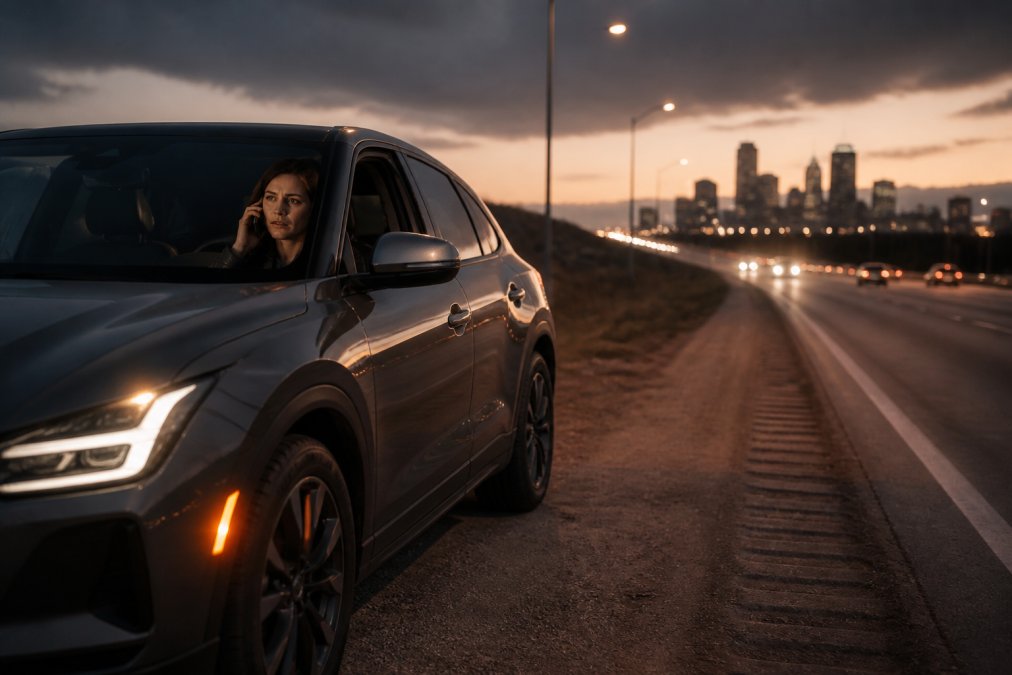
The core issue centers on the battery management system. When an EV is towed improperly, the vehicle’s computer systems can’t communicate with the towing equipment, and the battery may enter a protective state that locks the wheels or disables steering. According to Tesla’s official towing guidelines, improper towing can trigger thermal management issues that compromise battery integrity and create fire hazards during transport.
High-Voltage Battery Risks During Transport
The high-voltage battery in a Tesla or other EV is a sophisticated system managing thousands of individual cells while monitoring temperature and communicating constantly with onboard computers. Incorrect towing can disrupt this delicate electrical system, potentially triggering thermal runaway, a chain reaction where a battery cell overheats, damaging adjacent cells and spreading through the entire battery pack. This can lead to fires, explosions, or complete battery failure costing tens of thousands to replace.
Never allow a standard wheel-lift tow truck to tow your EV by the front wheels. This is the single most common cause of drivetrain damage and battery system failure in electric vehicles. If a tow operator suggests this method, hang up and call someone else immediately.
Drivetrain and Regenerative Braking Concerns
Regenerative braking captures energy when you brake in a Tesla or similar EV, slowing the vehicle while charging the battery. During towing, this system becomes a liability. When a wheel-lift tow truck pulls an EV by the front wheels, those wheels are forced to rotate against the vehicle’s will. The regenerative braking system interprets this rotation as the vehicle moving under its own power, triggering the motor to engage and fight against the tow. This creates enormous stress on drivetrain components.
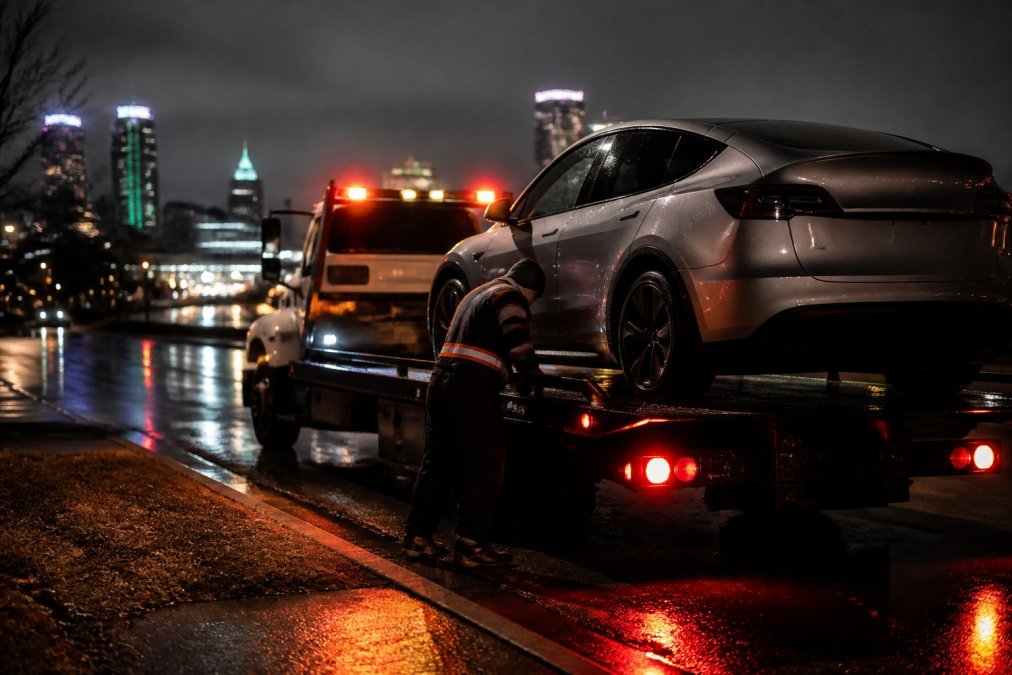
The solution is straightforward: flatbed towing. A flatbed truck lifts the entire vehicle off the ground, preventing any wheels from rotating and eliminating the regenerative braking conflict. This is the only safe method for transporting an EV, and it’s the standard that Neptune Towing uses for every electric vehicle we transport across Tulsa and surrounding areas.
Flatbed Towing Tulsa: The Only Safe Method for EVs
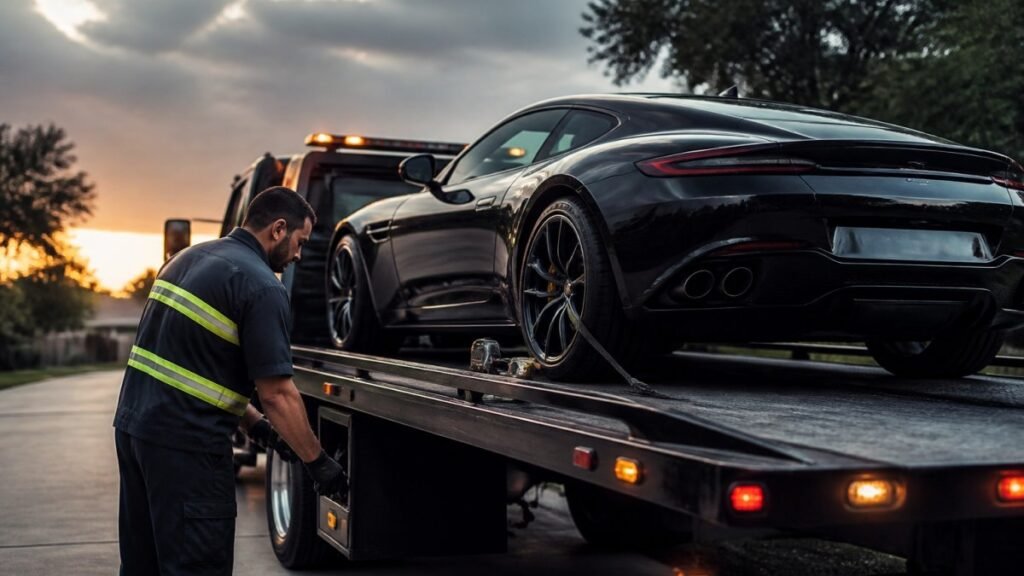
A flatbed tow truck has a long, flat platform that can be lowered to ground level. The vehicle is driven or winched onto the platform, then secured with multiple tie-down straps. Once fully supported by the flatbed, the platform is raised, lifting all four wheels completely off the ground. Nothing rotates, nothing drags, and the EV’s drivetrain remains untouched during transport.
Why Wheel-Lift Towing Damages EV Drivetrains
Wheel-lift towing works fine for many vehicles because traditional cars have mechanical transmissions that tolerate being towed with wheels rotating. Electric vehicles cannot. When a wheel-lift operator raises the front wheels of an EV and begins towing, the rear wheels remain on the ground and roll freely. As the vehicle moves, those rear wheels rotate continuously, triggering the regenerative braking system, which interprets the movement as the vehicle driving itself. The electric motor engages to slow what it thinks is forward motion, creating a mechanical conflict between the tow truck’s pull and the motor’s resistance.
This conflict generates heat and stress in components designed for smooth, controlled operation. The result is often a burnt-out motor, damaged axle bearings, or a transmission that no longer engages properly.
If you’re ever unsure whether [a tow](/blog/the-ultimate-guide-to-choosing-the-best-towing-company-in-tulsa-oklahoma/) operator understands EV towing, ask them directly: “Will you use a flatbed and keep all four wheels off the ground?” If they hesitate or suggest any other method, find a different operator. Neptune Towing always uses flatbed towing for electric vehicles, no exceptions.
Proper Loading and Securement on a Flatbed
Once a flatbed is chosen, proper loading becomes critical. The EV should be centered on the flatbed with equal weight distribution front to back. For low-clearance vehicles like certain Tesla models, the operator must be careful not to drag the front bumper or undercarriage during loading.
Once positioned, the vehicle is secured using at least four heavy-duty tie-down straps, one at each corner. These straps should never contact the vehicle’s body directly but instead attach to designated tie-down points on the frame, or soft straps protect the paint and wheels. The straps must be tightened evenly to prevent shifting during transport. The steering wheel should be locked straight, and the transmission placed in neutral.
Tesla Towing in Tulsa: What Every Owner Should Know
Tesla owners in the Tulsa area face unique challenges when their vehicle needs towing. Tesla recommends that vehicles always be transported on a flatbed, with all four wheels off the ground. The company specifically warns against wheel-lift towing and discourages dolly towing. For any Tesla breakdown in Tulsa, Jenks, Bixby, or surrounding communities, flatbed towing is the only method Tesla owners should accept.
Battery Management During an Emergency
When a Tesla experiences a breakdown on the side of I-44 or in a Tulsa neighborhood, the vehicle’s battery management system remains active, even if the main propulsion system has failed. Understanding what’s happening inside the battery during an emergency helps you make better decisions about when to call for help.
If your Tesla shows a low battery warning and you’re far from a charging station, you have two options: call for roadside charging assistance or call for a tow. Many EV owners don’t realize that roadside charging services exist and can often get you moving again without a tow truck. A mobile charger can deliver enough power to reach a nearby charging station, turning what might have been a full tow into a quick roadside charge.
However, if your Tesla has experienced a mechanical failure, suspension issue, brake problem, or drivetrain malfunction, towing is necessary. When you call for a tow, inform the operator immediately that you have an electric vehicle and require flatbed towing. Be specific: "I need flatbed towing only. Do not use a wheel-lift or dolly." This clarity prevents miscommunication that could result in damage.
Preventing Thermal Runaway and Safety Hazards
Thermal runaway is the most serious risk associated with EV towing emergencies. It’s a chain reaction where a battery cell overheats, damaging adjacent cells, which then overheat, spreading through the entire battery pack. In extreme cases, this can lead to fires that are difficult to extinguish.
To prevent this, ensure your EV is towed by an operator who understands the risks. We know how to secure a Tesla or other EV without putting stress on the battery management system. We keep the vehicle in neutral, avoid sudden movements, and transport it directly to the repair facility without unnecessary stops or detours.
If you notice any unusual smells, burning odor, chemical smell, or anything that seems wrong during or immediately after a tow, alert the operator and your repair technician immediately.
Roadside Assistance Tulsa: Your First Response When Stranded
When your EV breaks down, the first person you should call isn’t always a tow truck. Depending on your situation, roadside assistance might be the faster, cheaper solution. Roadside assistance services in the Tulsa area include jump starts for the 12V battery, lockout service, fuel delivery for hybrid vehicles, tire changes, and increasingly, mobile EV charging.
Range Anxiety vs. Actual Emergency: When to Call for Help
Range anxiety is the fear that your EV will run out of power before reaching a charging station. If you’re driving a Tesla in Tulsa and see the battery warning light, you have time to make decisions. Most modern EVs give you 20-30 miles of range after the low-battery warning appears.
The first step is to locate the nearest charging station using your vehicle’s navigation system or apps like PlugShare. If you’re within reasonable distance, say 10-15 miles, drive to the charger yourself. Don’t call for a tow yet.
If you’re genuinely stranded, your vehicle won’t move, the battery is completely depleted, or you’re on a highway with no charging stations nearby, that’s when you call for help. At that point, you have two options: roadside charging or towing. Roadside charging is faster and cheaper if available in your area.
However, if your EV has a mechanical problem, flat tire, brake failure, suspension damage, or drivetrain malfunction, roadside assistance won’t solve it. You need a tow truck. And when you need a tow truck in Tulsa, you need one that understands EV towing.
If your EV won’t move because of a mechanical problem, call for a flatbed tow immediately. If it won’t move because the battery is low, try mobile charging first. If mobile charging isn’t available or doesn’t work, then call for a tow.
Mobile Charging as an Alternative to Towing
Mobile EV charging is becoming more common in the Tulsa area. Services like Blink’s mobile charging solutions deploy chargers that come to your location, allowing you to add range without towing. A mobile charger typically provides Level 2 or Level 3 DC fast charging. Level 2 charging adds about 10-15 miles of range per hour. Level 3 DC fast charging can add 150+ miles in 30 minutes, though most mobile chargers provide a more modest boost, enough to get you to a public charging station.
The advantage is obvious: you avoid the expense and time of a full tow. The disadvantage is availability. Mobile charging services aren’t yet available everywhere in the Tulsa metro area, though coverage is expanding. When you call for roadside assistance, ask if mobile charging is available for your location. If it is, request it. If it’s not, ask for a tow to the nearest charging station or repair facility.
Damage-Free Towing: How to Protect Your EV Investment
Your EV represents a significant investment. Whether you own a Tesla, Chevy Bolt, Hyundai Ioniq, or another electric vehicle, protecting that investment during a towing emergency is paramount. Damage-free towing isn’t just a nice feature, it’s essential for EV owners.
Neptune Towing specializes in damage-free towing for all vehicle types, with particular expertise in electric vehicles. Every EV we transport is handled with the same care and attention we’d give to a luxury sports car. We use flatbed towing exclusively for EVs, proper tie-down procedures, and equipment designed to protect paint, wheels, and undercarriage.
Insurance and Warranty Implications of Improper Towing
Improper towing can void your vehicle’s warranty. If your Tesla or other EV is damaged during a tow because the operator used an unsafe method, the manufacturer may refuse to cover the repair under warranty. You’ll be responsible for the entire cost. Additionally, if improper towing causes damage and you file an insurance claim, your insurer may deny the claim if they determine the towing company was negligent.
When you choose a tow truck company, verify they understand EV towing and have proper insurance coverage. Ask about their experience with electric vehicles. Ask whether they use flatbed towing exclusively for EVs. Ask for references from other EV owners they’ve towed. These questions take two minutes but can save you thousands.
Questions to Ask Before Handing Over Your Vehicle
Before you allow any tow truck operator to take your EV, ask these critical questions:
-
Will you use a flatbed and keep all four wheels off the ground? The answer must be yes, without hesitation.
-
Do you have experience towing electric vehicles? Listen for specific examples. A good operator will mention specific EV models they’ve towed and safety protocols they follow.
-
What tie-down equipment do you use? They should use heavy-duty straps with soft protectors to prevent paint damage.
-
Where are you taking my vehicle? Confirm the destination before the tow begins.
-
What’s your insurance coverage? They should be licensed and bonded, with liability insurance that covers damage during transport.
-
How long will the tow take? Understand the timeline so you can arrange alternate transportation.
-
What happens if my vehicle is damaged during the tow? Know their liability policy upfront.
If a tow operator seems annoyed by these questions or can’t answer them clearly, find a different operator. Your vehicle deserves better, and you deserve an operator who takes EV towing seriously.
| Question | Why It Matters | Red Flag Answer |
|---|---|---|
| Flatbed towing? | Prevents drivetrain damage | "We can use a wheel-lift" |
| EV experience? | Operator understands risks | "We tow everything the same way" |
| Tie-down equipment? | Protects paint and wheels | Vague or no clear answer |
| Destination confirmation? | Ensures correct delivery | Operator seems uncertain |
| Insurance coverage? | Protects you if damage occurs | No insurance or no answer |
| Timeline? | Helps you plan accordingly | Extremely vague estimate |
| Damage liability? | Clarifies responsibility | Operator avoids the question |
Your EV Emergency Preparedness Checklist
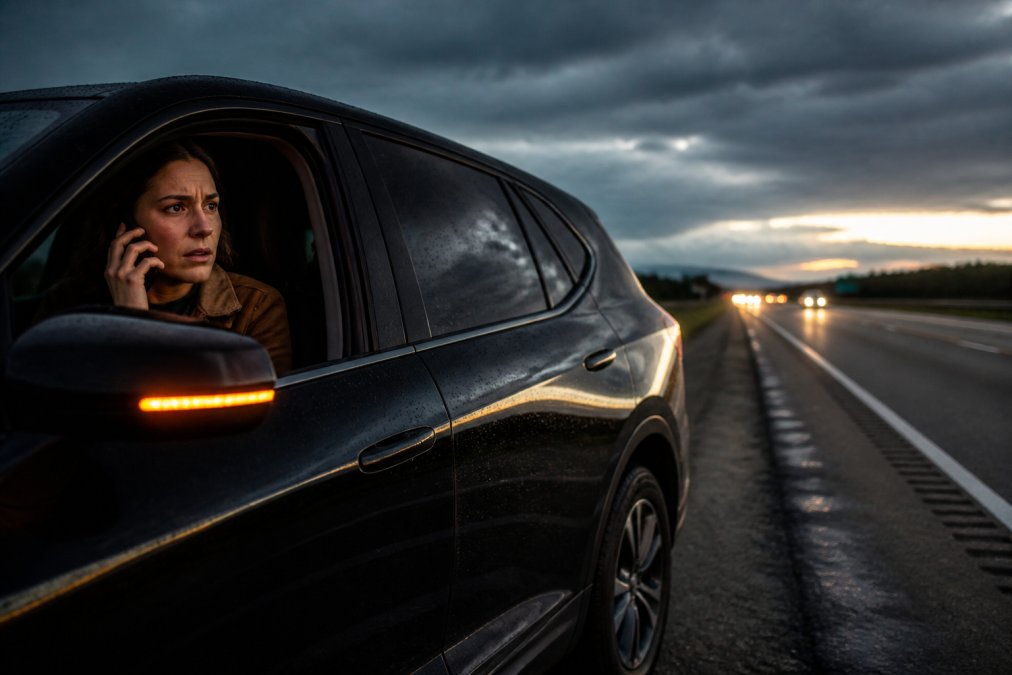
Being prepared for an EV emergency means understanding what to do when your vehicle breaks down, knowing what information to provide to emergency responders, and having a plan for what happens next.
What to Document Before Help Arrives
When your EV breaks down, take photos of your vehicle’s condition, including the odometer reading, battery charge percentage, and any visible damage. Document the location, nearby landmarks, and time of day. Note any warning messages or error codes displayed on the vehicle’s screen.
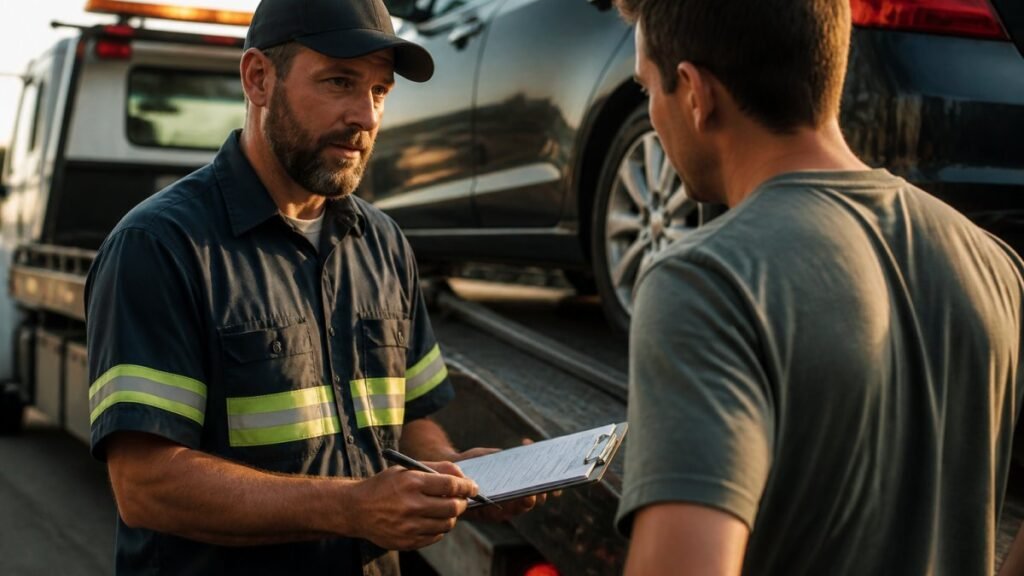
Document the tow operator’s information: name, company name, license plate number, and flatbed truck identification number. Ask for their insurance information and take a photo of their ID and business license. If possible, stay with your vehicle during the towing process and watch how the operator loads your EV. Confirm they’re using flatbed towing and that all four wheels are off the ground.
Get a receipt or invoice from the tow operator that includes the date, time, starting location, destination, vehicle information, and the towing method used. This documentation is essential if you need to file an insurance claim or dispute a charge later.
Finding Certified EV Towing Providers in the Tulsa Area
Not every tow truck company in Tulsa is equipped to handle electric vehicles safely. Start by asking your vehicle’s manufacturer for recommended towing services. Tesla, Chevy, Hyundai, and other EV makers maintain lists of approved tow operators in different regions.
If manufacturer recommendations aren’t available, call local tow truck companies and ask about their EV experience. Specifically ask how many electric vehicles they’ve towed in the past year, whether they’re trained in EV safety protocols, if they use flatbed towing exclusively for EVs, and whether they can provide references from other EV owners.
Neptune Towing has been serving the Tulsa area since 2019, and we’ve developed extensive expertise in EV towing. Our team is trained in the specific requirements of Tesla, Chevy Bolt, Hyundai Ioniq, and other electric vehicles. We use flatbed towing exclusively for all EVs, and we understand the battery management systems, regenerative braking concerns, and safety protocols that protect your vehicle during transport.
When you call Neptune Towing for EV towing in Tulsa, Jenks, Bixby, Broken Arrow, Glenpool, Owasso, Sapulpa, or surrounding areas, you’re working with an owner-operated company that treats your vehicle like it’s our own. We don’t cut corners on EV safety, and we don’t compromise on damage-free towing practices.
Electric vehicle breakdowns create anxiety because the stakes feel higher. Your EV is a sophisticated machine with systems that demand specialized knowledge. When you need a tow truck in Tulsa, you need one that understands those systems and knows how to transport your vehicle safely. Neptune Towing provides damage-free flatbed towing for all electric vehicles, trained operators who understand EV safety protocols, and a commitment to protecting your investment during transport. Call (539) 292 3074 when you need help, and experience the difference that specialized EV towing expertise makes.
Frequently Asked Questions
Can you tow an electric vehicle with a standard tow truck, or do I need specialized equipment?
Standard wheel-lift tow trucks can severely damage an EV's drivetrain because many electric vehicles have single-speed transmissions and regenerative braking systems that cannot tolerate being towed with powered wheels on the ground. Specialized flatbed towing is required to keep all four wheels off the pavement. This protects both the vehicle's mechanical systems and the high-voltage battery. When you need EV towing in the Tulsa area, always confirm your tow truck operator uses a flatbed and has experience with electric vehicles.
What should I do immediately if my Tesla breaks down on I-44 or another Tulsa highway?
First, move to a safe location if possible and activate your hazard lights. Contact your roadside assistance provider or call a local towing service experienced with Tesla towing right away. Provide your exact location and describe any warning signs your vehicle displayed before stopping. Do not attempt to restart the vehicle repeatedly, as this can drain the battery further. Stay in the vehicle with doors locked if you feel unsafe, and provide the tow operator with your Tesla's key fob and any relevant vehicle information when they arrive.
Does improper EV towing void my warranty or damage the battery?
Yes. Towing an EV with a wheel-lift method or dragging it with powered wheels can damage the drivetrain, transmission, and battery management system, potentially voiding manufacturer warranty coverage. Improper towing can also trigger thermal runaway conditions in the battery or cause high-voltage system failures. This is why damage-free towing using a flatbed is critical. Before allowing any tow, confirm the operator is using proper equipment and ask if they have experience with your vehicle's specific model and battery system.
What is the difference between roadside assistance and towing, and when do I need each?
Roadside assistance includes jump starts, lockouts, tire changes, and fuel delivery, services that get you back on the road without a tow. Towing is needed when your vehicle cannot be safely driven, such as a complete battery failure, mechanical breakdown, or collision damage. For EV owners in Tulsa, roadside assistance might include mobile charging in some cases, which can eliminate the need for a tow. However, if your battery is completely depleted or your vehicle is unsafe to drive, specialized EV towing is your only option.
How do I find a certified EV towing provider in the Tulsa area when I need help?
Look for towing companies that explicitly advertise flatbed towing and EV experience. Ask whether their operators have received EV-specific training and understand battery management systems and immobilization procedures. Owner-operated local companies often provide more personalized service and expertise than large chains. When you call, describe your vehicle (including the battery type if you know it), confirm they use a flatbed, and ask about their experience with your specific model. Neptune Towing serves the Tulsa area with damage-free flatbed towing and specializes in electric vehicle transport.
This article was written using GrandRanker