


Table of Contents
- Safety First: What You Need to Know Before Changing a Flat Tire
- Essential Tire Change Tools List You’ll Need
- Step-by-Step: How to Change a Flat Tire Safely
- Step 1: Position your vehicle on level ground and turn on hazard lights
- Step 2: Engage the parking brake and place wheel chocks
- Step 3: Remove the hubcap and loosen the lug nuts
- Step 4: Locate the proper jack lift points on your vehicle
- Step 5: Raise the vehicle and remove the flat tire
- Step 6: Install the spare tire and tighten lug nuts in a star pattern
- Step 7: Lower the vehicle and finish tightening
- How Long Does It Take to Change a Tire?
- Troubleshooting: What to Do When Lug Nuts Won’t Budge
- No Spare Tire? Your Options and Roadside Assistance in Tulsa
- Understanding Your Spare Tire: Pressure, Speed, and Limitations
- Conclusion
Last Updated: August 10, 2026
Safety First: What You Need to Know Before Changing a Flat Tire
Changing a flat tire might seem straightforward until you’re standing on the shoulder of I-44 with traffic whizzing past at 70 miles per hour. That’s when safety becomes everything. Your decision to DIY or call for roadside assistance should start with an honest assessment of your situation, a quiet residential street in Bixby is completely different from being stranded on a busy highway near Broken Arrow.
Why changing a tire on the highway is risky
Highway tire changes carry serious dangers that many drivers underestimate. When you’re working on the side of a busy road, you’re exposed to oncoming traffic, reduced visibility (especially at night or in bad weather), and the distraction of trying to focus on a technical task while remaining aware of your surroundings. Even with hazard lights on, drivers sometimes don’t see someone working on the roadside. You’re also dealing with uneven ground, vibration from passing trucks, and the stress of knowing you’re in a vulnerable position.
If you’re on I-44, the Broken Arrow Expressway, or any major highway around Tulsa, the risk calculation changes. Professional towing services exist for exactly this reason.
When to call roadside assistance instead
You should call for roadside assistance if you’re on a busy highway, it’s dark outside, you’re in bad weather, you don’t have proper tools or a spare tire, you have a medical condition that makes physical work difficult, or you’re simply uncomfortable with the process. There’s no shame in calling, it’s the smart choice.
Neptune Towing provides roadside assistance throughout Tulsa, Jenks, Bixby, Broken Arrow, Glenpool, and surrounding areas. When you need a tow truck near you or professional roadside assistance, we can have someone to you quickly. We handle tire changes as part of our service, and we do it safely without putting you at risk.
Essential Tire Change Tools List You’ll Need
Before you attempt to change a flat tire safely, make sure you have the right equipment. Missing tools don’t just make the job harder, they make it dangerous.
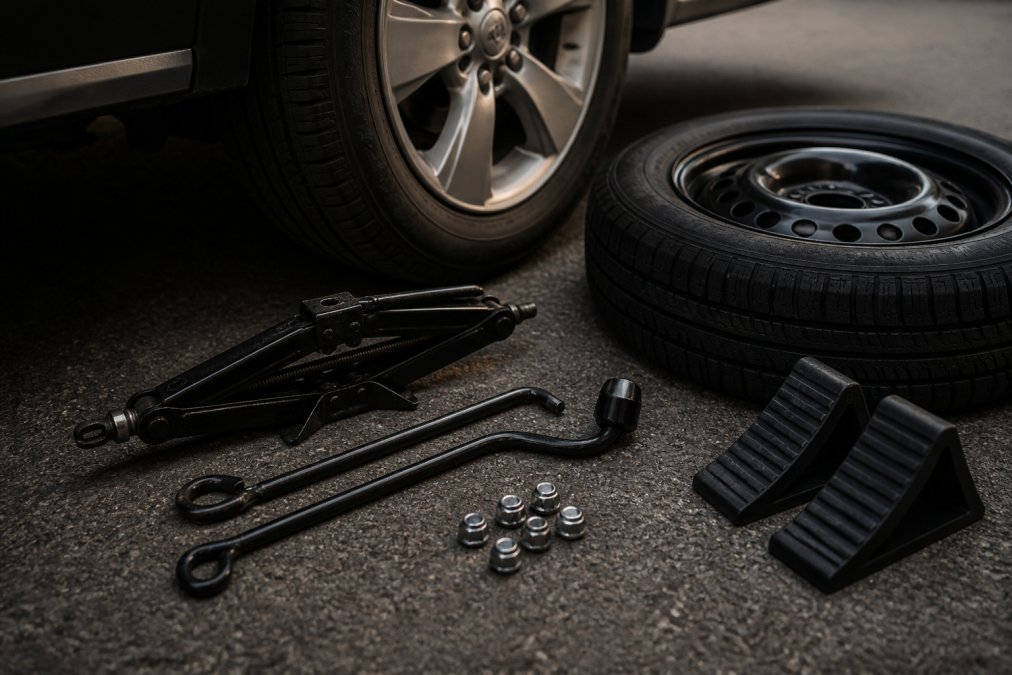
Here’s what you actually need:
- Spare tire – Check that it’s properly inflated.
- Jack – Your vehicle’s factory jack or a quality floor jack. Know where the proper lift points are on your vehicle chassis.
- Tire iron or lug nut wrench – A cross-shaped wrench gives you better leverage than a single-ended tool.
- Wheel chocks – Blocks or wedges to secure the vehicle and prevent it from rolling.
- Flashlight or headlamp – Essential if you’re changing a tire at night.
- Work gloves – Protects your hands and keeps your grip secure.
- Vehicle manual – Know where your lift points are and any special instructions for your specific vehicle.
If you don’t have these basics, it’s another good reason to call for help instead.
Step-by-Step: How to Change a Flat Tire Safely
Changing a flat tire safely requires following a specific sequence. Skip steps or rush through them, and you’ll either damage your vehicle or put yourself at risk.

Step 1: Position your vehicle on level ground and turn on hazard lights
Move your vehicle to a safe location as far off the road as possible, ideally onto a shoulder or parking area on level ground. Turn on your hazard lights immediately. If you have a safety triangle, place it behind your vehicle at a safe distance. Level ground matters because if your vehicle is on an incline or soft ground, the jack can slip or your vehicle can shift while you’re working on it.
Step 2: Engage the parking brake and place wheel chocks
Engage your parking brake firmly before you touch the jack. If you have wheel chocks, place them behind the wheels that will remain on the ground. This provides a second line of defense against the vehicle moving, especially if you’re on any kind of slope.
Step 3: Remove the hubcap and loosen the lug nuts
Before you jack up the vehicle, loosen the lug nuts while the tire is still on the ground. Use your tire iron and loosen each lug nut by turning counterclockwise. You don’t need to remove them completely at this stage, just break them loose enough that you can turn them by hand once the vehicle is lifted. If a lug nut is stuck, apply steady pressure rather than jerking.
Step 4: Locate the proper jack lift points on your vehicle
Every vehicle has specific lift points where the jack should contact the chassis. These are reinforced areas designed to handle the weight. Check your vehicle manual for the exact location. On most vehicles, the lift points are along the frame rails, marked by small notches or indentations. Proper jack placement prevents damage to your vehicle’s undercarriage and ensures the jack won’t slip.
Step 5: Raise the vehicle and remove the flat tire
Raise the vehicle slowly and steadily, just high enough to clear the tire. Watch for any shifting or unusual movement. Once the tire is clear of the ground, finish removing the lug nuts by hand and set them aside. Grip the tire firmly and pull it straight toward you to remove it from the hub.
Step 6: Install the spare tire and tighten lug nuts in a star pattern
Place the spare tire onto the hub, aligning the holes with the studs. Hand-thread the lug nuts back on to prevent cross-threading. Tighten the lug nuts in a star pattern, not in a circle. This distributes pressure evenly and prevents the tire from sitting unevenly on the hub. Tighten each lug nut firmly, but don’t over-tighten.
Step 7: Lower the vehicle and finish tightening
Lower the vehicle slowly until the tire makes contact with the ground, then lower the jack completely and remove it. With the vehicle fully on the ground, do a final tightening of all lug nuts using the same star pattern. Replace your hubcap if you have one and pack your tools away. Remember: your spare tire is temporary. Drive carefully to a repair shop to get your flat tire fixed or replaced.
How Long Does It Take to Change a Tire?
For someone doing it for the first time with the right tools and on level ground, expect 30 to 45 minutes. If you’re experienced and everything cooperates, you might finish in 15 to 20 minutes. If you encounter stuck lug nuts, a difficult jack, poor lighting, or difficult terrain, you could be working for an hour or more. A flat tire at night on a rainy highway will take longer than one in broad daylight in your driveway.
Troubleshooting: What to Do When Lug Nuts Won’t Budge
Stuck lug nuts are one of the most common reasons a tire change goes wrong. Make sure you’re turning counterclockwise to loosen. If the lug nut still won’t move, apply steady, sustained pressure rather than jerking. If steady pressure doesn’t work, try spraying the lug nut with penetrating oil and waiting 10 to 15 minutes, then reapply the wrench.
Another approach is to use a longer wrench or tire iron for additional leverage. If nothing works, stop and call for help. Forcing a stuck lug nut can strip it, round off the studs, or damage your vehicle. Neptune Towing has the professional tools and experience to handle stuck lug nuts without causing damage.
No Spare Tire? Your Options and Roadside Assistance in Tulsa
Modern vehicles sometimes come without a spare tire. Instead, they have tire repair kits or run-flat tires. A tire repair kit is a temporary fix that seals small punctures, but it won’t work for sidewall damage. Run-flat tires are designed to keep working even when flat, but they have speed and distance limitations.
Your best option when you don’t have a spare is to call for roadside assistance. Neptune Towing serves Tulsa, Broken Arrow, Bixby, Jenks, Glenpool, and surrounding areas with professional roadside assistance. We can transport your vehicle to a repair facility where your tire can be properly fixed or replaced. Trying to drive a flat tire to a repair shop damages the rim and makes the repair more expensive.
Understanding Your Spare Tire: Pressure, Speed, and Limitations
A donut spare tire should be inflated to the pressure specified on the tire itself, not the pressure listed on your vehicle’s door jamb. Donut spares have speed and distance limits: you should not drive faster than 50 miles per hour, and you should not drive more than 70 miles on a donut spare. Exceeding these limits can cause the spare to fail.
If your vehicle has a run-flat tire, check your vehicle manual for the specific speed and distance limitations. Once you’ve installed a spare or used a run-flat, your first priority is getting to a repair facility. Spares and run-flats are temporary solutions, not permanent ones.
Conclusion
Knowing how to change a flat tire safely puts you in control of a stressful situation, but it’s not always the right choice. If you’re on a busy highway, uncomfortable with the process, or lacking proper tools, calling for professional help is the smarter decision. Neptune Towing provides roadside assistance and tire change service throughout the Tulsa area, including Jenks, Bixby, Broken Arrow, and surrounding communities. When you need a tow truck near you or professional roadside assistance, we’re here 24/7. Call Neptune Towing at (539) 292-3074 for fast, dependable service from a local company that values your safety and your vehicle.
Frequently Asked Questions
Is it safe to change a tire on the side of a busy highway like I-44?
No. Changing a tire on a busy highway puts you at serious risk from passing traffic. If you're stranded on I-44 or another major road in the Tulsa area, turn on your hazard lights, stay in your vehicle if possible, and call for roadside assistance. Neptune Towing and other local towing services can reach you quickly and safely. Your safety is worth far more than the cost of professional help.
What should I do if I don't have a spare tire?
Modern vehicles sometimes come with run-flat tires or no spare at all. If you have a flat and no spare, do not attempt to drive on the flat tire, you risk rim damage and loss of control. Call roadside assistance immediately. In the Tulsa area, Neptune Towing can dispatch a tow truck to your location and transport your vehicle safely to a repair shop. Many drivers keep a portable tire plug kit or inflator in their vehicle as a backup solution.
How long does it typically take to change a tire?
For someone with experience, changing a tire usually takes 15 to 30 minutes, depending on how tight the lug nuts are, road conditions, and whether you have all the right tools. If lug nuts are stuck or you're on an uneven surface, it can take longer. If you're uncomfortable doing it yourself or you're in an unsafe location, calling for roadside assistance in Tulsa is a smarter choice than rushing through the job alone.
What's the correct way to tighten lug nuts after installing a spare tire?
Always tighten lug nuts in a star pattern (also called a cross pattern), not in a circle. This ensures even pressure across the rim and prevents the wheel from becoming unbalanced. Tighten them snugly, but do not over-tighten, use firm hand pressure with the tire iron. Once the vehicle is lowered, tighten them once more. If you're unsure about torque specifications, check your vehicle manual or have a professional verify the job.
This article was written using GrandRanker