
Last Updated: November 3, 2026
Quick Summary
The right spare tire depends on how far you need to drive and what your car’s drivetrain needs. A compact spare is light and fits small spaces, but it has a speed and distance limit and is meant only to reach a tire shop. A full-size spare matching your other tires allows normal driving and is the safer choice for AWD vehicles and EVs.
- Compact spares typically carry a speed and distance limit printed on the sidewall.
- A full-size spare adds 25 to 40 pounds and takes up significant trunk space.
- Check bolt pattern, lug count and tire diameter before buying any spare.
- Check the four-digit date code on the sidewall, since older spares can have hardened rubber.
- Confirm brake caliper clearance and TPMS sensor compatibility before installing a spare wheel.
Table of Contents
- Why Your Spare Tire Choice Matters More Than You Think
- Compact Spare Tire vs Full Size: Which One Fits Your Needs
- Checking Your Vehicle’s Bolt Pattern, Lug Count, and Tire Diameter
- Brake Caliper Clearance, TPMS Sensors, and AWD Risks to Check Before You Buy
- How to Change a Flat Tire Safely With Your Spare
- Storing, Maintaining, and Inspecting Your Spare Tire
- Keeping Your Spare Ready Before Your Next Roadside Emergency in Tulsa
- Frequently Asked Questions
Why Your Spare Tire Choice Matters More Than You Think
A flat tire can happen on a busy highway or on a quiet back road. The spare tire in your trunk is what gets you moving again.
Here is the problem. According to Cars.com analysis of 2026 and 2027 model-year equipment, 39 automotive brands no longer offer spare tires on new 2026 and 2027 models.
So if your car did not come with a spare, or you have a spare that does not match, you need to know your options.
Compact Spare Tire vs Full Size: Which One Fits Your Needs
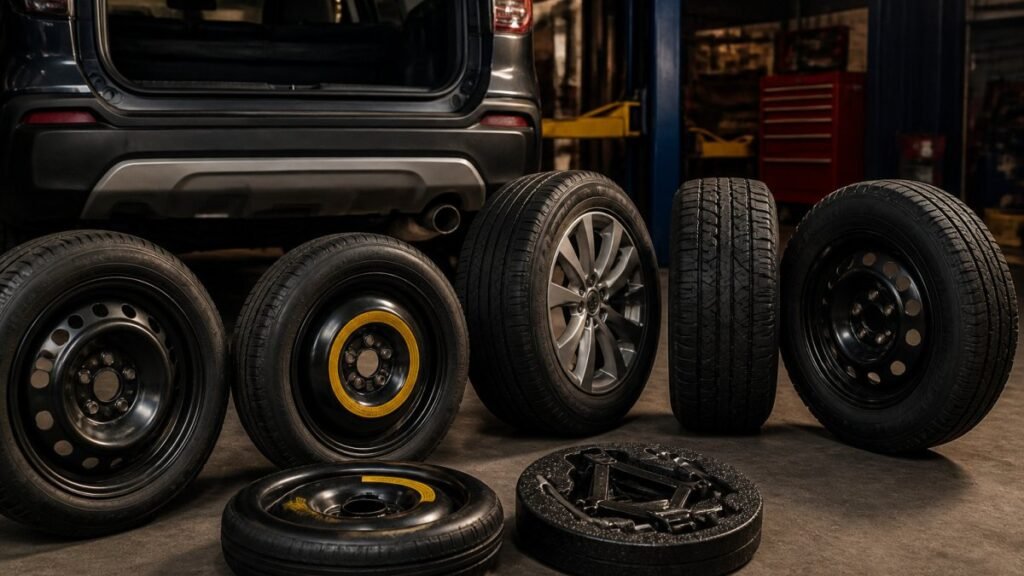
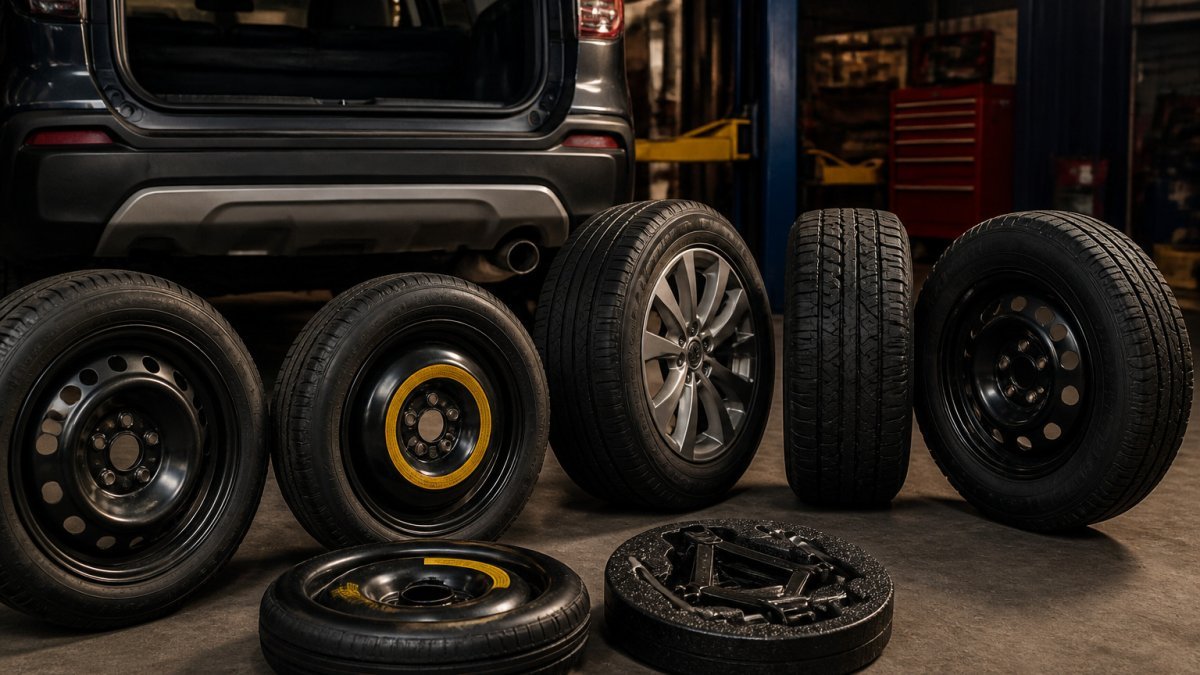
A compact spare, often called a donut or space-saver, is narrower and lighter than a regular tire. A full-size spare matches the tires already on your car. The choice between them is not really about trunk space, it is about how far you need to drive after the flat, and what kind of drivetrain is turning the wheels.
What a compact spare actually is
A compact spare is built to get you to a tire shop, not to live on the car. Compact spares typically carry a speed and distance limit, and those limits are printed on the sidewall of the spare itself. Read them before you drive.
A compact spare also changes how the vehicle behaves. Because it is narrower and often smaller in diameter, one corner of the car sits lower. Traction control and stability control may interpret the different wheel speed as a slip and intervene.
What a full-size spare actually is
A full-size spare is a road tire on a road wheel. If it matches the size, load index, and speed rating of the other four tires, you can drive on it normally until the flat is repaired.
The trade-off is weight and space. A full-size spare adds noticeable weight, and it takes up trunk volume. On a sedan that is a nuisance. On a crossover or SUV that already has a compact spare well, a full-size spare may not fit under the floor at all.
The AWD and EV wrinkle
This is where most guides stop, and it is the part that matters most for newer vehicles. All-wheel-drive systems compare wheel speeds continuously. A compact spare that is a different diameter from the other three tires makes that one wheel turn at a different rate, and the differential or clutch pack has to absorb the difference.
The same logic applies to many EVs. Electric drivetrains often use open differentials or independent motors, and some EVs are sensitive to rolling circumference differences because the traction and stability software is tuned tightly.
A quick comparison
| Feature | Compact Spare | Full-Size Spare |
|---|---|---|
| Typical speed limit | 50 mph | Matches road tires |
| Typical range limit | 50 to 70 miles | No special limit |
| Weight | Light | 25 to 40 lbs heavier |
| Trunk space | Minimal | Significant |
| AWD/EV friendly | Short hops only | Yes, if size matches |
| Best for | Getting to a shop | Long trips, AWD, EVs |
How to decide
If you commute short distances around midtown or Broken Arrow and your car has a compact spare well, a donut is fine as long as you keep it inflated and check the date code. To weigh that against the cost of relying on help instead, see our comparison of mobile tire repair and roadside assistance.
Watch out: a compact spare that is more than a few years old may look fine but have hardened rubber. Check the four-digit date code on the sidewall before you trust it.
Checking Your Vehicle’s Bolt Pattern, Lug Count, and Tire Diameter
Before you buy any spare, confirm that it fits your car. Three numbers matter most.
- Bolt pattern: The number of lug holes and the distance across them. A wrong bolt pattern means the wheel will not mount.
- Lug count: How many lug nuts hold the wheel on. Most cars have four, five, or six.
- Tire diameter: The overall height of the tire. A spare that is too big or too small can throw off your speedometer and strain the drivetrain.
You can find these specs in your owner’s manual or on a sticker inside the driver’s door. Write them down before you shop. Bring them to the tire shop so nobody guesses.
Brake Caliper Clearance, TPMS Sensors, and AWD Risks to Check Before You Buy
A spare can bolt on and still be wrong. The three failures that strand drivers most often are caliper interference, TPMS warnings, and drivetrain strain on AWD vehicles. Each one has a specific check you can do before you buy.
Brake caliper clearance
Brake calipers sit inside the wheel barrel, and on vehicles with larger brakes, performance trims, heavy SUVs, and many EVs with regenerative braking hardware, the caliper can be wide enough that a smaller-diameter spare will not clear it. Because a spare must clear the caliper and seat flush against the hub, choosing the right tires and rims for your vehicle starts with checking brake and wheel fitment together.
The check is simple. Look at the back of your current wheel where it meets the brake rotor. Note how much gap exists between the caliper and the inside of the wheel spokes. A spare with less internal clearance than your stock wheel will not fit.
Watch out: some compact spares are designed for the rear only on vehicles with large front brakes. If your owner’s manual says to mount the spare on the rear, follow it, even if the flat is on the front.
TPMS sensors
Most newer passenger vehicles use tire pressure monitoring systems. Most systems use a sensor mounted inside each wheel that broadcasts pressure to the dashboard.
That light is not just an annoyance. It masks a real low-pressure warning if another tire starts losing air.
Some vehicles also require a relearn procedure after a wheel swap. A tire shop can do it in minutes with a scan tool.
AWD diameter tolerance
All-wheel-drive systems are designed around four tires of the same rolling circumference. When one tire is a different diameter, the differential or clutch pack has to slip continuously to make up the difference. Over a short distance at low speed that is manageable. Over a long drive it generates heat, and heat is what kills AWD hardware.
Keeping all four tires at similar tread depth is important on an AWD vehicle. A compact spare is often well outside that window. That is why the manual limits how far you can drive on it. If you are buying a full-size spare for an AWD vehicle, match the tire size, load index, and speed rating exactly, and check the tread depth against your current set. If your current tires are worn, a brand-new matching spare is still a different diameter, plan to replace tires in sets of four, or have the spare shaved to match.
Aftermarket wheel vs OEM spare
An OEM spare is built for your exact vehicle, bolt pattern, offset, hub bore, brake clearance, and sensor mounting are all correct out of the box. An aftermarket wheel can work, but every one of those dimensions has to be verified.
If you are not sure whether a spare will clear your brakes or satisfy your AWD system, call us before you buy. A short conversation before you buy can save you from a costly repair later.
How to Change a Flat Tire Safely With Your Spare
A flat on the side of the road is stressful. Work through these steps in order and stay safe.
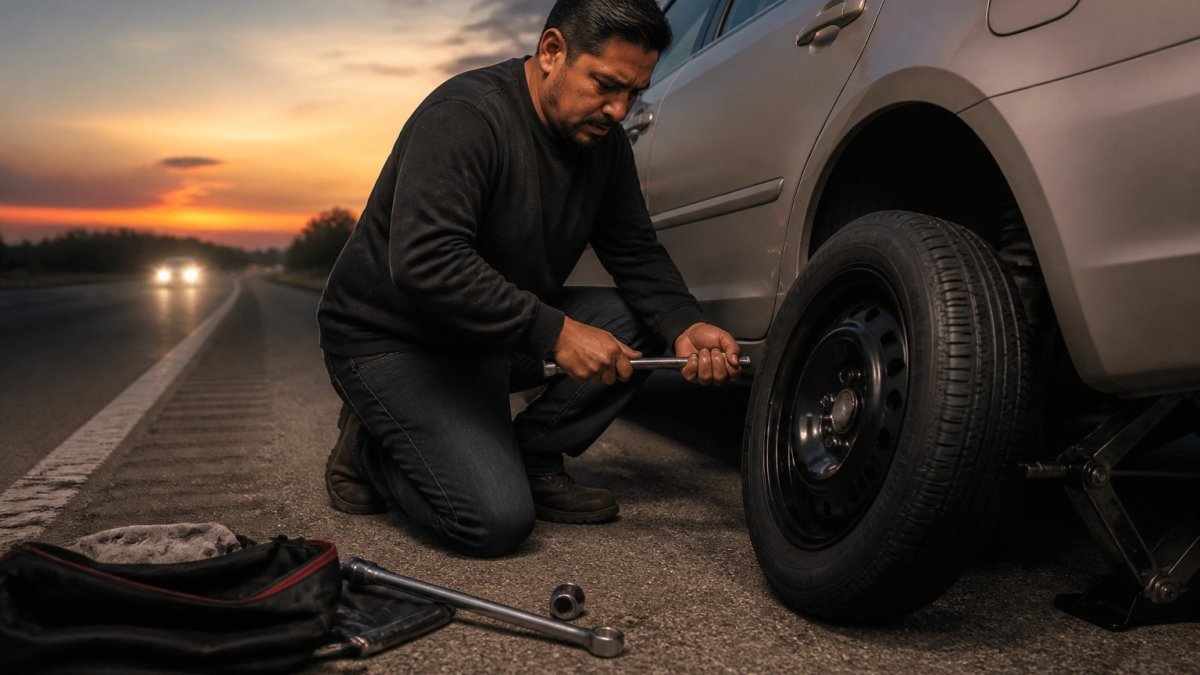
- Pull over safely. Get as far from traffic as you can. Turn on your hazard lights.
- Set the parking brake. Put the car in park or in gear, depending on your transmission.
- Loosen the lug nuts. Break them loose a half turn before you jack up the car.
- Place the jack correctly. Use the jack points in your owner’s manual. A bad jack spot can slip.
- Raise the car and remove the flat. Take off the lug nuts and pull the wheel off.
- Mount the spare. Line up the holes and hand-tighten the lug nuts in a star pattern.
- Lower the car and tighten fully. Finish tightening in a star pattern, then check the torque.
If you are on a busy road like I-44 or the Creek Turnpike, or you feel unsure at any point, call for help. Our step-by-step tire change guide walks through each stage of the process in more detail. Our crew can handle the change for you.
If your spare is not enough to get you home, Towing Service can help with roadside assistance.
Storing, Maintaining, and Inspecting Your Spare Tire
A spare only helps if it holds air and is ready to use. Check it every few months.
- Check the air pressure. Use the number on the tire sidewall.
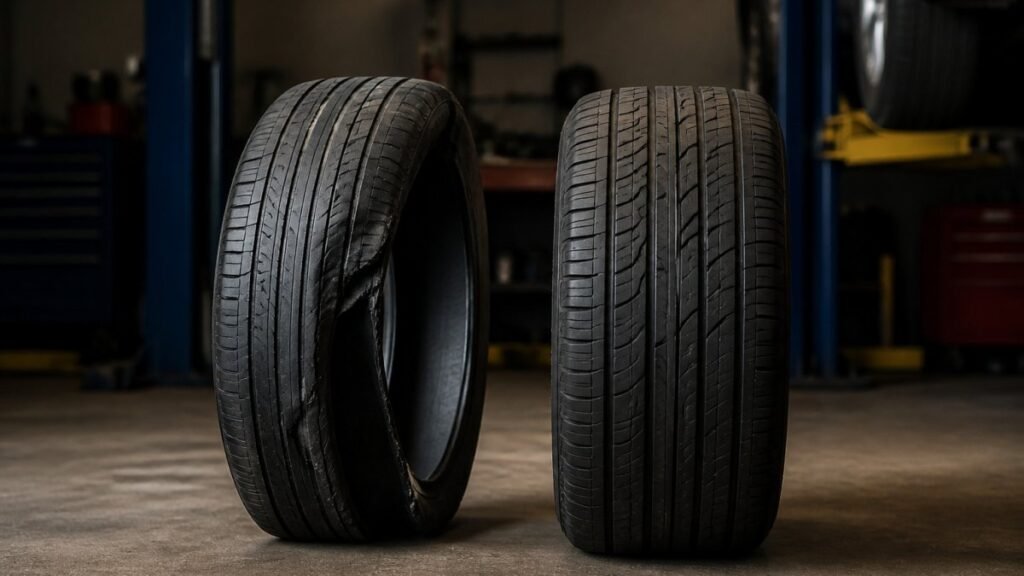
- Look for cracks, dry rot, and bulges.
- Note the tire age. According to Capital One car guidance on spare tires, spare tires can last up to 10 years when properly maintained.
- Keep it secured in the trunk so it does not rattle or shift.
The legal minimum tread depth for tires is 2/32 of an inch, according to Bridgestone guidance on tire replacement. Check your spare’s tread too.
Keeping Your Spare Ready Before Your Next Roadside Emergency in Tulsa
Preparation makes the difference when a flat hits. Keep your spare inflated, your jack and lug wrench in the car, and your owner’s manual handy.
A spare is not always enough. If you have a flat and no way to fix it, or your car needs a tow, Towing Service is ready to help. Towing Service provides roadside assistance and damage-free towing in Tulsa and nearby communities.
Neptune Towing is owner-operated. We handle every vehicle with care and never impound cars.
Frequently Asked Questions
What is the 50/50 rule for spare tires?
The 50/50 rule is a guideline for temporary spare use: a compact spare is typically rated for a limited distance and speed, so you should drive gently and get your regular tire repaired or replaced as soon as possible. Check the sidewall markings on your specific spare, since manufacturers set their own limits. If you are stuck on a Tulsa highway with a flat, call Neptune Towing and we will get you to a tire shop safely.
Can I use a 16 inch spare for a 17 inch tire?
In most cases, no. Mismatched diameters change the effective rolling circumference, which can strain the drivetrain, affect traction control and ABS, and damage differentials, especially on all-wheel drive vehicles. Compact spares are designed for temporary use only, and a spare must match your vehicle’s bolt pattern, lug count, and tire height specifications. Confirm the fit with your owner’s manual or a tire professional before relying on any substitute.
How do I determine the correct bolt pattern for a spare tire?
Bolt pattern is listed as the number of lug holes multiplied by the diameter of the circle they sit on, such as 5×114.3 millimeters. Your owner’s manual, the wheel itself, or your vehicle’s documentation will list this figure. The spare must match it exactly, or the wheel will not seat properly and the lug nuts can loosen. Always check your bolt pattern and lug count before buying a spare, and if you are unsure, ask a local tire shop to confirm the fit.
What is the difference between a full-size spare and a donut?
A full-size spare matches your primary tires in size and tread, so it can be driven normally for long distances. A donut, or compact spare, is smaller and lighter, saving trunk space, but it is strictly temporary and usually has a speed and distance limit. Full-size spares add weight and take up room, while donuts are easier to store. Choose based on how you drive and whether your vehicle can accommodate a full-size tire.