
Table of Contents
- Mobile Tire Repair vs Roadside Assistance: Cost Comparison at a Glance
- What Actually Drives the Cost of Each Option
- When a Mobile Tire Repair Service Makes Sense
- When Roadside Assistance Is the Better Route
- Hidden Fees and Coverage Gaps That Change the Math
- How Insurance and Membership Plans Factor In
- Tire Change Service Tulsa: What Local Drivers Should Know
- Emergency Towing Tulsa: When You Need More Than a Tire Fix
- Frequently Asked Questions
Last Updated: September 5, 2026
Mobile Tire Repair vs Roadside Assistance: Cost Comparison at a Glance
A blown tire on the I-44 shoulder near the Yale exit presents a simple question: do you call a mobile tire repair service or your roadside assistance plan? The answer depends less on the flat itself and more on your coverage, your location, and whether the tire is actually repairable. Mobile tire repair is a specialized, per-service option that brings the shop to you, while roadside assistance is typically a membership benefit that covers basic labor like swapping in your spare.
The cost gap between these options is significant. Without a membership plan, an average roadside assistance call for a flat tire change runs between $75 and $125 per incident according to Yelp’s 2026 roadside assistance cost data. A dedicated mobile tire repair service starts around $125 but includes the actual repair or replacement, not just the labor to mount your spare. At Neptune Towing, we handle both tire changes and towing across Tulsa, and we help drivers weigh these choices daily.
| Option | Typical Cost | What You Get | Best For |
|---|---|---|---|
| Roadside Assistance (no plan) | $75-$125 per call | Labor to mount your spare tire | Getting mobile quickly |
| Roadside Assistance (membership) | ~$33.50+/year | Tire change, jump start, lockout, towing limits | Year-round peace of mind |
| Mobile Tire Repair | From $125 | On-site repair or replacement | Non-drivable flats, no spare |
| Tow to Shop | Varies by distance | Transport to a tire shop | Complex damage, sidewall tears |
What Actually Drives the Cost of Each Option
Several factors push the final price of either service. For roadside assistance, the biggest variable is whether you have a membership plan. Annual plans from major providers start as low as $33.50 according to CNBC Select’s 2026 roadside assistance plan review, which makes a single incident dramatically cheaper than paying out of pocket. Without that coverage, you are paying the full service call rate.
Mobile tire repair pricing depends on the tire itself. A basic flat repair starts around $125, but full replacements are quoted based on tire size, according to TireDose’s 2026 mobile tire repair cost guide. Larger wheels, run-flat tires, and specialty rubber all increase the price. The condition of the tire matters too. A puncture in the tread can often be patched or plugged on site. Sidewall damage, tears, or a tire that has been driven flat for miles usually means replacement, which changes the job from a quick repair to a parts-and-labor call.
Time of day and location also shift costs. Many mobile services advertise no after-hours surcharges, but traditional towing and roadside companies often add fees for late-night calls. Distance from the provider’s base affects fuel and travel charges, which is why a local company like Neptune Towing keeps response times short across Tulsa, Jenks, Bixby, and Broken Arrow.
When a Mobile Tire Repair Service Makes Sense
You should call a mobile tire repair service when the tire might actually be saved or when you have no usable spare. If you hit a pothole on Memorial Drive and hear air escaping, a mobile unit can assess the damage on site. A clean puncture in the tread is patchable. Sidewall damage, which often happens when a tire is underinflated and rolls onto its edge, is not repairable and requires a replacement.
Mobile tire repair also wins on convenience when you are not in a dangerous spot. Instead of waiting for a tow truck to take your car to a shop, then waiting again for the shop to work you in, a mobile technician handles everything at your location. That direct model is often faster than the multi-step process of towing and shop repair. The tradeoff is availability. Mobile tire services cover specific regions, and a busy day can mean long wait times.
Do not drive on [a flat tire](/blog/how-to-change-a-flat-tire-safely-step-by-step/) to “save time.” Even a short distance on a deflated tire can shred the sidewall, turning a $30 patch into a $200 replacement and potentially damaging your wheel.
When Roadside Assistance Is the Better Route
Roadside assistance shines when the problem is not actually a tire problem. If you are stranded because of a dead battery, an empty fuel tank, or a lockout, a membership plan covers those calls at no extra charge. For tire issues specifically, roadside assistance gets you mobile again by swapping in your spare. That is the right call when your spare is in good condition and properly inflated.
Membership plans also make financial sense for drivers who want predictable costs. A single year of coverage is far cheaper than one out-of-pocket service call, and the plan covers you for every incident across the year. The Global Market Insights 2026 roadside assistance report values the vehicle roadside assistance market at USD 40.9 billion in 2025, reflecting how many drivers rely on these plans for emergency support.
The limitation is scope. Roadside assistance typically covers labor, not parts. If your tire is destroyed and your spare is unusable, the technician cannot fix that on site. You will need a tow to a shop, and many basic plans cap towing distance or charge per mile beyond the limit.
The DIY Cost-Benefit Analysis Most Guides Skip
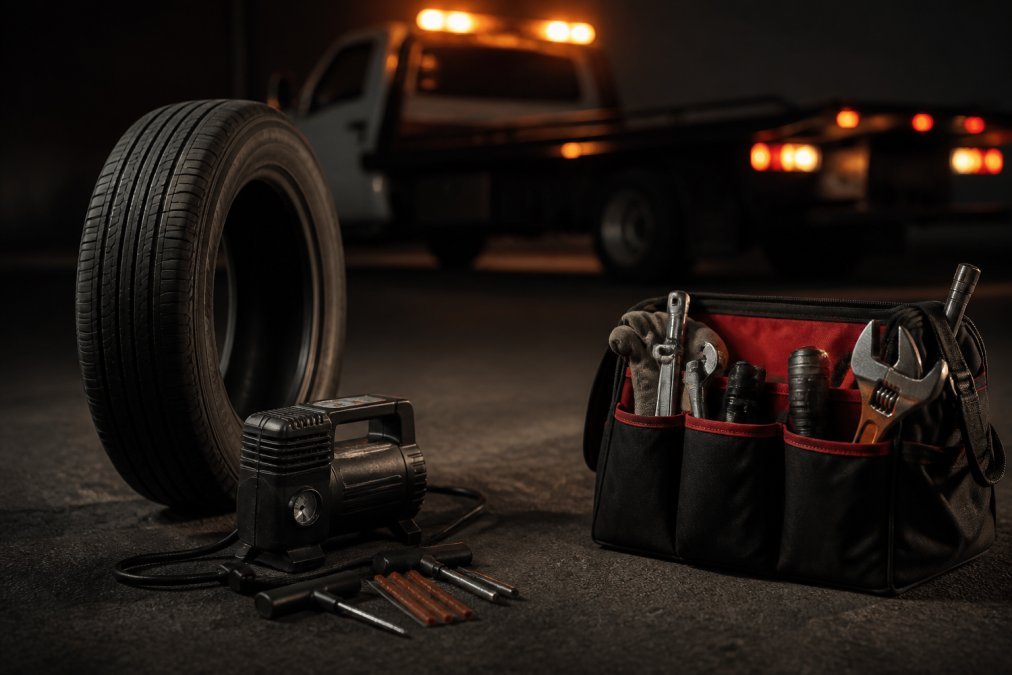
Before you decide between roadside assistance and mobile tire repair, consider what a DIY approach actually costs. A portable 12-volt air compressor runs $25 to $60 at any auto parts store. A basic tire plug kit costs $10 to $20. For a driver with a slow leak, that $35 to $80 investment can handle multiple incidents without a single service call.
The catch is that DIY only works for minor tread punctures. A plug kit cannot fix sidewall damage, a torn valve stem, or a tire that has been driven flat. And if you plug a tire that should have been replaced, you are risking a blowout at highway speed. The math changes dramatically when you factor in the cost of a new tire versus the cost of a service call.
Safety First: What to Do While You Wait
Whether you call roadside assistance or a mobile tire service, the wait time is when drivers are most vulnerable. Here is a safety checklist that applies whether you are on the Broken Arrow Expressway or a quiet street in Jenks:
- Pull as far off the road as possible. If you are on a highway, get your vehicle completely onto the shoulder. If you are on a curve or hill, move to a straighter, flatter stretch if you can do so safely.
- Turn on your hazard lights. This is non-negotiable, day or night.
- Set up reflective triangles if you have them. Place them 10 to 15 feet behind your vehicle to give approaching drivers earlier warning.
- Stay inside your vehicle with your seatbelt on. This is the safest position if another vehicle strikes yours. Exiting the car on a busy highway is far more dangerous than staying put.
- Call the service provider and confirm their ETA. If the wait is long, let someone know where you are and when you expect help.
- If you must exit the vehicle, use the side away from traffic. Never stand between your car and the passing lane.
If you are on the shoulder of a highway and feel unsafe, call 911. Law enforcement can send a unit to block traffic while you wait. This is especially important at night or in bad weather.
When the Spare Tire Is the Problem
A surprising number of “flat tire” emergencies become tow calls simply because the spare was never inflated. Check your spare’s pressure every few months. If your spare is a donut-style temporary tire, remember it is rated for limited speeds and distances, usually 50 mph and 50 miles. If your destination is farther than that, a mobile tire repair service that fixes the original tire on site might be the better call, because it gets you back on your full-size tire without the temporary-spare limitations.
Hidden Fees and Coverage Gaps That Change the Math
The advertised price of a roadside assistance plan rarely tells the whole story. Coverage limits vary widely between providers. Some plans cap towing at 5 miles, others at 100. Some exclude large vehicles like RVs or trucks. Many have a per-incident service charge even for members. Understanding your plan’s coverage limits before you need them matters more than the annual fee. garage service call cost.
Out-of-pocket roadside calls carry their own surprises. After-hours surcharges, mileage fees beyond a base radius, and charges for using your own spare tire can all appear on the final bill. The $85 tow quote that becomes a $145 invoice after mileage and a late-night fee is a common complaint. Asking for a flat, upfront price before service begins protects you from that shock.
Mobile tire repair pricing is generally more transparent because it is a per-service fee. The quoted price covers the full job, repair or replacement, with no membership required. The catch is that you pay that full price whether the repair takes ten minutes or an hour, and if the tire cannot be repaired, you are paying for a replacement tire at retail markup.
How Insurance and Membership Plans Factor In
Your auto insurance policy may already include roadside assistance as an add-on. These endorsements are typically inexpensive, often under $20 per year, and bundle into your existing policy. Coverage usually includes tire change labor, jump starts, lockouts, and towing to the nearest qualified repair facility. The catch is that these are labor-only benefits. You still pay for the tire itself if you need a replacement.
Deductibles and reimbursement rules vary. Some insurers reimburse you for a mobile tire repair call if you submit the receipt, while others require you to use their preferred provider network. If you use a non-network service, you may pay upfront and wait for reimbursement. That process can take weeks, which matters if the service charge strained your budget.
A key distinction is that roadside assistance plans cover the service call, not the repair. Whether you use a membership plan or an insurance add-on, a tire that needs replacement is still your cost. The plan saves you the labor and towing expense, which is often the larger portion of the bill.
Tire Change Service Tulsa: What Local Drivers Should Know
For a tire change service in Tulsa, the decision often comes down to location and time. If you are stranded on the Broken Arrow Expressway during rush hour, the priority is getting safely off the road and mobile again. A roadside assistance call that mounts your spare gets you to a shop on your own schedule. If you are in a parking lot near 71st and Lewis with a destroyed tire and no spare, a tow to a tire shop is the practical move.
Neptune Towing provides tire changes and towing across Tulsa, Jenks, Bixby, Broken Arrow, Glenpool, and Owasso. As an owner-operated local towing company, we give you a straight answer on pricing before we roll a truck. We do not impound vehicles or tack on storage fees. Our focus is getting you back on the road or safely to a repair shop.
Check your spare tire’s pressure every few months. A surprising number of “flat tire” emergencies become tow calls simply because the spare was never inflated and is unusable when needed.
Emergency Towing Tulsa: When You Need More Than a Tire Fix
Some tire failures are not tire failures at all. A blowout at highway speed can damage the wheel, suspension, or undercarriage. A tire that separates from the rim, or a wheel that locks up from brake failure, needs a professional assessment before anyone drives the vehicle. In those cases, emergency towing in Tulsa is the safe choice.
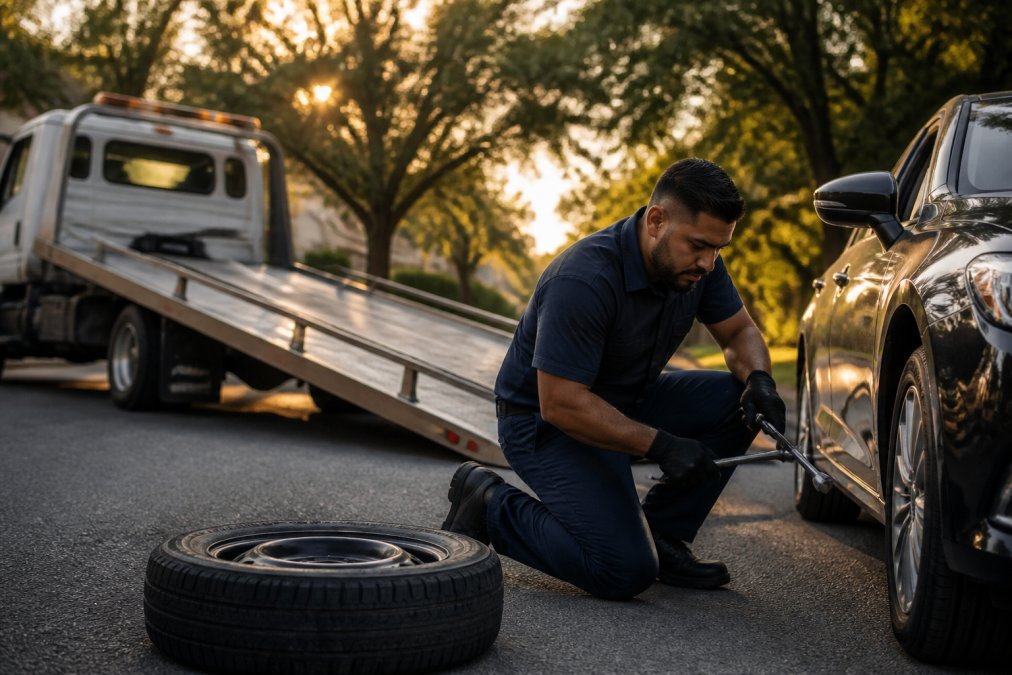
Flatbed towing is the damage-free standard for vehicles that cannot be driven safely. Every vehicle is handled with proper loading and securement procedures, which is especially critical for low-clearance cars, classic vehicles, and electric vehicles. Teslas and other EVs require specific protocols to avoid drivetrain damage during transport. A local towing service that understands these requirements protects your vehicle when a simple tire change is not enough.
The roadside assistance market is projected to grow to USD 68.7 billion by 2035 according to Global Market Insights 2026 growth forecast, a sign that drivers increasingly expect professional help at the roadside. Whether you need a tire change, a jump start, or a full tow, the right call depends on understanding what each service actually covers before you are stranded.
Getting stranded with a tire issue is stressful, but the choice between mobile tire repair and roadside assistance does not have to be confusing. Know what your plan covers, check your spare, and call a provider that gives you honest pricing upfront. When you need a tow truck in Tulsa or reliable roadside assistance near you, Neptune Towing offers 24/7 emergency service, damage-free flatbed towing, and transparent pricing with no surprise charges. Get started with Neptune Towing and get the help you need, when you need it. Call (539) 292 3074.
Frequently Asked Questions
What is the difference between mobile tire repair and roadside assistance?
Mobile tire repair is a specialized service that sends a technician directly to your location to patch, plug, or replace a tire on the spot. Roadside assistance is a broader service, often membership-based, that covers tire changes using your spare, jump starts, lockouts, fuel delivery, and towing. The key difference is scope: mobile tire repair focuses only on getting your tire roadworthy, while roadside assistance handles a wider range of breakdown scenarios but may not perform a full repair on-site.
Is it cheaper to use a membership-based roadside service or an on-demand mobile repair?
It depends on how often you need help. Annual roadside assistance memberships start around $33.50 per year, which is inexpensive if you use it once or twice. However, without a plan, a single service call averages $75 to $125. Mobile tire repair starts near $125 per visit but includes the actual repair work, not just swapping in a spare. For drivers with older tires or repeated issues, a membership offers predictable costs, while on-demand mobile repair makes sense for a one-time flat with no commitment.
When should you call a mobile tire service instead of a tow truck?
Call a mobile tire service when the tire has a repairable puncture in the tread, you have a spare but no way to fix the original, or the vehicle is in a safe, accessible location. A tow truck becomes necessary when there is sidewall damage, the vehicle cannot be safely lifted, you lack a usable spare, or the car needs a repair you cannot complete on-site. If you are stranded on a busy highway like I-44, safety should guide your decision.
Does roadside assistance cover the cost of a new tire?
No. Standard roadside assistance plans cover the labor to change a tire using your usable spare. The cost of a replacement tire is your responsibility. Some credit card roadside programs or premium insurance add-ons may include limited reimbursement for tire damage, but this is rare. Before assuming coverage, check your specific plan details. If your tire is damaged beyond repair, roadside assistance can tow your vehicle to a shop, but you will pay for the new tire separately.