

Table of Contents
- Why Car Batteries Die Suddenly Without Warning
- Signs of a Bad Car Battery Before It Fails
- Terminal Corrosion and Loose Battery Cables
- Parasitic Electrical Drain When Your Car Is Off
- Alternator Failure vs. Battery Failure: How to Tell the Difference
- How to Jump Start a Car Safely
- What to Do When Your Battery Dies on the Road in Tulsa
- Conclusion
Last Updated: August 8, 2026
Why Car Batteries Die Suddenly Without Warning
Your car starts fine in the morning. By evening, you turn the key and hear nothing but a dead click. No warning lights. No gradual decline. Just silence.
This is what causes a car battery to die suddenly, and it happens more often than most drivers realize. Sometimes it fails in the parking lot at work. Sometimes it’s 2 a.m. on I-44 heading back to Tulsa from out of town. The frustrating part is that sudden battery failure often looks like it came from nowhere, but something was already wrong, you just didn’t see the signs yet.
At Neptune Towing, we respond to battery-related breakdowns across Tulsa, Bixby, Broken Arrow, and surrounding communities every single day. We’ve seen batteries fail on I-44, in parking lots, on the BA bypass, and in driveways from Owasso to Sapulpa. Some drivers call us for a jump start. Others need a tow to a repair shop. Either way, we understand the panic that comes with a dead battery, and we know what actually causes it.
Signs of a Bad Car Battery Before It Fails
Most of the time, there are clues before complete failure. A slightly slower crank. Dim headlights. A clicking sound when you turn the key. These are signs of a bad car battery telling you something is wrong before the final failure happens.
Pay attention to how your car starts in the morning. Does the engine crank normally, or does it turn over slowly? Slow cranking is one of the earliest signs that your battery is losing its ability to deliver cold cranking amps (CCA), the amount of current a battery can deliver at freezing temperatures. As a battery ages, that number drops.
Dim or flickering headlights when the engine is off are another red flag. Your battery should power your lights at full brightness without the engine running. If they’re noticeably dimmer, your battery is weakening.
Corrosion on the battery terminals is visible. Look under the hood and check the battery connections. If you see a blue-green crusty buildup on the metal connectors, that’s terminal corrosion reducing the electrical connection between your battery and the rest of your vehicle.
A swollen or bloated battery case is a serious warning sign. If the plastic casing looks puffy or distorted, internal chemical reactions are happening that shouldn’t be.
If you notice any of these signs, have your battery tested before you’re stuck on the side of the road. A basic battery test takes minutes and costs nothing at most auto parts stores.
Terminal Corrosion and Loose Battery Cables
Terminal corrosion is one of the most common causes of sudden battery failure, and it’s easy to miss because it happens on the outside of the battery where you might not look regularly.
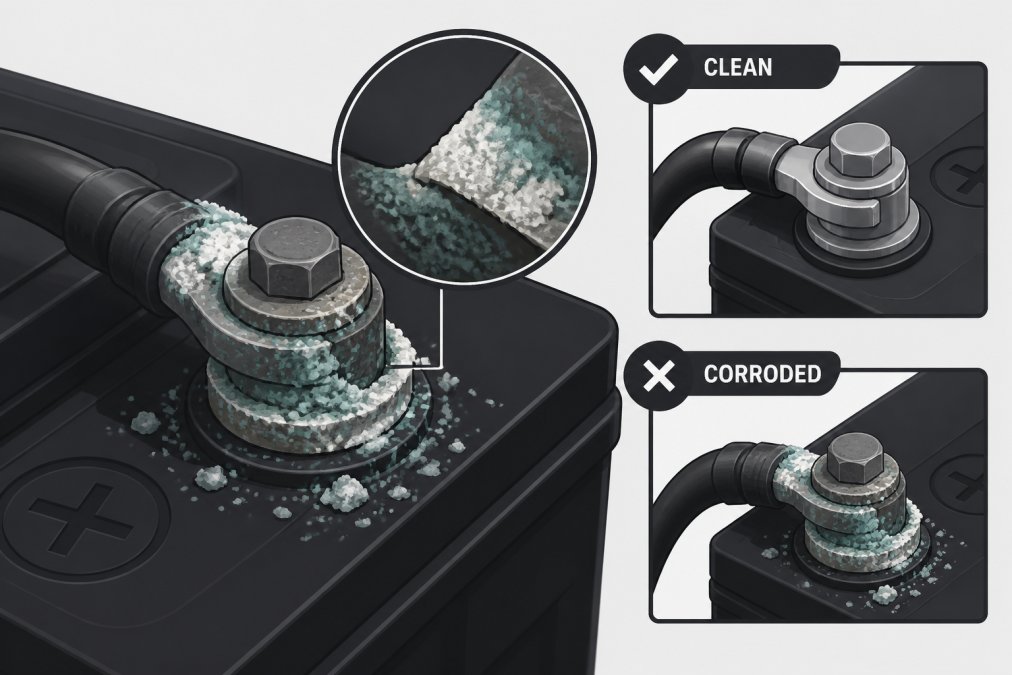
The battery terminals are where your battery connects to the electrical system. They’re metal connectors, one positive (usually red) and one negative (usually black). Over time, these terminals oxidize. Moisture, salt air, and chemical reactions from the battery itself create that blue-green or white crusty buildup. When corrosion builds up, it acts like a barrier between the battery and the cables that carry power to your starter and alternator.
Here’s what happens: you turn the key, and the starter motor needs massive current from the battery to crank the engine. But if corrosion is blocking the connection, that current can’t flow. The battery might be perfectly fine internally, but the corrosion prevents it from delivering power. Your car won’t start, even though the battery has charge.
Loose battery cables are equally dangerous. The cable clamps that grip the terminals can loosen over time from vibration or temperature changes. A loose cable connection creates resistance, preventing power from flowing efficiently from the battery to the starter. The result is the same: your car won’t start.
You can inspect this yourself. Pop the hood and look at the battery terminals. If you see corrosion, you can clean it off with baking soda and water or a battery terminal cleaner. If the cables are loose, you can tighten the clamps with a wrench. But if you’re not comfortable working on your battery, Neptune Towing can help. When you call for roadside assistance in Tulsa, we can assess the problem and either jump-start your car or tow you to a repair shop if the battery itself has failed.
Parasitic Electrical Drain When Your Car Is Off
This one catches drivers off guard because your car is parked and turned off, yet something is still draining your battery.
A parasitic electrical drain happens when components in your vehicle continue to draw power even after you’ve shut off the engine. Some drain is normal, the clock, security system, and radio memory need to stay powered. But excessive parasitic drain can flatten a battery overnight.
Common culprits include a faulty alternator that isn’t charging the battery properly, an interior light that stays on because the door switch is stuck, an aftermarket alarm system that draws more power than it should, or a radio wired incorrectly. Even a phone charger left plugged into the 12-volt outlet can contribute to drain over days.
The tricky part is that parasitic drain is invisible. Your car looks completely normal, but every night something is quietly pulling power from the battery. After a few days or a week, the battery is completely dead.
If you suspect parasitic drain, a multimeter can help you test it. A healthy vehicle should draw less than 50 milliamps when everything is off. If you’re seeing much higher numbers, something is draining power that shouldn’t be. A mechanic will need to find the source of the drain to fix it permanently. Neptune Towing’s jump start service can get you moving immediately.
Alternator Failure vs. Battery Failure: How to Tell the Difference
Here’s where it gets confusing: your car won’t start, but is it the battery or the alternator?
The alternator is the component that recharges your battery while the engine is running. If the alternator fails, your battery doesn’t get recharged. You might drive all day, and by the next morning, the battery is completely dead. It feels like battery failure, but the battery itself might be fine, the alternator just isn’t doing its job.
The difference matters because replacing an alternator is more expensive and time-consuming than replacing a battery.
Here’s how to tell the difference. If your car starts but the battery warning light comes on while you’re driving, your alternator is probably failing. If your car won’t start at all, it could be either the battery or the alternator.
A quick test: if someone jump-starts your car and it starts and runs fine, but the battery warning light is on, the alternator is the problem. If the car won’t start even with a jump, the battery itself is likely dead.
When you’re unsure, call Neptune Towing for roadside assistance in the Tulsa area. We can assess the situation, jump-start your car if that’s the solution, or tow you to a mechanic who can run proper diagnostics.
How to Jump Start a Car Safely
If your battery is dead but the car is otherwise fine, a jump start might get you moving. But doing it wrong can damage your vehicle or hurt you, so safety matters.
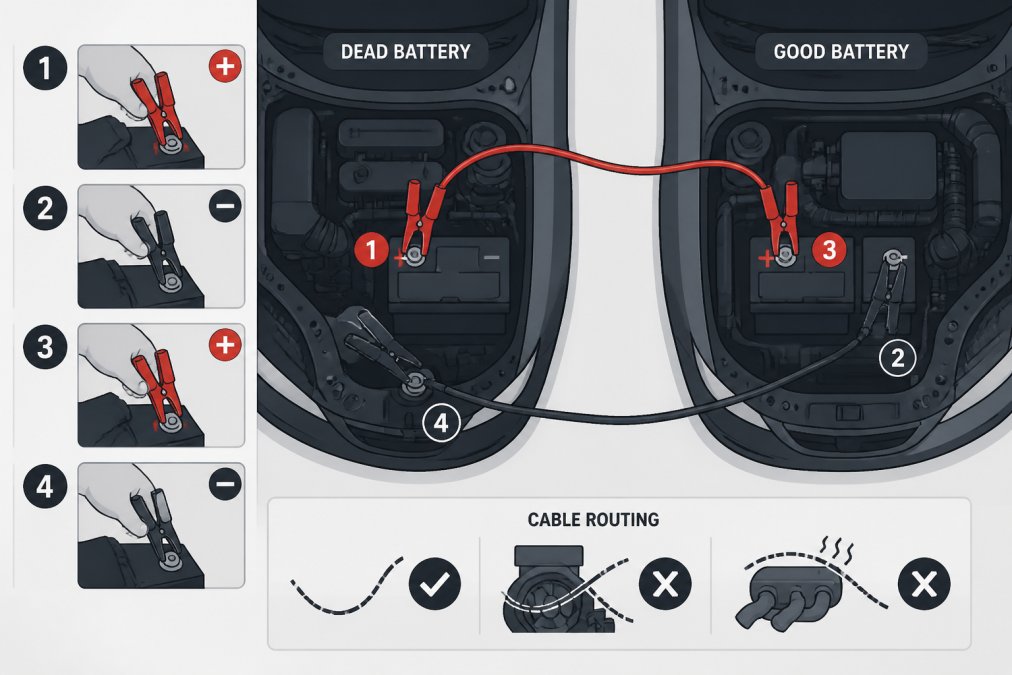
You’ll need jumper cables and another vehicle with a working battery. Both cars should be turned off before you connect anything.
Locate both batteries and find the positive and negative terminals. The positive terminal is marked with a plus sign and usually has a red cap. The negative terminal is marked with a minus sign and is usually black.
Connect one end of the red (positive) cable to the positive terminal of the dead battery. Connect the other end of the red cable to the positive terminal of the good battery. Now take the black (negative) cable and connect one end to the negative terminal of the good battery. Here’s the critical part: connect the other end of the black cable to an unpainted metal surface on the engine block of the dead car, not directly to the negative terminal of the dead battery. This grounds the cable and reduces the risk of sparks near the battery.
Start the working vehicle and let it run for a few minutes. Then start the car with the dead battery. If it starts, let both cars run for a minute or two.
Remove the cables in reverse order: black cable from the dead car, black cable from the good car, red cable from the good car, red cable from the dead car. Keep the revived car running for at least 20 minutes so the alternator can recharge the battery.
If the car doesn’t start after a few attempts, stop. Repeated attempts can overheat the starter and damage it further. This is when you need a tow. Call Neptune Towing for jump start service or towing in Tulsa.
Never jump-start a battery that’s leaking, swollen, or cracked. And never jump-start a Tesla or other electric vehicle using this method, EVs have different electrical systems, and improper jump-starting can cause serious damage. Neptune Towing specializes in EV towing and can safely transport electric vehicles without risking damage to the battery or drivetrain.
What to Do When Your Battery Dies on the Road in Tulsa
You’re driving on I-44 heading toward downtown Tulsa, or maybe you’re on the BA bypass in Broken Arrow, and suddenly your car loses power. The dashboard goes dark. The engine dies. You coast to the shoulder, and nothing happens when you turn the key.
First, turn on your hazard lights. Even though your battery is dead, hazard lights often run on a separate circuit and might still work. If they do, other drivers can see you.
If you’re on a highway, stay in your car with the doors locked. Don’t try to walk for help on I-44 or any major road. It’s dangerous, and help will come faster if you stay put.
Turn off all electrical systems, headlights, radio, everything. This prevents further drain on the battery.
Call for help. If you have roadside assistance through your insurance or a membership like AAA, call them first. If not, call Neptune Towing directly at (539) 292-3074. We serve Tulsa, Jenks, Bixby, Broken Arrow, Glenpool, Owasso, Sapulpa, and surrounding areas. Tell the dispatcher where you are and what happened.
While you wait, stay calm. A dead battery is inconvenient, not dangerous. You’re safe in your car.
When Neptune Towing arrives, the driver will assess the situation. If it’s just a dead battery and the rest of your car is fine, a jump start might get you going. If the battery is damaged or the alternator is failing, we’ll tow you to a repair shop. We use flatbed towing for vehicles that need it, and we handle everything from family sedans to luxury vehicles and electric cars with the same professional care.
Conclusion
A dead battery feels sudden, but it’s usually the result of something building for a while, corrosion, a failing alternator, parasitic drain, or an aging battery losing its ability to hold a charge. Recognizing the warning signs gives you a chance to fix the problem before you’re stranded.
When you need immediate help in the Tulsa area, Neptune Towing is ready. Whether you need a jump start, a tow to a repair shop, or emergency roadside assistance, we’re available 24/7. We handle vehicles of all types with damage-free towing and honest service. Call (539) 292-3074 when you need a tow truck near you in Tulsa, Bixby, Broken Arrow, or surrounding communities. We’ll get you and your vehicle to safety.
Frequently Asked Questions
Can a car battery die suddenly without any warning signs?
Yes, but usually there are early indicators you might miss. A battery can fail suddenly if a shorted cell develops inside, if terminal corrosion cuts off electrical contact completely, or if parasitic drain has depleted the battery while your car sat parked. Some drivers don't notice dim lights or slow cranking until the battery won't turn the engine over at all. If your car battery dies suddenly, it's often because the problem was building for days or weeks but went undetected.
What drains a car battery when the car is off?
Parasitic electrical drain occurs when components continue drawing power after you turn off the ignition. This includes the clock, radio memory, security system, and some modern infotainment systems. A faulty alternator, a shorted cell in the battery itself, or wiring problems can also cause significant drain. If your battery dies after sitting for several days without driving, parasitic draw is the likely culprit. A multimeter can help you measure whether your electrical system is draining more than normal.
How do I know if my alternator is bad instead of my battery?
If your car starts fine but the battery warning light comes on while driving, or if the lights dim when you're at a red light, your alternator likely isn't charging properly. A working battery will crank the engine normally, but a failing alternator won't replenish the charge. You can test this by checking the voltage at the battery terminals with a multimeter while the engine runs, it should read around 13.5 to 14.5 volts. If it reads 12 volts or lower while running, your alternator isn't doing its job.
Is it bad for a car battery to go completely dead?
Yes. A completely dead battery, especially if left drained for days, can cause permanent damage to lead-acid battery cells through sulfation, a chemical process that hardens lead sulfate crystals on the battery plates. This reduces the battery's ability to hold a charge in the future. If your battery dies completely, it's best to recharge it or jump-start it as soon as possible. Some batteries recover fully, but others may have permanently shortened lifespan after a complete discharge.
This article was written using GrandRanker