



Last Updated: October 27, 2026
Quick Summary
To test car battery health with a multimeter, set the meter to DC volts, connect the red probe to the positive terminal and the black probe to the negative terminal, and read the resting voltage with the engine off. A fully charged battery should read about 12.6 volts at rest, and anything from 12.4 to 12.7 volts is normal.
- Let the car sit at least an hour after driving so surface charge clears before you read resting voltage.
- Below 12.4 volts means partially discharged, and 12.0 volts or lower means significantly drained.
- During the cranking test, voltage should not fall below about 9.6 volts.
- With headlights on high beam for about a minute, voltage should stay above roughly 12.2V.
- Many auto parts stores will run a proper load or conductance test at no charge.
Table of Contents
- What You Need Before You Test a Car Battery
- How to Use a Multimeter to Test a Car Battery
- What Voltage Should a Car Battery Have?
- How to Test a Car Battery Under Load
- Test the Charging System With the Engine Running
- Common Multimeter Mistakes and Safety Tips
- How Long to Drive to Charge a Car Battery
- When to Stop Testing and Call Neptune Towing
- Frequently Asked Questions
What You Need Before You Test a Car Battery
A digital multimeter can help you check a car battery’s voltage. Learning how to test car battery with multimeter basics takes about ten minutes.
Here’s what to grab before you open the hood:
- A digital multimeter with a DC voltage setting
- Safety glasses and nitrile gloves
- A rag or wire brush for dirty terminals
- A flashlight if you’re testing after dark
- Your battery’s age, if you know it
One thing most guides skip: a multimeter gives you voltage, not the full story.
How to Use a Multimeter to Test a Car Battery
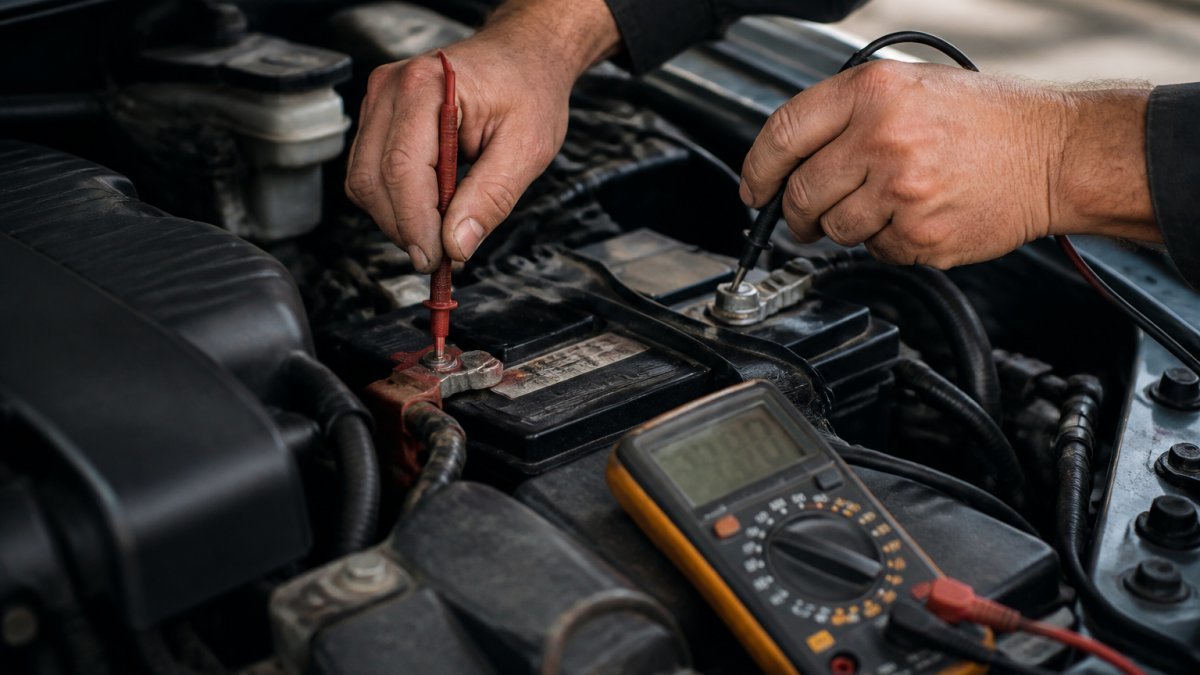
Testing a car battery with a multimeter takes three steps: set the meter, connect the probes, and read the number. Do it with the engine off and the keys out of the ignition. If your car has a push-button start, keep the fob far from the cabin so nothing wakes up the electrical system.
Step 1: Set the Multimeter to DC Volts
Turn the dial to DC voltage, marked with a V and a straight line above a dashed line. Pick the 20V range if your meter isn’t auto-ranging. A healthy 12-volt battery never exceeds that range, so 20V DC is the safe setting.
Step 2: Connect the Probes to the Battery Terminals
Touch the red probe to the positive terminal and the black probe to the negative terminal. The positive post is usually larger and marked with a plus sign or a red cover. Look for corrosion first. A crusty terminal can skew your reading or block contact entirely. If yours looks rough, here’s how to clean corroded car battery terminals before you test.
Step 3: Read the Resting Voltage
Let the car sit for at least an hour after driving, or overnight if you can. That clears the surface charge and gives you a true resting voltage. Write the number down. You’ll compare it against the chart below.
What Voltage Should a Car Battery Have?
A fully charged car battery should read about 12.6 volts at rest with the engine off. Anything from 12.4 to 12.7 volts is normal. Below 12.4 volts means the battery is partially discharged, and 12.0 volts or lower means it is significantly drained.
Here is a general reading chart:
| Resting Voltage | State of Charge | What It Means |
|---|---|---|
| 12.6V or higher | 100% | Fully charged, healthy |
| 12.4V | About 75% | Needs a recharge |
| 12.2V | About 50% | Weak, recharge or test further |
| 12.0V | About 25% | Discharged, likely failing |
| Below 12.0V | Near zero | Dead or deeply discharged |
That chart is a starting point, not a final answer. Three things routinely fool people, and they are the reason a reading that looks bad is sometimes fine and a reading that looks good is sometimes not.
Surface charge
A battery that just came off a charger or a long drive can read 13V or more. That is surface charge, a temporary voltage sitting on top of the plates, not a sign of health. Let the car sit for at least an hour after driving, or overnight if you can, before you trust a resting reading. If you need to test sooner, turn on the headlights for about a minute to bleed off the surface charge, then let the battery rest a few minutes and read again.
Temperature
Voltage drops in cold weather and rises in heat. A battery that reads 12.4V on a mild afternoon may read lower on a freezing morning, and that is normal chemistry, not necessarily a failing battery. Cold also reduces a battery’s ability to deliver current, which is why weak batteries tend to fail on the first cold snap. Test in mild weather when you can, and if you must test in the cold, interpret a slightly low number with that in mind.
Battery type and vehicle
Most conventional lead-acid batteries follow the chart above. Many newer vehicles use AGM (absorbed glass mat) batteries, often paired with start-stop systems, and AGM batteries can behave a little differently under charge and load. They are also more sensitive to how they are charged. If your vehicle came with an AGM battery, follow the manufacturer’s testing guidance rather than a generic chart, and do not assume a conventional charger is appropriate for it.
Do not test a battery that is visibly damaged, swollen, leaking, or smells like rotten eggs. A damaged battery can vent or rupture. Have it handled safely rather than probing it yourself.
If your number looks low after you have accounted for surface charge and temperature, check these 7 signs your car battery is failing before you buy a new one. And if you are wondering what causes a car battery to die suddenly, the answer is often a bad connection or a failing alternator, not the battery itself. When you would rather have someone look at it in person, our roadside assistance in Tulsa can jump your battery on the spot.
How to Test a Car Battery Under Load
A resting voltage test tells you how full the battery is. It does not tell you whether the battery can still deliver the current a starter demands on a cold morning.
Here is the honest limitation up front: a multimeter is a voltmeter, not a load tester. It measures electrical pressure, not capacity. A battery can read a healthy 12.6 volts at rest and still fail under load because its internal plates are sulfated or worn.
The headlight load test
With the engine off and the keys out of the ignition, turn on the headlights on high beam for about one minute. This pulls a modest, steady load. Then read the meter at the battery posts.
- Voltage should stay above roughly 12.2V with the lights on.
- A quick drop below 12V points to a weak battery.
- A slow, steady decline over the minute means low capacity.
This is a light load, not a starter load, so a pass here does not guarantee the battery is healthy. It is a screen, not a verdict.
The cranking test
The real load test happens when you crank the engine. Have a helper turn the key while you watch the display. Cranking voltage should not fall below about 9.6V. If it dives lower, the battery cannot handle starting loads anymore.
A few things to keep in mind so the number means something:
- Crank for no more than a few seconds at a time. Starter motors heat up fast, and repeated long cranks can damage them.
- Make sure the probes are on clean, tight posts. A loose or corroded connection adds resistance and drags the reading down, which looks like a bad battery but is really a bad connection.
- Test at the posts, not on the cable clamps, so you are reading the battery and not the connection.
- If the engine is already warm and starts instantly, the cranking number is less meaningful. A cold start is the harder test.
What the results actually mean
A battery that holds 12.6V at rest, stays above 12.2V under the headlight load, and holds above 9.6V while cranking is very likely healthy.
A battery that fails the resting test is a different story. That is a charge problem, not necessarily a capacity problem, and it may just need a proper recharge before you test again. Recharge it, let it rest, and retest before you condemn it.
If your meter has a min/max or peak-hold function, use it during the crank test. It captures the lowest voltage the battery hit, which is easy to miss if you are watching a flickering display.
If the battery passes every test but the car still cranks slowly, the problem may be the starter, the cables, or a ground connection rather than the battery. That is the point where a roadside visit from a local towing company can save you from guessing. Our jump start service in Tulsa can help when your car cranks slowly. Relying on a professional jump start service ensures that the underlying electrical failure is handled safely while you determine whether the issue stems from a depleted charge or a more complex mechanical fault.
Test the Charging System With the Engine Running
Start the car and let it idle. Now read the meter again. A charging-system reading is taken at the battery posts while the engine is running.
Common Multimeter Mistakes and Safety Tips
The biggest mistake is testing while the engine is running and expecting a resting voltage reading. You’ll get charging voltage instead, and you’ll misdiagnose a good battery. Other common errors:
- Touching the probes to the wrong posts, which can blow the meter’s fuse
- Testing right after a drive and reading surface charge as battery health
- Using a dirty probe tip that can’t make solid contact
- Leaving the meter on the wrong setting, like ohms, which gives nonsense
- Testing a battery that’s still connected during a charger cycle
On safety: batteries vent hydrogen gas, which ignites easily. Keep sparks and open flames away. Remove rings and watches before reaching over the terminals. And never lay a wrench across both posts.
How Long to Drive to Charge a Car Battery
Driving recharges a battery, but the trip needs to be long enough.
When to Stop Testing and Call Neptune Towing
If you’re stuck in a parking lot near the Arkansas River or on the shoulder of I-44, you don’t need to keep poking at a multimeter in the dark. Our jump start and roadside assistance services in Tulsa can help. Not sure whether to try a jump first? This step-by-step jump start guide walks you through it safely. When you’d rather have someone handle it, our Tulsa towing services cover jump starts, lockouts, and flatbed transport across the metro.
Frequently Asked Questions
Can a multimeter tell if a car battery is bad?
A multimeter can show a low or healthy voltage, but a single reading does not prove the battery is bad. A battery can read 12.6 volts at rest and still fail under load. Use the multimeter to check resting voltage, then watch what happens when you crank the engine.
Should you test a car battery with the engine on or off?
Do both, but for different reasons. With the engine off, you get the resting voltage, which tells you the battery’s state of charge. With the engine running, you are testing the charging system, not the battery.
What voltage should a car battery have?
A fully charged battery at rest should read about 12.6 volts. Let the car sit for a few hours before testing so surface charge from a recent drive does not inflate the number.
How long do you need to drive to charge a car battery?
A 20-minute drive is usually not enough to fully recharge a battery that was drained. Plan on 30 minutes or more of highway driving, and longer in stop-and-go traffic around Tulsa. If the battery was deeply discharged, a trickle charger overnight is a better fix than a short drive. If it keeps dying after long drives, the battery or alternator needs testing.
A dead battery never picks a convenient moment. If your testing points to a battery that won’t hold a charge, or you’d rather skip the diagnosis and get moving, call Neptune Towing at (539) 292 3074. We’re owner-operated, we handle every vehicle with damage-free equipment, and we don’t impound cars. We’ll get you a jump, a tow, or a ride to the shop, day or night. Get started with Neptune Towing and get back on the road.