



Last Updated: October 22, 2026
Quick Summary
A dead battery leaves your car with no power at all, while a failing alternator leaves you with a battery that keeps running down because nothing is recharging it. The fastest tell is what happens after a jump: a car that starts and keeps running usually has a weak battery, but a car that starts and dies again has a charging problem.
- A healthy battery should stay above roughly 9.6 volts during the crank.
- Charging voltage should read typically 13.5 to 14.5 volts with the engine running.
- Wait at least an hour after driving or charging before reading resting voltage.
- A swollen or bulging battery case means replacement, no multimeter required.
- Drive twenty to thirty minutes after a jump to recharge what the starter pulled.
Table of Contents
- Dead Battery vs. Bad Alternator: Key Symptoms Compared
- How to Test a Car Battery with a Multimeter
- How to Test an Alternator
- Car Starts with a Jump but Dies: What It Means
- Bad Battery vs. Bad Alternator Symptoms: A Side-by-Side Breakdown
- Other Causes That Mimic a Dead Battery or Failing Alternator
- When to Call for Roadside Assistance or a Tow
- Frequently Asked Questions
Dead Battery vs. Bad Alternator: Key Symptoms Compared
A dead battery leaves your car with no power at all. A failing alternator leaves you with a battery that keeps running down because nothing is recharging it. That’s the whole difference, and it’s what makes the two so easy to confuse.
Here’s the part most drivers miss: a healthy battery can be drained by a bad alternator, and a bad battery can make a good alternator look guilty. You’re not diagnosing one part, you’re diagnosing a charging system.
At Neptune Towing, we jump-start cars all over Tulsa and the surrounding towns, and we hear the same story constantly. Someone gets a jump on the Broken Arrow Expressway, drives ten minutes, and the car dies again. That pattern points one direction. A car that cranks slowly but fires up after a jump and keeps running points another.
Below, we’ll walk through the symptoms side by side, show you how to test a car battery with a multimeter, and explain how to test an alternator before you spend money on the wrong part.
A jump start that gets you home is a battery problem. A jump start that gets you a mile down the road is a charging problem. Which one you had tells you more than any dashboard light.
How to Test a Car Battery with a Multimeter
Testing a car battery takes about five minutes and one cheap tool, but the order matters. A voltage reading on a battery that just came off a charger, or was cranked hard five minutes ago, will give you a number that lies. Here is the sequence most technicians follow.
Step 1: Look before you test. Pop the hood with the engine off and inspect the battery case. A swollen or bulging case means the battery is done, no multimeter required.
Step 2: Check the connections. Grab each cable end and try to twist it.
Step 4: Read resting voltage. Set your multimeter to DC volts, touch the red probe to the positive post and the black probe to the negative post, engine off and all accessories off. Here is how to interpret what you see:
- 12.6 volts or a touch above: fully charged and holding it
- 12.4 volts: about 75 percent charged
- 12.2 volts: roughly half charged, needs attention
- 12.0 volts: about 25 percent charged
- Below 12 volts: deeply discharged, and possibly damaged
- Well under 12 and still dropping while you watch: the battery is not holding a charge
Those numbers assume a normal-temperature battery. Cold weather lowers resting voltage a little and heat raises it, so don’t condemn a battery over a tenth of a volt on a 20-degree morning.
Step 5: Crank it and watch the dip. Have a helper crank the engine while you hold the probes on the posts. A healthy battery should stay above roughly 9.6 volts during the crank.
Step 6: Load test. A resting voltage test tells you the state of charge, not the battery’s health or cold-cranking amps. For that you need a load test.
Resting voltage tells you charge. A load test tells you health. A battery can pass the first and fail the second, and that is exactly the battery that quits in a parking lot off Memorial on a January morning.
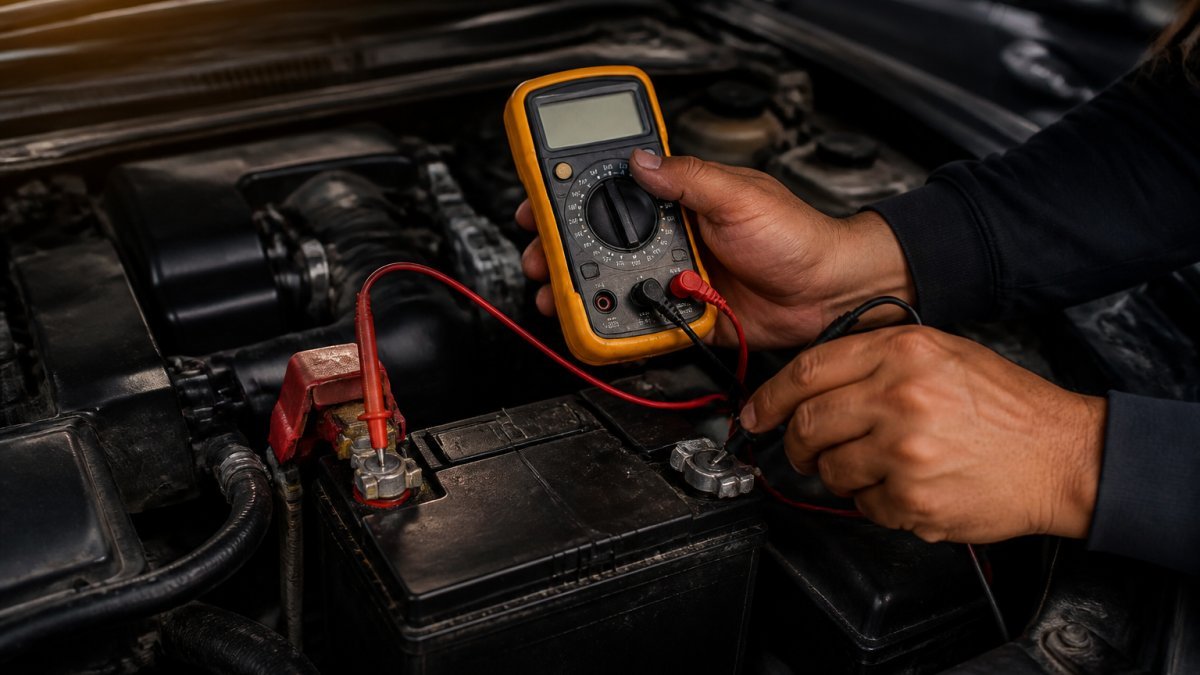
Once you have a resting number and a crank number, you have half the picture. The other half is what the charging system does once the engine is running.
Never lean over a battery while jumping or testing it, and never smoke near one. A charging battery can give off hydrogen gas, and a spark is all it takes. If you smell rotten eggs under the hood, step back and call for help instead of grabbing cables. And never lay a wrench or probe across both posts, a short across a battery can weld metal, burn skin, and damage electronics.
How to Test an Alternator
Testing an alternator means checking what the charging system does while the engine runs. With the car started, put your multimeter across the battery terminals again. You should see a charging voltage noticeably higher than the resting number, typically 13.5 to 14.5 volts on most vehicles.
Then turn things on. Headlights, blower motor, rear defroster. If the voltage sags hard and stays low, the alternator is struggling to keep up with electrical load.
A few more checks that cost nothing:
- Listen for a whine or grind from the belt area that changes with engine speed
- Look at the belt itself for glazing or cracks
- Watch whether the headlights brighten when you rev the engine, then dim at idle
One honest caveat: modern vehicles with smart charging systems don’t always hold a steady voltage, and some will drop charging on purpose to save fuel. If your numbers look strange but the car runs fine, that’s a question for a shop with the right scan tool, not a verdict.
Car Starts with a Jump but Dies: What It Means
A car that starts with a jump and then dies is almost always an alternator problem. The jump gave the battery enough juice to fire the engine. Once the cables came off, nothing was recharging it, so the engine ran on borrowed power until it quit.
A car that starts with a jump and keeps running usually has a weak or aging battery. It lost its charge sitting, or in cold weather, but the alternator is doing its job once the engine is spinning.
That single outcome splits the diagnosis in half. Remember which one happened to you, because it’s the first thing any honest mechanic will ask.
If your car starts with a jump and stays running, drive it for at least twenty to thirty minutes before shutting it off. A short trip to the corner store won’t put back what the starter pulled out, and you’ll be calling for another jump tomorrow morning.
Bad Battery vs. Bad Alternator Symptoms: A Side-by-Side Breakdown
The two failures overlap more than most people expect. Here’s how the symptoms usually sort out:
| Symptom | Bad Battery | Bad Alternator |
|---|---|---|
| Engine cranking | Slow, labored crank | Normal crank until battery drains |
| Clicking sound | Single click or rapid clicking | Usually starts fine, then won’t restart |
| Headlights | Dim at idle, brighten with revs | Dim and get worse as you drive |
| Battery warning light | May appear briefly | Commonly stays on while running |
| After a jump | Runs normally | Starts, then dies again |
| Battery age | Often 3+ years old | Battery may be new |
| Smell or appearance | Swollen case, corrosion | Burning or rubber smell near the belt |
Read the table as a starting point, not a verdict. A battery drained repeatedly by a bad alternator will show battery symptoms too. That’s how people end up replacing a good battery twice.
The most expensive mistake here is replacing the battery without testing the alternator. A new battery will run the car for a while on its own charge, then die the same way. You’ve paid for a part you didn’t need and you still have the original problem.
Other Causes That Mimic a Dead Battery or Failing Alternator
Plenty of no-start problems have nothing to do with either part, and this is where a lot of money gets spent on the wrong repair.
Bad starter motor. A starter draws a huge burst of current.
Corroded or loose ground cables. The ground side of the circuit gets ignored because it is not the pretty red cable.
Loose or dirty terminals. The cheapest fix on the list.
Parasitic drain. Something in the car keeps drawing power while it sits, and the battery is flat by morning.
Blown fuses and fusible links. A blown main fuse or fusible link can cut charging or starting power without the battery or alternator being at fault.
Intermittent faults and conditions that change the symptoms. This is the hardest category, and where a lot of good parts get replaced.
If your problem comes and goes, tell whoever tests it exactly when it happens.
Keep a simple log on your phone for a week: date, temperature, how long the car sat, what happened. A pattern like “dead every Monday after sitting all weekend” points at parasitic drain, while “slow crank only on cold mornings” points at the battery. That log turns a guessing game into a diagnosis.
None of this means you should skip the battery and alternator tests. It means the tests are the start of the diagnosis, not the end. If the battery passes a load test and the charging voltage looks right but the car still will not start, the problem is somewhere in this list, and that is where a shop with the right tools saves you money.
When to Call for Roadside Assistance or a Tow
Call for help when the car won’t start and you’re not in a safe spot to troubleshoot. A shoulder on I-44, a parking lot off Memorial, the inside lane at a red light on 71st. Safety beats diagnosis every time.
Call for a tow when:
- A jump start gets you moving but the car dies again within a few miles
- You see smoke, or smell burning rubber or hot wiring
- The battery is swollen, cracked, or leaking
- The car won’t crank at all and you’ve already checked the terminals
- You’re in an EV or a Tesla and the low-voltage system is acting up
That last one deserves its own note. Electric vehicles don’t have a traditional alternator, and they shouldn’t be jump-started or towed like a gas car. A Tesla or any EV with a dead low-voltage battery needs a flatbed and someone who knows where the tow points are.
This is where we earn our keep. Neptune Towing is owner-operated, and we run flatbeds built for damage-free towing, from daily drivers to classics to EVs. We don’t impound vehicles. We get you and your car where you need to go.
A dead battery or a failing alternator will both leave you stuck, and guessing wrong costs you money. Test the battery first, check the charging voltage second, and let the results point you to the right part.
Frequently Asked Questions
Does a bad alternator act like a dead battery?
Yes, a failing alternator can mimic a dead battery because it stops charging the battery while the engine runs. You may see dim headlights, a battery warning light, or slow cranking. The key difference is that a jump start might get you going, but the car will likely die again once the battery drains. Testing voltage at the battery with the engine running will show if the alternator is charging.
How quickly will a bad alternator drain a battery?
A completely failed alternator can drain a battery in as little as 30 minutes of driving, depending on the electrical load. If the alternator is weak, it might take longer, but you’ll notice symptoms like flickering lights or a dying engine. If your car starts with a jump but dies shortly after, the alternator is the likely culprit. A voltage test can confirm.
Can a car start with a bad alternator?
Yes, if the battery has enough charge, the car can start and run for a short time even with a bad alternator. However, the engine will eventually stall as the battery drains. To test, jump-start the car and check the battery voltage with the engine running. If it’s below 13.5 volts, the alternator isn’t charging properly.
Will a jump start fix a bad alternator?
No, a jump start only provides temporary power to start the engine. It does not fix a bad alternator. If the alternator is faulty, the car will die again once the battery is depleted. You’ll need to replace the alternator or have the vehicle towed to a repair shop.