
Table of Contents
- Understanding Towing Damage and Why Prevention Matters
- Step 1: How to Prepare Your Car for Towing
- Step 2: Verify Proper Equipment and Hitch Setup
- Step 3: Weight Distribution and Load Balancing
- Step 4: Flatbed Towing Tulsa, Why It Protects Your Vehicle
- Step 5: EV Towing Requirements and Special Considerations
- Step 6: Post-Towing Inspection Checklist
- Step 7: Communicating with Your Tow Operator
- Frequently Asked Questions
Last Updated: September 24, 2026
Understanding Towing Damage and Why Prevention Matters
Vehicle damage during towing isn’t just an inconvenience, it’s expensive and often preventable, which is why learning how to avoid towing damage matters. When a car is towed improperly, you could face thousands in repair costs on top of whatever mechanical issue got you stranded in the first place. The good news is that understanding how to avoid towing damage puts you in control.
Most damage happens because of three things: improper weight distribution, wrong securement methods, and using the wrong towing equipment for your vehicle type. According to U.S. PIRG Education Fund analysis of predatory towing practices, new legislation effective April 2026 now requires tow operators to clearly communicate all costs and obtain explicit consent before towing. This means you have more power to ask questions and verify that proper procedures will be used.
At Neptune Towing, we’ve seen firsthand how the difference between a careful tow and a careless one determines whether your vehicle arrives damage-free or with frame, suspension, or electrical problems. This guide walks you through the steps to protect your car, truck, or electric vehicle during transport.
Step 1: How to Prepare Your Car for Towing
Before a tow truck arrives, take photos from multiple angles, front, back, sides, and undercarriage if possible. This creates a record of pre-towing condition.
Document Your Vehicle’s Current Condition
Take clear pictures in daylight, capturing any existing scratches, dents, the undercarriage, suspension components, and the area where the tow hook or flatbed will make contact. If your vehicle has low clearance, a sports car, luxury sedan, or lowered truck, document that clearly.
Check Fluid Levels and Tire Pressure
Check all four tires and inflate to the manufacturer’s recommended PSI. Also check engine oil, transmission fluid, coolant, and brake fluid, low levels can cause internal damage during towing. Let the tow operator know if anything is low.
Step 2: Verify Proper Equipment and Hitch Setup
The equipment used determines whether your vehicle arrives undamaged. Not all tow trucks are created equal, and not all are right for your car.
Inspect the Trailer Hitch and Safety Chains
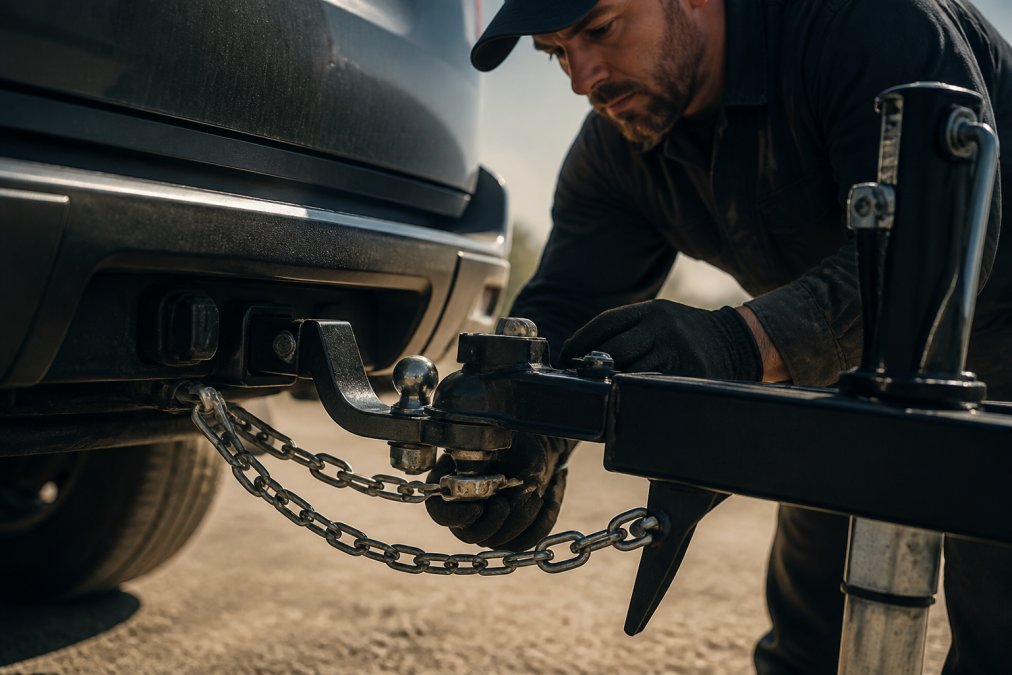
When the tow truck arrives, verify the hitch ball matches your vehicle’s coupler size. Safety chains should be attached to both sides of your vehicle’s frame, not the bumper. Chains crossed underneath the tongue provide backup if the hitch fails. Check that chains have no rust, cracks, or damage.
Check Electrical Connections and Brake Lights
Ask the operator to test brake lights and turn signals before they start moving. A malfunctioning brake light system creates safety hazards and traffic violations.
Step 3: Weight Distribution and Load Balancing
Improper weight distribution is one of the leading causes of towing damage, and it manifests differently depending on your vehicle type. Understanding how your specific car, truck, or SUV responds to towing forces helps you catch problems before they happen.
How Weight Distribution Causes Different Damage by Vehicle Type
Front-wheel-drive vehicles towed with front wheels on the ground risk bent tie rods, damaged control arms, and steering misalignment. Rear-wheel-drive vehicles towed with rear wheels on the ground risk rear axle overload and frame stress cracks. All-wheel-drive vehicles are the most damage-prone: if any wheels roll, the transmission can be damaged internally. AWD vehicles should only be towed on a flatbed or with all four wheels off the ground.
Tongue Weight and Axle Load: The Numbers That Matter
For flatbed towing, your vehicle should be centered front-to-back and side-to-side. A centered load distributes weight evenly across all axles of the tow vehicle and prevents traction loss or front-wheel lift.
Red Flags: How to Spot Improper Weight Distribution Before Towing Starts
Before the tow truck leaves, watch for these red flags: the tow vehicle’s front wheels lifting, sagging on one side, your vehicle sitting at an angle on the flatbed, straps pulling at an angle, or the operator not checking the load. If you see any of these, ask the operator to reposition. A professional will respect this and make adjustments without complaint.
Why Flatbed Towing Eliminates Weight Distribution Problems
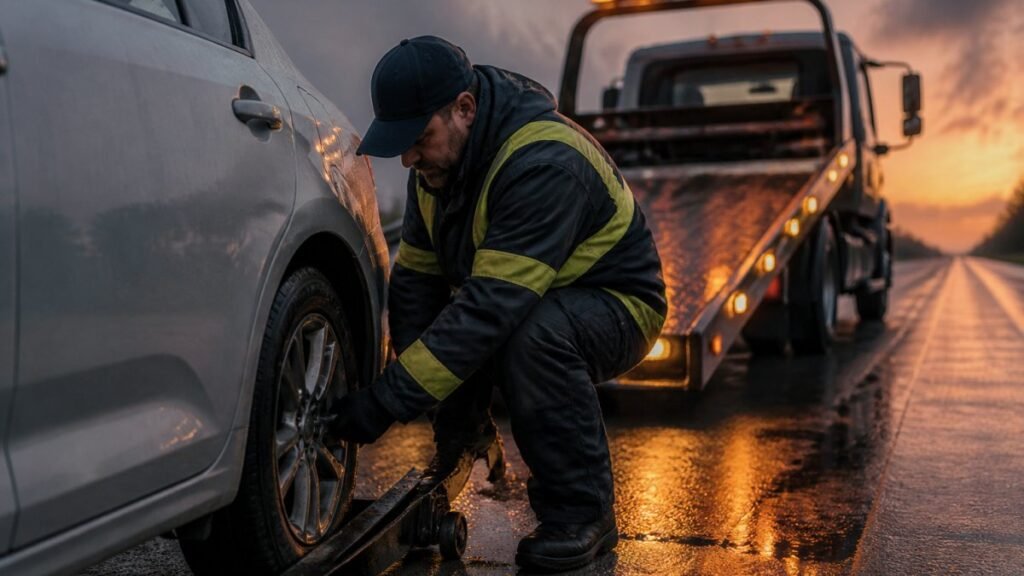
Flatbed towing removes weight distribution as a damage risk because all four wheels are off the ground. There’s no wheel rotation, no transmission stress, and no uneven suspension loading. The vehicle sits on a flat platform, and straps distribute the load across multiple attachment points. This is why flatbed towing is the standard for luxury vehicles, sports cars, and any vehicle with low clearance, and why it’s the safest choice for protecting your investment during transport throughout the Tulsa area.
Step 4: Flatbed Towing Tulsa, Why It Protects Your Vehicle
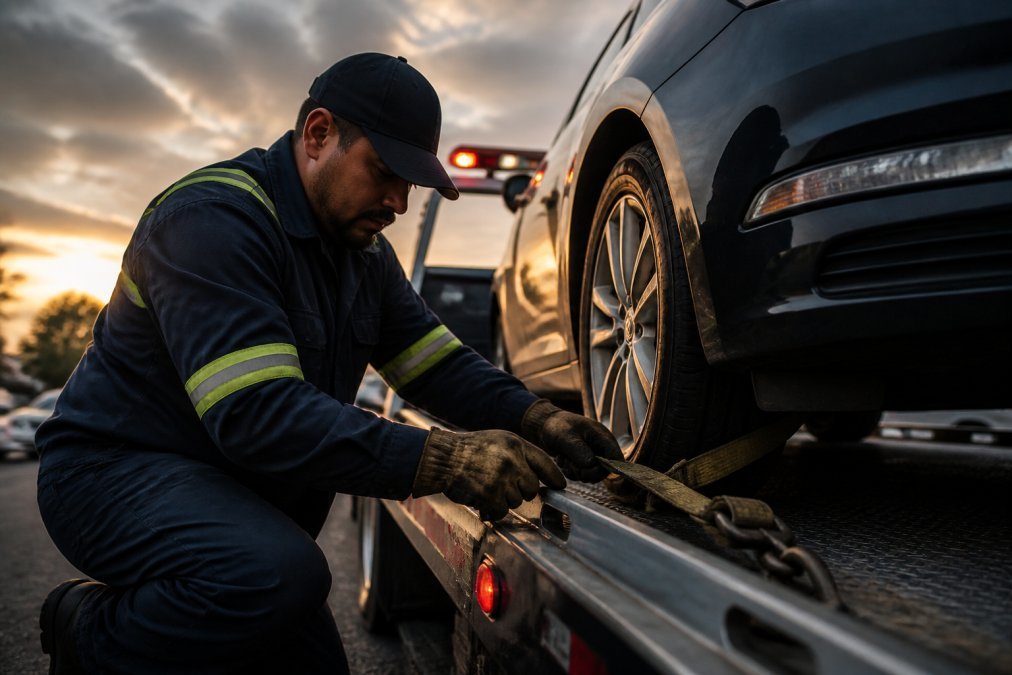
Flatbed towing removes all four wheels from the ground, eliminating suspension stress, tire damage, and frame stress. For luxury vehicles, sports cars, lowered trucks, and any vehicle with low clearance, flatbed towing is the only safe option. Neptune Towing specializes in flatbed towing throughout the Tulsa area because it prevents jackknifing and actually protects your investment.
Step 5: EV Towing Requirements and Special Considerations
Electric vehicles require different towing procedures than gas-powered cars. If you own a Tesla or another EV, understanding these requirements prevents thousands in drivetrain damage.
Understanding Electric Vehicle Transport Risks
EV drivetrains are directly connected to the wheels through a single-speed transmission. If your EV is towed with the wheels rolling, the wheels turn the motor and damage internal components. The solution is flatbed towing: when your EV is on a flatbed, all wheels are off the ground and no drivetrain damage occurs.
Proper Securement for Tesla and Other EVs
Modern electric vehicles have reinforced attachment points designed for towing. For Teslas and similar vehicles, never allow straps to be attached to the bumper or body panels, they should attach to the frame or designated tow points. Ask the operator to show you the attachment points before they start, and verify that all four wheels are fully off the ground.
Step 6: Post-Towing Inspection Checklist
Inspect your vehicle immediately after arrival, within the first hour if possible. Most towing damage isn’t obvious at first glance, and a thorough inspection creates documentation for any damage claim while the tow operator is still present.
The Complete Post-Towing Inspection: What to Look For and Why
Exterior and Paint Damage
Tire and Wheel Condition
Suspension and Frame Inspection
Electrical System and Lights
Engine and Mechanical Systems
Steering and Brake Response
Visual Indicators of Improper Towing: What They Mean
Red flags for improper towing include: bent or twisted frame rails, suspension components hanging loose or bent, tire flat spots or sidewall damage, brake fluid leaking, electrical connectors loose or corroded, paint transfer or deep scratches from straps, misaligned wheels or steering pulling to one side, and cracks in the frame or welds. If you see any of these signs, document everything with clear photos and get the tow operator’s name, company name, phone number, date, time, and vehicle mileage.
Filing a Damage Claim
This is why choosing a professional, owner-operated towing service matters. When you call Neptune Towing, you’re working with someone who cares about your vehicle’s safety and stands behind their work. We communicate clearly about what we’re doing, and take responsibility if something goes wrong. That’s the difference between a towing company that protects your vehicle and one that just moves it from point A to point B.
Step 7: Communicating with Your Tow Operator
Clear communication prevents misunderstandings and damage. When you call for a tow, provide specific information about your vehicle.
Tell the operator:
- Vehicle type (car, truck, SUV, sports car, electric vehicle)
- Any low clearance or special features
- Current mechanical issue (engine won’t start, flat tire, collision)
- Location and road conditions
- Whether you need flatbed towing
Ask the operator these questions before they begin:
- Where will you attach straps or hooks?
Neptune Towing operates throughout the Tulsa area, from Broken Arrow to Sapulpa, Bixby to Owasso, and our team understands damage prevention because we’re owner-operated.
Frequently Asked Questions
What is the difference between wheel-lift and flatbed towing?
Wheel-lift towing raises two wheels off the ground while the other two remain in contact with the road. Flatbed towing places the entire vehicle on a flat platform. Flatbed towing is gentler on your vehicle’s suspension, transmission, and frame because there’s no stress on the wheels or drivetrain. For luxury vehicles, electric vehicles, or any car with low clearance, flatbed towing is the safer choice to avoid towing damage.
Can towing a car ruin the transmission?
Yes, improper towing can damage your transmission if the vehicle is towed with the drive wheels on the ground while the transmission is in neutral. This forces the transmission to rotate without proper lubrication, potentially causing internal damage. All-wheel-drive and front-wheel-drive vehicles are especially vulnerable. Flatbed towing eliminates this risk entirely because all wheels are lifted off the ground. Always communicate your vehicle type to your tow operator to ensure the correct towing method is used.
Are electric vehicles more susceptible to towing damage?
Electric vehicles require specialized towing procedures because they have different weight distribution, low ground clearance, and sensitive electrical systems. Improper hook-up points can cause thousands in drivetrain damage. EV towing requirements include using flatbed transport, avoiding wheel-lift methods, and ensuring the operator understands EV-specific handling. Many EVs also have regenerative braking systems that can be damaged if the vehicle is towed with wheels on the ground. Always request a tow operator experienced with electric vehicle transport.
What should I look for when choosing a local towing company?
Choose a towing company that uses flatbed equipment, has experience with your vehicle type, and communicates clearly about procedures before the tow begins. An owner-operated local company often provides more personalized service and accountability than large chains.
Protecting your vehicle during towing starts with knowing what to look for and asking the right questions. When you need a tow truck in the Tulsa area, Neptune Towing provides flatbed towing and damage-free transport for all vehicle types, including electric vehicles and luxury cars. We prioritize proper securement, clear communication, and your vehicle’s safety. Call Neptune Towing at (539) 292-3074 for professional towing service you can trust.