

Last Updated: November 4, 2026
Quick Summary
Check your tire tread depth once a month with a penny or a tread gauge. Passenger tires are legally worn out at 2/32 of an inch, but replacing them closer to 4/32 gives better grip in heavy rain. Rotate tires every 5,000 to 7,500 miles and keep pressure at the door sticker level.
- Passenger vehicle tires have a legal minimum tread depth of 2/32 of an inch.
- The penny test is a quick check: if the top of Lincoln’s head shows, replace the tire.
- Measure several grooves across each tire, since uneven readings can signal an alignment problem.
- Rotate tires every 5,000 to 7,500 miles to even out front and rear wear.
- Check pressure monthly when tires are cold, using the driver’s door sticker number.
Table of Contents
- Why Tire Tread Depth Matters on Tulsa Roads
- Step 1: Know the Legal Minimum Tread Depth
- Step 2: Check Tread Depth With a Penny
- Step 3: Measure Accurately With a Tire Tread Depth Gauge
- Step 4: Recognize Signs of Uneven Tire Wear
- Step 5: Set a Tire Rotation Frequency You Can Keep
- Step 6: Keep Pressure and Alignment in Check
- Step 7: Decide When It Is Time to Replace Your Tires
- Frequently Asked Questions
Why Tire Tread Depth Matters on Tulsa Roads
Tire tread is the only part of your car touching the road, and worn tread means less grip when it counts. Storms can drop heavy rain on I-44 or the Broken Arrow Expressway in minutes, and that is when shallow tread struggles most.
Tread grooves are built to channel water away from the tire. When those grooves wear down, the tire has a harder time pushing water out, which raises the risk of hydroplaning. Worn tires also take longer to stop on wet pavement.
Here is the short version: check your tread often, and replace tires before they get too thin to handle a Tulsa rainstorm. The steps below show you how.
Step 1: Know the Legal Minimum Tread Depth
For passenger vehicles, the minimum legal tread depth is 2/32 of an inch. The National Highway Traffic Safety Administration tire safety guidance sets this as the standard you should not drop below.
Commercial vehicles follow stricter rules. Steer tires on trucks need at least 4/32 of an inch, according to Heavy Vehicle Inspection’s 2026 tread depth guidance.
Many drivers replace tires well before the legal limit. The legal minimum is the floor, not the target.
Step 2: Check Tread Depth With a Penny
The penny test is the quickest way to check tread at home. Here is how to do it:
- Grab a penny and turn it upside down.
- Slide it into several tread grooves across the tire.
- Look at how much of Lincoln’s head shows.
If the top of his head is visible, the tread is at or near the 2/32-inch limit. That means it is time to think about replacement. The U.S. Tire Manufacturers Association tire care guidance recommends this check as a basic habit.
Step 3: Measure Accurately With a Tire Tread Depth Gauge
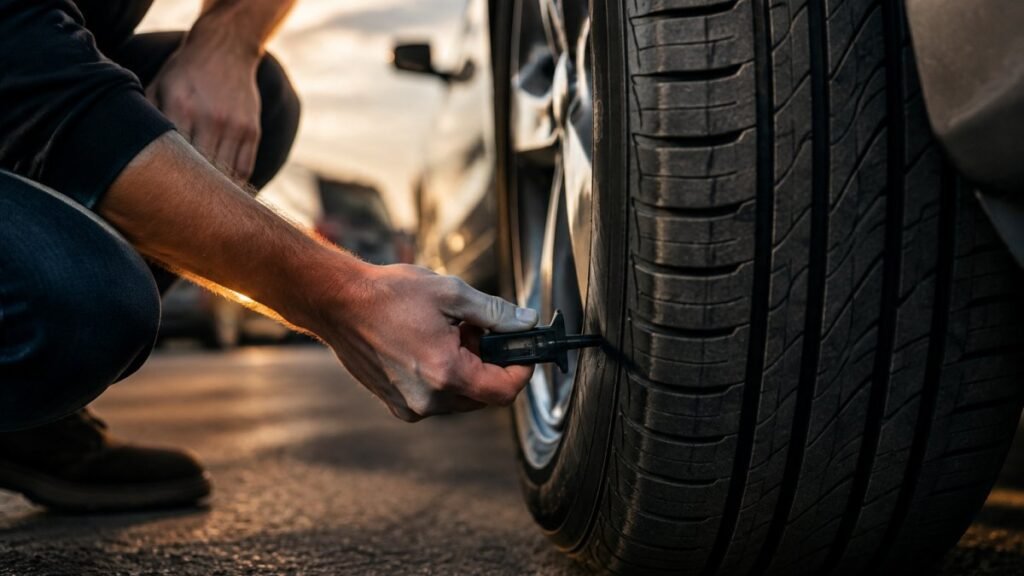
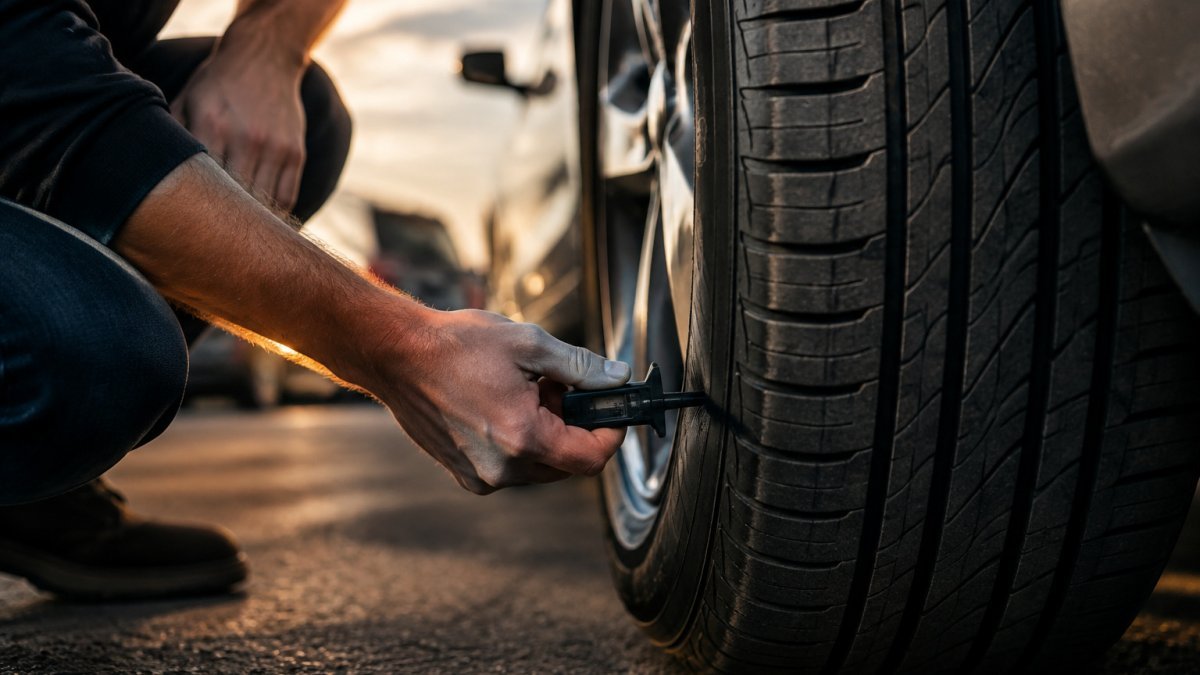
A penny tells you if you are close. A tread depth gauge tells you the exact number. A cheap gauge in your glovebox is a practical habit.

To use one:
- Press the gauge flat against the tread.
- Push the probe into the shallowest groove.
- Read the measurement in 32nds of an inch.
Check several grooves across each tire, not just one spot. Uneven readings can point to a bigger problem, which leads to the next step.
Step 4: Recognize Signs of Uneven Tire Wear
Tread depth alone does not tell the whole story. A tire can pass the penny test and still be wearing in a pattern that points to an alignment, inflation, or suspension problem. Catching the pattern early is how you avoid replacing a set of tires that were never the real issue.
Run your hand slowly across the tread (a clean hand, or a shop rag) and look at the tire from a crouch, not just from above. The shape of the wear is the clue.
- Wear on only the inner or outer edge. This usually means the wheel is leaning, camber is out of spec, or the toe setting is off. A hard hit on a Tulsa pothole or a curb can knock alignment out in a single trip. If one edge is noticeably smoother than the rest, get an alignment check before the tire is ruined.
- Cupping or scalloped dips across the tread. Cupping looks like a series of shallow scoops around the tire. It typically points to worn shocks, struts, or other suspension parts that let the tire bounce instead of staying planted. No amount of rotation fixes cupping; the suspension has to be inspected.
- A smooth center with worn shoulders. This is the classic overinflation pattern. The center of the tire bulges out and takes the load while the shoulders barely touch. Check the pressure against the door sticker and bring it down to spec. Our guide to portable tire inflators for roadside emergencies covers options for keeping pressure correct between service visits.
- Worn shoulders with a healthy center. The opposite pattern, underinflation. The tire squirms, the edges scrub, and the sidewalls run hot. This is the pattern most likely to end in a blowout on a hot afternoon on the Broken Arrow Expressway.
- Bald spots that repeat around the tire. Repeated flat spots can come from hard braking, a bent wheel, or a balance problem. If the spots are in one place, it may be a single locked-up brake event; if they repeat, have the wheel and balance checked.
- Feathering across the tread blocks. The tread blocks feel sharp on one side and rounded on the other. That is a toe problem, and it chews through tires fast.
A common pattern in many areas: drivers notice one tire looks different, assume it is just worn, and keep driving. A five-minute look at all four tires once a month catches it while a rotation and alignment can still save the tire.
Watch out: if you see cords or wire showing through the tread or sidewall, stop driving on that tire. That is a failure waiting to happen, and it is a roadside call, not a repair-shop drive.
Step 5: Set a Tire Rotation Frequency You Can Keep
Measuring tread is the easy part. Keeping tread even is what actually extends tire life, and that comes down to two habits: rotation and pressure. Most drivers who lose a set of tires early did not skip the penny test, they skipped the schedule.
Rotation. A common recommendation is every 5,000 to 7,500 miles, or at every other oil change if you follow a traditional interval. Front and rear tires wear differently, front tires carry steering and braking load, rear tires carry drive load on many vehicles, so swapping them front-to-back evens out the wear. All-wheel-drive and four-wheel-drive vehicles are less forgiving: mismatched tread depth across axles can stress the drivetrain, so rotation matters more, not less. Check your owner’s manual for the pattern your vehicle uses; some directional tires can only go front-to-back on the same side.
Pressure. Check once a month and before any long trip, when the tires are cold, meaning the car has sat for at least a few hours or been driven less than a mile. Use the number on the driver’s door jamb sticker, not the maximum on the tire sidewall. The sidewall number is the tire’s limit, not your vehicle’s target. A slow leak from a nail is the most common cause of a tire that keeps losing pressure; if one tire drops a few pounds a week, have it checked rather than topping it off forever. Because a slow leak can make one tire lose pressure between monthly checks, knowing how to check tire pressure at home helps you catch the change before it affects tread wear.
A schedule that actually sticks. The plan that works is the one tied to something you already do:
- Check tread depth and pressure on the first weekend of every month.
- Rotate at every oil change, or every 5,000 miles, whichever comes first.
- Write the date and mileage on a sticker inside the driver’s door jamb so the next check has a baseline.
- After any hard pothole hit, and Tulsa has plenty, do a quick walk-around and look for a bulge or a new vibration.
Seasonal reality. Summer heat on I-44 and the Broken Arrow Expressway raises tire pressure and accelerates wear on underinflated tires. Winter cold drops pressure roughly a pound per 10-degree drop in ambient temperature, so a tire that was fine in October can be low by December without leaking at all. A monthly check catches both swings.
If a tire goes flat before the schedule catches up, a local towing company can help get you to a shop. Neptune Towing is owner-operated and does not impound vehicles.
Checking tread is the easy part, so here is how to keep tread wearing evenly over time.
| Task | Frequency | Why it matters |
|---|---|---|
| Tire rotation | Every 5,000 to 7,500 miles | Evens out front and rear wear |
| Pressure check | Monthly and before long trips | Prevents edge or center wear |
| Pressure check (cold tires) | Cars sat a few hours or driven under a mile | Gives an accurate reading |
| Tread and pressure check | First weekend of each month | Builds a consistent habit |
| Walk-around after pothole hit | After any hard impact | Catches bulges or vibration early |
| Winter pressure drop | About 1 psi per 10-degree drop | Explains low pressure in cold months |
Step 6: Keep Pressure and Alignment in Check
Underinflated tires wear on the edges and run hot. Overinflated tires wear in the center and ride harsh. Check pressure with a gauge when the tires are cold, and use the number on the driver’s door sticker, not the number on the tire sidewall.
Alignment matters too. If your car pulls to one side or the steering wheel sits off-center, get an alignment check. Hitting a Tulsa pothole hard enough can knock it out of spec, and then your tires start wearing unevenly.
Step 7: Decide When It Is Time to Replace Your Tires
Replace tires when they reach 2/32 of an inch, or sooner if you drive a lot in heavy rain. Many drivers choose to replace at around 4/32 for better wet-weather grip. Tires older than 10 years should also be checked for aging, even if the tread looks fine.
If a worn tire goes flat on the road, you can get roadside help for tire problems in Bixby fast, or compare options through mobile tire repair versus roadside assistance costs before you decide.
For current towing and roadside pricing in Tulsa, see Tulsa Towing Prices.
If you are worried about being stranded with worn tires, our EV towing emergency guide for Tulsa drivers covers what to do next.
Frequently Asked Questions
Is a 3/32 inch tread depth good or bad for tires?
A 3/32 inch tread depth is above the legal minimum of 2/32 inch for passenger vehicles, but it is getting close to the point where replacement should be planned. AAA recommends replacing tires once tread reaches 4/32 inch because stopping distances on wet pavement begin to grow well before the legal limit. If your tires read 3/32 inch, schedule a replacement soon, especially before heavy rain season on Tulsa-area highways like I-44 or the Broken Arrow Expressway.
What is the minimum legal tire tread depth in the United States?
For passenger vehicles, the minimum legal tread depth in the United States is 2/32 of an inch, according to guidance from the National Highway Traffic Safety Administration. Commercial vehicle steer tires must meet a higher minimum of 4/32 of an inch. Most safety experts treat 2/32 inch as the absolute floor rather than a target, and recommend replacing tires earlier for better wet-road traction.
How often should I check my tire tread depth?
Check your tire tread depth at least once a month, and before any long trip. NHTSA recommends monthly visual inspections, which also help you catch uneven wear early. Combine these checks with your tire pressure review so you can spot problems before they turn into a roadside breakdown that needs a tow.
Does tire rotation help maintain even tread depth?
Yes. Rotating tires roughly every 5,000 miles helps wear the tread evenly across all four positions, which extends tire life and keeps braking and handling balanced. Uneven tread depth from side to side can also pull the vehicle toward one side, so rotation and a periodic alignment check work best together.