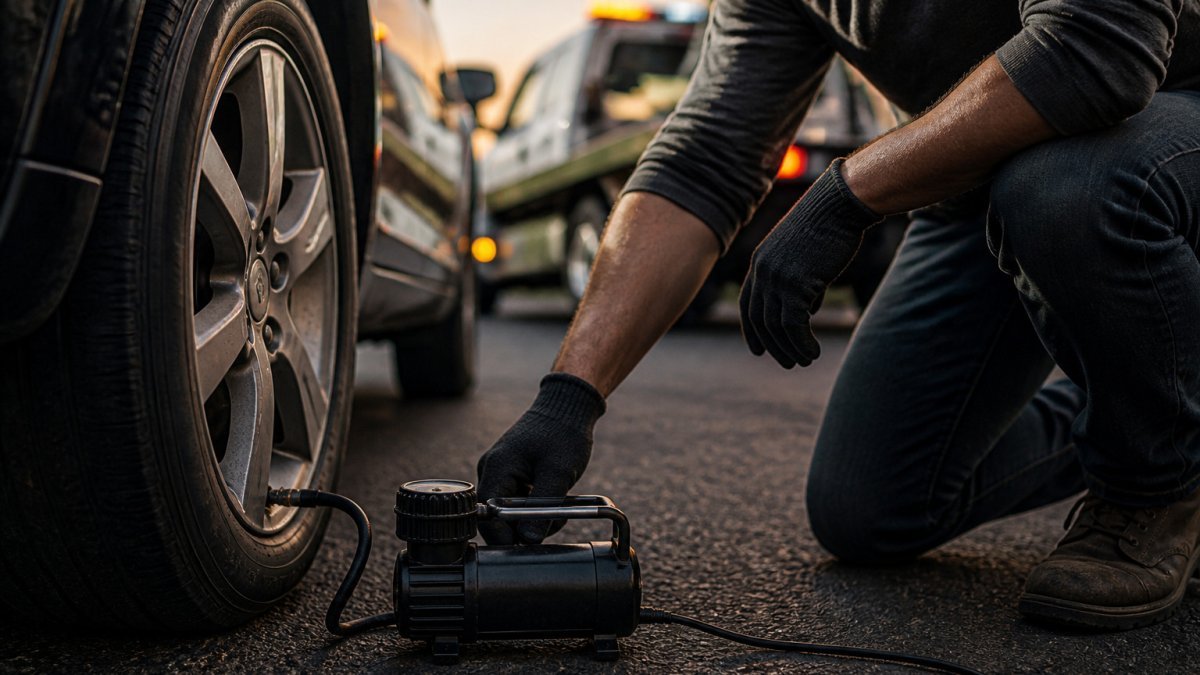

Last Updated: November 1, 2026
Quick Summary
A portable tire inflator is a first-response tool that can top up a low tire and get you moving again after a slow leak or temperature drop. It will not repair a torn sidewall or a nail puncture in the tread, so match the unit to your tire size and conditions.
- Match the inflator to your tire size, since larger SUV and truck tires take much longer to fill.
- Use the recommended PSI on your driver’s door jamb sticker, not the number on the tire sidewall.
- Check the pressure with a separate gauge partway through and after disconnecting the hose.
- Uncoil the hose and cord before buying to confirm it reaches your farthest wheel.
- Stop inflating and call for help if the tire has visible damage or is losing air faster than you can add it.
Table of Contents
- Why a Portable Tire Inflator Belongs in Every Glovebox
- How Our Picks Were Chosen and What the Research Does and Doesn’t Show
- Top Portable Tire Inflator Options for Emergency Use
- Portable Tire Inflator for SUV and Truck Tires
- How to Use a Portable Tire Inflator Safely on the Roadside
- What to Do With a Flat Tire on the Roadside
- Get Help Fast With Neptune Towing When an Inflator Isn’t Enough
- Frequently Asked Questions
Why a Portable Tire Inflator Belongs in Every Glovebox
A portable tire inflator is one of the cheapest insurance policies a driver can carry. Maintaining proper pressure prevents many roadside hazards, but having a plan for what to do when stranded remains essential for handling more complex mechanical failures.
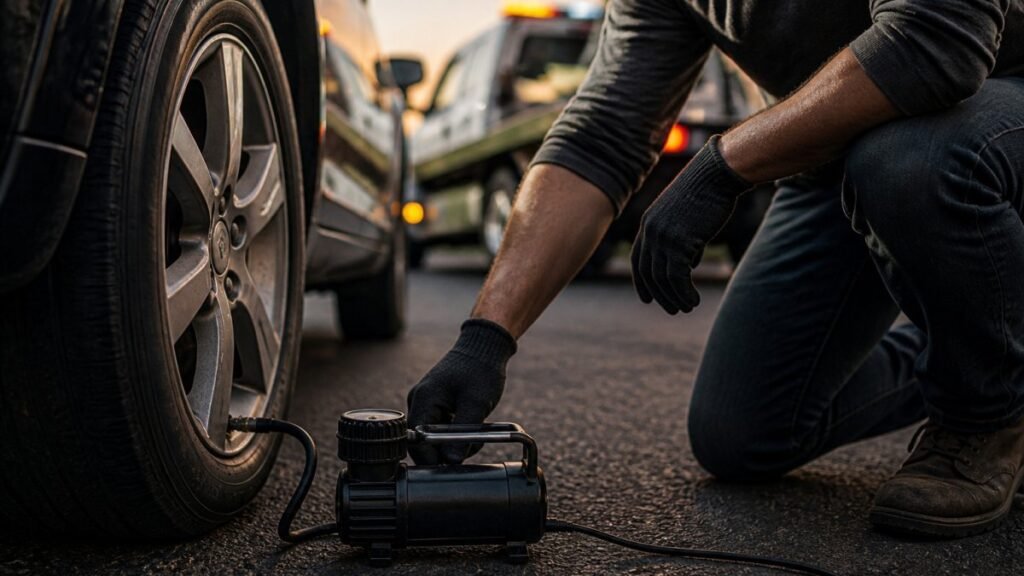
We think of it as a first-response tool, not a permanent fix. It handles a tire that has lost pressure from temperature changes, a slow leak, or a valve that needs a little air.
How Our Picks Were Chosen and What the Research Does and Doesn’t Show
We built this list from product roundups and comparison pieces published in the past year, along with the specifications those sources listed.
That matters for you. A product being named a “top pick” tells you someone liked it, not how it will perform on your specific tire.
We also do not have local data on roadside breakdowns in the Tulsa area, so this guide focuses on general vehicle and tire guidance rather than local statistics.
Top Portable Tire Inflator Options for Emergency Use
Most inflators in this category fall into two groups: cordless, battery-powered units, and 12-volt models that plug into your vehicle’s power outlet. Rather than rank them by marketing copy, it helps to match the unit to the tire it will actually fill and to the conditions you will be standing in when you use it.
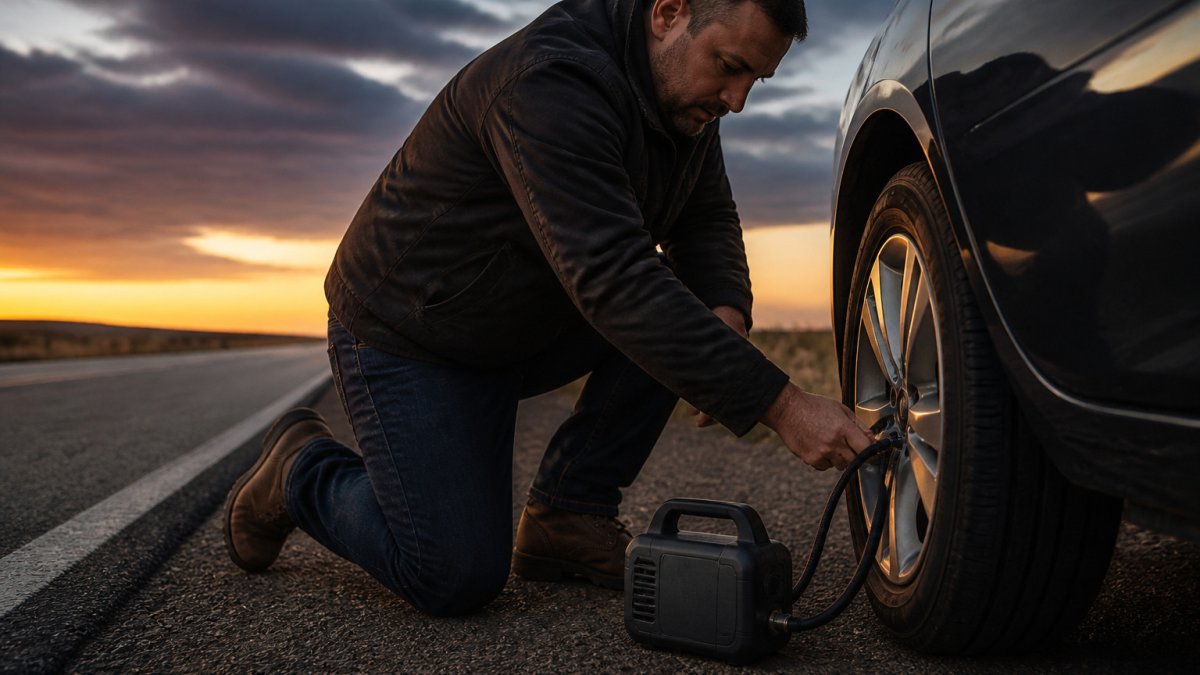
Here is how the options we reviewed break down, with the caveats that matter for roadside use.
| Model | Power Source | Listed Max Pressure | Best For | Emergency Notes |
|---|---|---|---|---|
| AstroAI L7 | Cordless | 150 PSI | Cars, bikes, balls | Digital display, automatic shutoff, built-in LED light for dark shoulders |
| NOCO Boost Air AX65 | Battery | Up to 100 PSI | Higher-volume roadside use | Described as high-pressure, high-volume; confirm runtime before a long trip |
| Kohree | Not verified | Not verified | Compact, lightweight storage | Small footprint fits under a seat; verify hose length reaches all four wheels |
| Avid Power Pistol Grip | Not verified | Not verified | General-purpose use | Pistol-grip form is easy to hold one-handed beside traffic |
| Airmoto | Not verified | Not verified | Emergency preparedness | Compact form factor; check whether it needs a separate charger |
| Viair 84P | Not verified | Not verified | All tire sizes | Listed for all tire sizes; confirm duty cycle before filling a large truck tire |
Match the Inflator to the Tire, Not the Label
The single most useful number on any inflator box is not the maximum PSI. It is how much air the unit can move, usually expressed as CFM or liters per minute, and how long it can run before it needs to cool down.
A practical rule of thumb many drivers use:
- Sedans and small crossovers: a compact cordless unit is usually enough for a top-up.
- Mid-size SUVs and half-ton pickups: look for a unit that lists a higher volume rating or explicitly mentions larger tires.
- Heavy-duty pickups, trailers, and oversized tires: a compact inflator may not be the right tool; plan on a full-size spare or a call for help.
Check the recommended PSI on the driver’s door jamb sticker, not the number molded into the tire sidewall. The sidewall number is the tire’s maximum, not what your vehicle needs.
Cordless and Battery-Powered Models
Cordless inflators are what most people want in an emergency because they do not depend on a running engine or a working outlet. The AstroAI L7 is listed with a 150 PSI maximum, an automatic shutoff, a digital display, and an emergency LED light.
The NOCO Boost Air AX65 is described in one review as a high-pressure, high-volume option and a top pick. Battery runtime matters here.
12-Volt Models That Plug Into Your Vehicle
A 12-volt inflator draws power from your car’s accessory socket, so it never runs out as long as the engine is running. The AstroAI 12-Volt model is a common budget choice, and Car Talk lists it among its favorites.
The tradeoff is that you need the engine running, and the cord has to reach the nearest wheel. On a longer vehicle, that may mean starting at the rear wheel closest to the socket and working forward.
Before you buy, uncoil the hose and cord in your driveway and check that they reach the farthest wheel on your vehicle. A unit that cannot reach the passenger-side rear tire is not much help in an emergency.
What the Specs Do Not Tell You
A maximum pressure rating and a digital display are useful, but they do not tell you how the unit behaves after five minutes of continuous running, how accurate the built-in gauge is, or whether the hose fitting stays seated on a valve stem when the tire is vibrating on a roadside. Those are the details that separate a tool you trust from one you leave in the garage. When you compare models, look for a duty cycle rating, a hose that is long enough for your vehicle, and a gauge you can cross-check with a separate tire pressure gauge.
Portable Tire Inflator for SUV and Truck Tires
Larger tires take longer to fill, and many compact inflators struggle with them. The reason is simple: a bigger tire holds more air, so bringing it from 20 PSI back to its recommended pressure takes more volume, not just more pressure.
If you drive an SUV or truck, look for a unit that lists a higher volume rating or specifically mentions larger tires.
A Simple Way to Think About Tire Size
You do not need a spec sheet to estimate whether a compact inflator is up to the job. Compare the tire’s volume, not just its diameter:
- Sedans and small crossovers typically run tires in the 15- to 18-inch range with a relatively small air volume. A compact cordless unit is usually enough for a top-up.
- Mid-size SUVs and half-ton pickups run larger tires with more volume. Look for a unit with a higher volume rating, and expect longer fill times.
- Heavy-duty pickups, trailers, and oversized off-road tires hold substantially more air. A compact inflator may still add pressure, but it is not a realistic substitute for a full-size spare or a call for help when the tire is badly low.
A common pattern is that drivers underestimate how long a small inflator takes on a truck tire and overheat the unit by running it continuously. Most manufacturers publish a duty cycle, for example, a run time followed by a cool-down period, and ignoring it is one of the fastest ways to shorten the life of the tool.
Check Pressure Partway Through
Do not trust the inflator’s display alone on a large tire. Check the pressure with a separate gauge partway through the fill, especially if the unit has been running for several minutes. Pressure can climb faster near the end of the fill, and stopping at the recommended PSI matters more than filling to the maximum on the inflator.
If a truck or SUV tire is losing air rapidly, stop inflating and assess the damage. An inflator is for low pressure or minor leaks, not for a torn sidewall or a puncture that is venting faster than the unit can add air. In that situation, a spare or a call for roadside help is the safer choice.
When a Compact Inflator Is the Wrong Tool
There are situations where no compact inflator will get you moving safely:
- The tire has a visible tear, bulge, or sidewall damage.
- Air escapes faster than the unit can add it.
- The tire is completely flat and unseated from the rim.
In those cases, the right move is to get to a safe spot, stay in the vehicle with your seatbelt on if you are beside traffic, and call for help. A local towing company can handle a tire change or a flatbed tow without you working in a traffic lane.
How to Use a Portable Tire Inflator Safely on the Roadside
Work through these steps before you start:
- Park on level ground, well away from traffic, and turn on your hazard lights.
- Set the parking brake and, if possible, put the car in park with the engine running for a 12-volt unit.
- Find the recommended PSI on your door jamb sticker. Do not use the number printed on the tire sidewall, which is the tire’s maximum.
- Attach the inflator to the valve stem firmly, then turn it on.
- Check the pressure every minute or so. Stop when you reach the recommended PSI.
- Recheck the tire with a separate gauge after you disconnect the hose, since pressure can drop slightly.
Watch out for overinflation. Stopping at the recommended PSI matters more than filling to the maximum on the inflator. Overinflating a tire reduces its contact with the road and can make the car handle poorly.
What to Do With a Flat Tire on the Roadside
An inflator is the right tool when a tire is low but still holding air. If the tire is visibly flat, or the air escapes faster than you can add it, stop inflating and assess the damage.
If you have a spare and the tools to change it, follow your owner’s manual for the jack points and lug nut pattern.
Get Help Fast With Neptune Towing When an Inflator Isn’t Enough
Sometimes the tire is too damaged to fix or the problem is something an inflator cannot solve. Neptune Towing provides flat tire assistance, tire changes, jump starts, lockout service, and flatbed towing across Tulsa, Jenks, Bixby, Broken Arrow, and surrounding communities.
We also do not impound vehicles. When you call, you are speaking with the owner, and our job is to get you and your car to safety, not to add storage fees to a bad day.
Call (539) 292 3074 for roadside help.
Frequently Asked Questions
What is the best portable tire inflator for emergencies?
The best choice depends on your vehicle and how you plan to power it. Cordless, battery-powered models are convenient because they do not need your car running, but they depend on a charged battery. 12-volt models plug into your vehicle’s power outlet and work as long as the car has power. Look for a listed maximum pressure that covers your tire’s recommended PSI, an automatic shutoff, and a digital gauge so you can stop at the right pressure. Check the specifications on the current listing before you buy, since features and prices change.
Are battery-powered or 12-volt tire inflators better for roadside use?
Battery-powered inflators work well when you want a self-contained tool you can use without starting the engine, which helps if your battery is weak or the car is disabled. The tradeoff is that you need to keep the battery charged and check it periodically. 12-volt inflators draw power from your car, so they are reliable as long as the vehicle’s electrical system works. If you already have a dead battery, a 12-volt unit will not help, so a cordless model may be the better backup.
Can a portable tire inflator fix a flat tire?
A portable tire inflator can restore air to a tire that is low but not torn or punctured. It cannot seal a puncture, repair a sidewall cut, or fix a tire that has lost air because of a damaged valve or rim. If the tire does not hold air after inflation, stop, mark the location of the leak, and replace the tire with a spare or call for roadside help.
What to do with a flat tire on the roadside?
First, move the vehicle to a safe spot away from traffic if you can, turn on your hazard lights, and set out reflective triangles or flares if you have them. Apply the parking brake and keep passengers out of traffic lanes. If the tire is only low, use your portable inflator to bring it up to the pressure printed on the driver’s door jamb sticker. If the tire is flat, damaged, or the inflator cannot hold pressure, change the tire or call a towing service for help. Neptune Towing offers tire changes and roadside assistance throughout the Tulsa area.