

Last Updated: October 28, 2026
Quick Summary
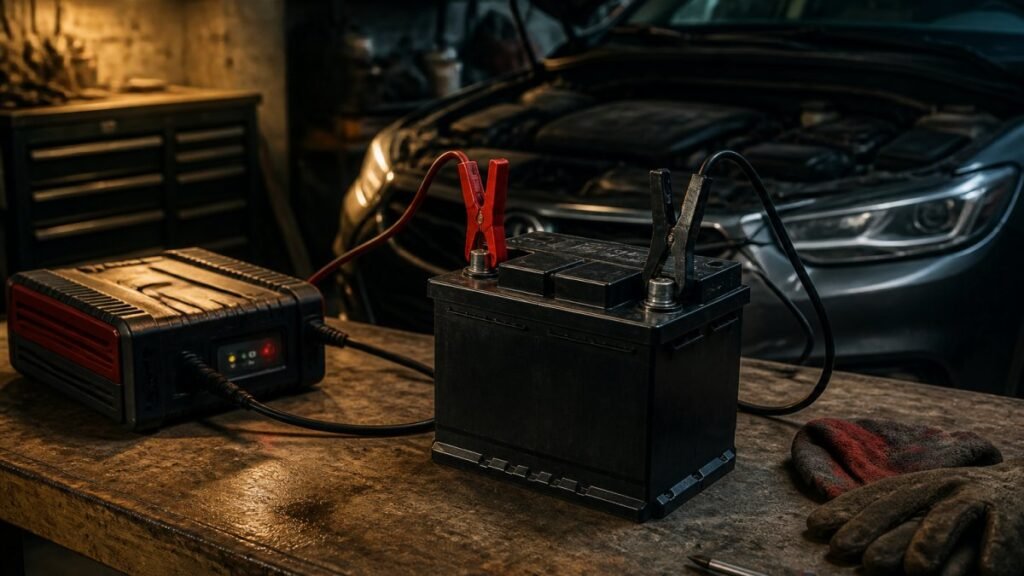
To charge a car battery at home, first confirm it isn’t cracked, swollen, leaking, or smelling like rotten eggs, then work in a well-ventilated space. Connect the red clamp to the positive terminal first, the black clamp to the negative, then plug in the charger and select the correct mode.
- Charge outdoors or with the garage door fully open, since lead-acid batteries vent hydrogen gas while charging.
- A standard charger can take 4 to 12 hours, while a trickle charger can run 24 hours or more.
- Estimate time with hours ≈ (missing amp-hours ÷ charger amps) × 1.2 to account for inefficiency.
- A smart charger tapers current as the battery fills, making overnight charging safer than a manual unit.
- Stop and call for help if the battery is hot, swollen, leaking, or voltage won’t climb after several hours.
Table of Contents
- Before You Start: Tools, Ventilation, and a Battery Worth Charging
- How to Use a Car Battery Charger, Step by Step
- Car Battery Charging Safety Precautions That Prevent Real Accidents
- How Long to Charge a Car Battery (and What Changes the Answer)
- Modern Batteries and Vehicle Electronics: Lithium 12-Volt and EV Cautions
- Jump-Starting a Car Battery Safely vs. Charging: Which One Fits Your Situation
- When to Stop Charging and Call Neptune Towing Instead
- Frequently Asked Questions
Before You Start: Tools, Ventilation, and a Battery Worth Charging
Knowing how to charge a car battery at home is one of the easiest ways to skip a tow. But it only works when the battery is healthy enough to take a charge. That’s the part most guides skip, and it’s the part that matters most.
Here’s what you need before you touch a charger.
What You’ll Need
- A battery charger matched to your battery type, ideally a smart charger that adjusts current on its own
- Protective gloves and safety glasses, because battery acid and sparks don’t mix with skin or eyes
- A wire brush or terminal cleaning tool for corrosion
Skip the ventilation and you’re charging a battery that can vent hydrogen gas. That’s a real fire risk, not a hypothetical one.
Check the Battery’s Condition First
A car battery that’s cracked, swollen, leaking, or smells like rotten eggs is not a charging candidate. Stop there and call for help.
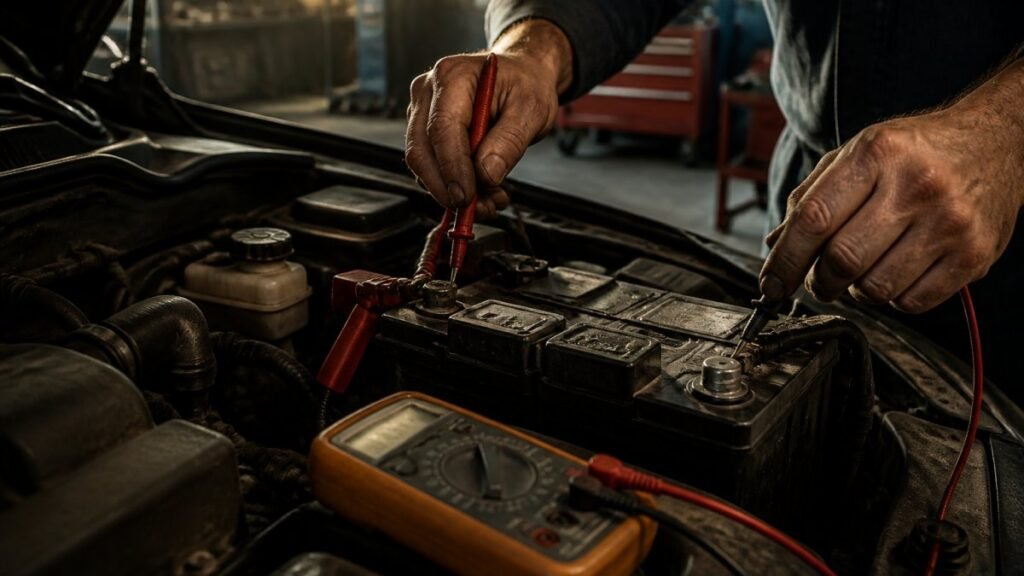
If it looks intact, check the voltage. A multimeter tells you whether the battery is discharged or dead. How to test a car battery with a multimeter walks through the process step by step.
Also look at the terminals. Heavy white or blue-green crust means a weak connection, and a weak connection means a charge that never reaches the battery. We’ll cover cleaning in the next section.
How to Use a Car Battery Charger, Step by Step
Using a car battery charger safely comes down to order: clamps on in the right sequence, settings matched to the battery, and the charger disconnected before anything else gets touched.
Identifying the Positive and Negative Terminals
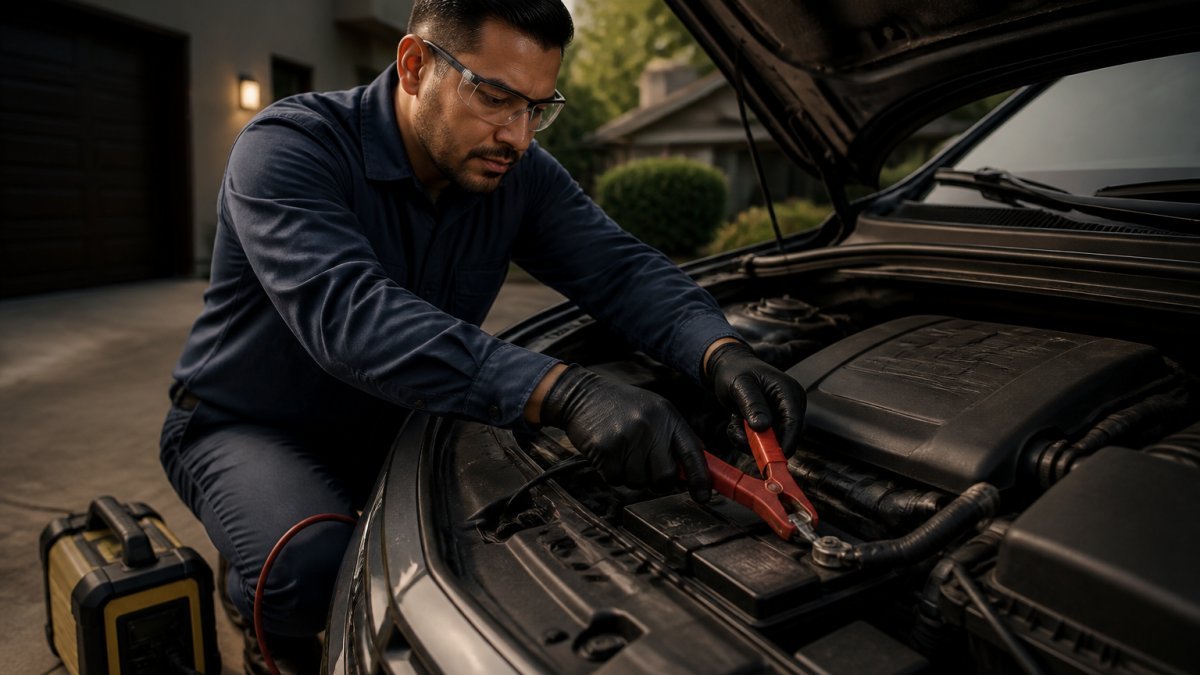
The positive terminal is marked POS or “+” and is usually larger. The negative terminal is marked NEG or “-“. On most vehicles the positive cable is red and the negative cable is black, but never trust color alone.
If the terminals are caked in corrosion, clean them before connecting anything. How to clean corroded car battery terminals covers the baking soda method and what to avoid.
Connecting the Clamps in the Correct Order
- Park safely. Set the parking brake, shift to park or neutral, and turn the ignition off.
- Connect the red clamp to the positive terminal first.
- Connect the black clamp to the negative terminal.
- Plug in the charger and select the correct charging mode and voltage.
- Confirm the charging status indicator shows a normal charge, not a fault.
- Monitor charging and check the battery every so often.
Reverse the order when you finish: unplug the charger, remove the black clamp, then the red clamp.
One more thing: a standard charger can take 4 to 12 hours, and a trickle charger can run 24 hours or more, according to GOOLOO’s car battery charging guide. Plan for that.
Car Battery Charging Safety Precautions That Prevent Real Accidents
The safety rules around charging a battery aren’t decoration. They exist because people get hurt doing this in driveways every year. Here’s what actually matters, in the order it matters.
Ventilation and Where to Charge
Charge outdoors or with the garage door fully open. A lead-acid battery vents hydrogen gas while charging, and hydrogen is lighter than air, it collects at the ceiling and finds an ignition source. A closed garage with a gas water heater pilot light is the classic bad setup. If you must charge indoors, keep the charger and battery near the open door, not in a corner, and never charge in a basement or utility closet.
Extension Cords and Household Fire Prevention
Use the shortest, heaviest-gauge extension cord the charger allows, a 12-gauge cord for runs up to 50 feet is a common rule of thumb. A thin 16-gauge cord on a long run overheats and is a real fire cause. Plug the charger directly into a wall outlet rated for the load, not into a power strip or daisy-chained surge protector.
Stop Conditions: When Not to Charge
Some batteries are not charging candidates, and no amount of patience will change that. Stop and do not connect a charger if the battery is:
- Swollen or bulging on the case or sides, internal damage, possible rupture risk
- Cracked or leaking, acid on skin or in the eyes is a serious injury
- Frozen, charging a frozen battery can cause the case to split; let it thaw indoors first, then inspect
If any of those apply, the battery needs testing or replacement, not a charger. A load test at a parts store or shop tells you in minutes what hours of charging won’t.
Personal Protection and Spark Control
- Wear eye protection. Battery acid under pressure can spray when a clamp slips.
- Keep sparks and flames away. No smoking, no space heaters, no grinding nearby.
- Use a UL-listed smart charger. Battery Tender’s 2026 charger guidance notes that smart chargers monitor voltage and adjust current in real time, which makes them safer for unattended charging.
Charging a battery with the clamps reversed can fry the charger and, on newer vehicles, damage sensitive electronics. Double-check the markings before you connect anything.
Unattended Charging
A smart charger that tapers current is designed to be left alone overnight. A manual charger is not. If you’re running a manual unit, set a timer, check the battery every hour, and never leave it charging while you sleep or leave the house. The difference between the two is the difference between a topped-up battery and a cooked one.
How Long to Charge a Car Battery (and What Changes the Answer)
There’s no single answer, and anyone who gives you one is guessing. Charging time depends on three things: battery capacity, how far it’s drained, and charger amperage. Once you know those, you can estimate it yourself.
The Math Behind the Estimate
A battery’s capacity is rated in amp-hours (Ah). A typical car battery is around 45 to 70 Ah. If a 60 Ah battery is at 50% state of charge, you need to replace roughly 30 Ah.
A simple working formula: hours ≈ (missing amp-hours ÷ charger amps) × 1.2. The 1.2 accounts for inefficiency and the slow tail end of the charge.
Worked Examples
| Battery | State of Charge | Charger | Estimated Time |
|---|---|---|---|
| 60 Ah | 50% (30 Ah missing) | 10-amp smart charger | ~3.5 hours |
| 60 Ah | 25% (45 Ah missing) | 10-amp smart charger | ~5.5 hours |
| 60 Ah | 25% (45 Ah missing) | 2-amp trickle charger | ~27 hours |
| 70 Ah | 10% (63 Ah missing) | 10-amp smart charger | ~7.5 hours |
| Any | Won’t hold a charge | Any | Stop, failed battery |
Those are estimates, not promises. Cold weather slows charging, a sulfated battery accepts current more slowly, and a charger that tapers current near full charge adds time at the end.
What Changes the Answer
- Battery size. A larger battery takes longer to fill. A small economy car battery fills faster than a truck battery on the same charger.
- Depth of discharge. A battery at 80% tops up in an hour or two. One at 10% takes most of a day.
- Charger amperage. A 2-amp trickle charger is gentle but slow. A 10-amp charger is the common middle ground. A 20-amp charger is faster but puts more heat into the battery.
Smart Charger vs. Manual Charger
A smart charger or automatic charger tapers current as the battery fills, which lowers the risk of overcharging and makes overnight charging safer. Manual chargers require you to watch the clock, and forgetting one overnight is how batteries get cooked. Transitioning to electric vehicles requires similar attention to power management, making it essential to understand the nuances of home EV charging before installing permanent infrastructure.
Check voltage with a multimeter every couple of hours once you’re past your estimate. A healthy battery climbing toward 12.6 volts is charging normally. One stuck at 11.5 volts after several hours is telling you something is wrong.
Modern Batteries and Vehicle Electronics: Lithium 12-Volt and EV Cautions
Battery chemistry matters more than it used to. A lead-acid battery, sealed lead-acid battery, or gel battery each wants a different charging profile.
Check the owner’s manual before you connect anything. Some modern vehicles have specific charging points under the hood rather than direct terminal access, and some manufacturers want the battery charged with the negative clamp on a chassis ground instead of the terminal.
Then there’s the big one: charging a 12-volt car battery is not the same as charging an electric vehicle. The U.S. Department of Energy’s home charging guidance covers Level 1 and Level 2 EV charging equipment, which is a completely separate process from a 12-volt charger. Our team handles Tesla towing and EV transport with flatbed equipment built for low-clearance vehicles.
Jump-Starting a Car Battery Safely vs. Charging: Which One Fits Your Situation
Jump-starting gets you moving in minutes. Charging actually restores the battery. Those are different jobs.
Jump-start when you need to get somewhere now and the battery is only mildly drained. Charge when you have time, the battery is deeply discharged, or you want to avoid stressing the alternator on a long drive.
If you’re going the jump-start route, do it in the right order and never let the cables touch. How to jump start a car properly has the full sequence, plus the signs that a jump start won’t be enough.
When to Stop Charging and Call Neptune Towing Instead
Some batteries aren’t coming back, and pushing a charger won’t change that. Stop and call for help if:
- The charger shows a fault or won’t start a charge
- The battery is hot to the touch, swollen, or leaking
- Voltage won’t climb after several hours
Those signs point to a failed battery or a deeper electrical issue. What causes dead car batteries explains the common culprits, from age to parasitic drains to a weak alternator.
When it’s time to stop, we’re a phone call away. Neptune Towing is owner-operated, and we run 24/7 towing and roadside assistance across Tulsa, Jenks, Bixby, Broken Arrow, Glenpool, Owasso, and Sapulpa.
Frequently Asked Questions
Can you charge a car battery without removing it from the vehicle?
Yes, in most cases you can leave the battery in the car. Park on a level surface, set the parking brake, turn the ignition off, and remove the key. Connect the charger clamps directly to the battery terminals, positive first, then negative. Check your owner’s manual first, because some vehicles require a specific charging point or advise against charging with the battery connected. If the battery sits under a seat or in the trunk, follow the manufacturer’s guidance before you start.
Is it safe to charge a car battery in the house?
No. Charge the battery in a well-ventilated space, ideally with the battery still in the vehicle or in a garage with the door open. Charging a lead-acid battery can release hydrogen gas, and a spark near that gas is a fire risk. Keep the charger and battery away from living areas, and never charge indoors in a closed room. If you smell rotten eggs or see the battery case swelling, stop and move away from the vehicle.
What should you do if a car battery is swollen, leaking, or damaged?
Do not charge it. A swollen case, cracked housing, or leaking electrolyte means the battery has failed and charging it can be dangerous. Put on gloves and safety glasses, keep sparks and flames away, and do not attempt a jump start either. Have the battery replaced or call for professional help. In the Tulsa area, Neptune Towing can transport the vehicle to a repair shop.
When should you call for roadside assistance instead of charging the battery yourself?
Call for help if the battery is damaged, if the vehicle will not start after a full charge, if the terminals are badly corroded, or if you are parked somewhere unsafe like a shoulder on I-44 or the Broken Arrow Expressway. A jump start service is available when you are away from home, and Neptune Towing offers flatbed towing for EVs. Neptune Towing serves Tulsa, Jenks, Bixby, and nearby communities around the clock.
A dead battery in a Tulsa driveway or a parking lot off Riverside is frustrating, but it’s rarely a crisis if you know the right steps. When charging stops making sense, call Neptune Towing at (539) 292 3074. We offer 24/7 emergency service, transparent pricing with no surprise charges, and damage-free flatbed towing for everything from daily drivers to classic cars and EVs. Get started with Neptune Towing and get back on the road without the runaround.