
Table of Contents
- Your First 60 Seconds: What to Do When Your Car Breaks Down in a Traffic Lane
- Should You Stay in the Car or Get Out? Exiting Safely When Your Car Breaks Down
- Highway vs. City Street: Different Breakdown Protocols
- Emergency Towing Tulsa: When to Call and What to Expect
- How to Jump Start a Dead Battery Safely
- Roadside Assistance Tulsa: Services That Can Save You a Tow
- Nighttime, Bad Weather, and EV Breakdowns: Special Considerations
- Frequently Asked Questions
Last Updated: September 19, 2026
Your First 60 Seconds: What to Do When Your Car Breaks Down in a Traffic Lane
According to ToolTroopers’ analysis of roadside emergencies, roadside breakdowns cause 30 million lost workdays every year. If your car breaks down in a traffic lane, your first job is simple: get out of the lane if you can, turn on your hazards, and get yourself to safety. This guide from Neptune Towing walks you through exactly what to do, step by step.
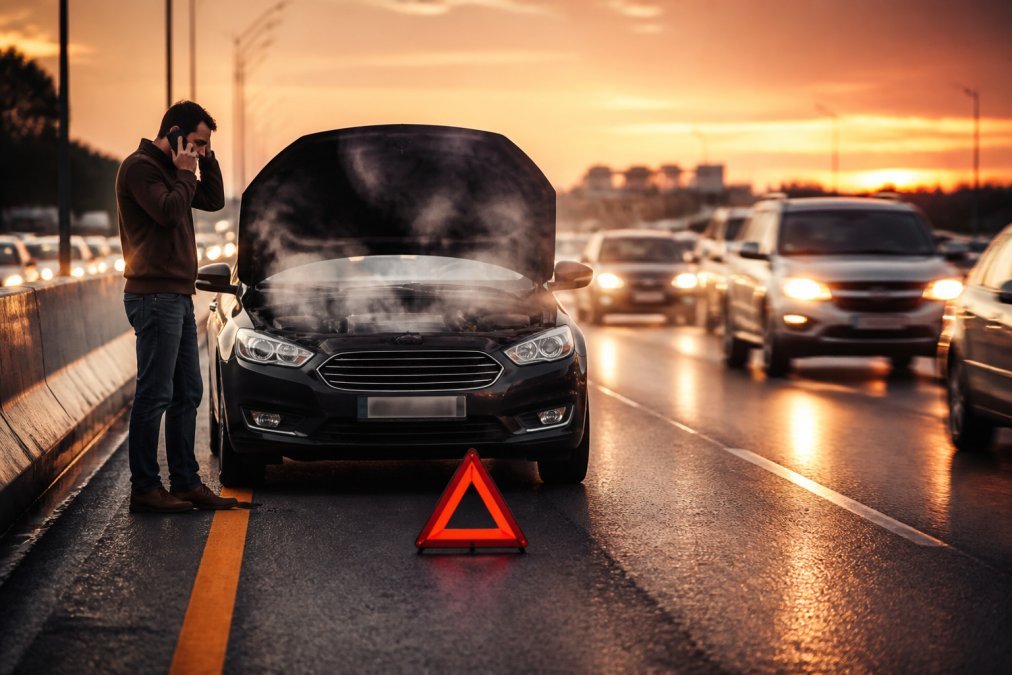
Step 1: Control the Vehicle and Get It Out of the Lane
Your car breaking down in a traffic lane is an emergency, so act fast but stay steady. Turn the wheel toward the shoulder and coast as far out of the lane as you can. If the engine quits, you still have steering and one or two good brake presses, so use them.
- Do not slam the brakes in the middle of the lane
- Aim for the shoulder, a parking lot, or any flat spot off the road
- If you cannot move, stay put and move to Step 2
Step 2: Turn On Hazard Lights and Signal Other Drivers
Flip on your hazard lights the moment you feel trouble. Hazards tell other drivers you are not moving at speed, and they buy you precious seconds. If it is dark, turn on your interior dome light too so your car is easier to see.
- Hazards on immediately, even before you stop
- Tap your brakes a few times to warn drivers behind you
- If you have an emergency triangle, set it out only when it is safe to walk
Should You Stay in the Car or Get Out? Exiting Safely When Your Car Breaks Down
The safest choice depends on where you are. If your car is in an active traffic lane, get out through the passenger side and move away from the road. If you are fully on the shoulder, staying buckled inside is usually safer. Research from CED Technologies on breakdown lane safety shows that drivers who exit in traffic lanes face serious risk from high-speed vehicles.
The Passenger-Side Exit Rule
Never step out into the driver’s side door when you are near traffic. Open the passenger-side door, check for a gap, and slip out away from oncoming traffic. This one habit prevents a huge share of secondary crashes.
Where to Stand While You Wait for Help
Stand behind the guardrail or well off the shoulder, never in front of or behind your car. A stranded driver standing in the wrong spot is hard to see and easy to hit. Keep your phone on you, not in the car.
Standing behind your vehicle on the shoulder is one of the most dangerous choices you can make. If another driver drifts, your car becomes the impact point, and you are directly in the path. Move to the far side of the guardrail instead.
Highway vs. City Street: Different Breakdown Protocols
A highway breakdown and a city-street breakdown call for different moves, and the difference is not just speed. On a highway or motorway, your goal is to get fully off the road and call for help from a safe spot. On a city street, you have more options, but traffic flow and blind spots still matter. Mastering these varied environments requires a calm approach, which is why developing consistent techniques for highway driving remains essential for maintaining composure when mechanical failure strikes.
| Situation | First Move | Where to Wait | Who to Call |
|---|---|---|---|
| Highway breakdown (I-44, US-169, Creek Turnpike) | Coast to right shoulder, wheels straight | Behind guardrail, uphill of your car if possible | Emergency towing Tulsa |
| City street breakdown (Peoria, 71st, Memorial) | Pull to curb or lot entrance | On sidewalk, behind a fixed object | Roadside assistance Tulsa |
| Intersection stall (Riverside and 21st, for example) | Call 911 first, then hazards | Far corner, off the roadway | Emergency services, then tow truck Tulsa |
| Night breakdown | Hazards plus dome light, stay in lit area | Under a streetlight or lit lot if reachable | Tow truck Tulsa |
A few local realities shape the call:
- On the Broken Arrow Expressway and I-44, the right shoulder is often narrow, and the left shoulder is worse. Get to the right if you can, but do not cross three lanes to do it.
- On surface streets like 15th, Lewis, or Sheridan, a stalled car at a red light is usually safer to leave in place with hazards on than to push through an intersection.
- In a tunnel or under a bridge, keep moving if the car will roll at all. Stopping under an overpass hides you from drivers cresting a hill.
- In heavy rain on the IDL, standing water can hide the shoulder edge. Aim for the curb line, not the grass, so you do not drop a wheel.
Highway rule: get off the road or stay buckled in. City rule: get out of the lane, then get out of the car on the passenger side. Night rule: add light and distance. Same three questions every time, where is the car, where am I, who is coming.
Emergency Towing Tulsa: When to Call and What to Expect
Call for emergency towing Tulsa when your car cannot move under its own power or is blocking traffic. A tow truck Tulsa dispatches to your location, loads your vehicle, and hauls it to a shop or your home. At Neptune Towing, we run 24/7 emergency service and use damage-free flatbed equipment for every job.
Here is what to have ready when you call:
- Your exact location, including the nearest cross street or mile marker
- Your vehicle’s make, model, and whether it is an EV or Tesla
- Whether you are in a lane, on the shoulder, or in a lot
- A callback number and where you want the car taken
How to Jump Start a Dead Battery Safely
A dead battery is one of the most common reasons a car breaks down, and a jump start service often gets you moving again in minutes. You need jumper cables and a second running vehicle, or a portable jump pack. Connect positive to positive first, then negative to a bare metal ground on the dead car, not the battery post.
- Red clamp to the dead battery’s positive terminal
- Red clamp to the good battery’s positive terminal
- Black clamp to the good battery’s negative terminal
- Black clamp to bare metal on the dead car’s engine block
Never connect the final black clamp to the dead battery’s negative post. That last connection can spark, and a battery can vent explosive gas. Ground it to bare metal on the engine instead. It is a small habit that keeps a simple jump start from turning into a burn.
Roadside Assistance Tulsa: Services That Can Save You a Tow
Roadside assistance Tulsa covers the small problems that do not always need a tow. A lockout service gets you back in your car. A tire change swaps your flat for the spare. Fuel delivery brings gas to a driver who ran dry. A jump start service handles a dead battery.
Nighttime, Bad Weather, and EV Breakdowns: Special Considerations
Night, bad weather, and electric vehicles each change the playbook, and most guides treat all three the same as a sunny afternoon. They are not.
Nighttime: Visibility Is the Whole Game
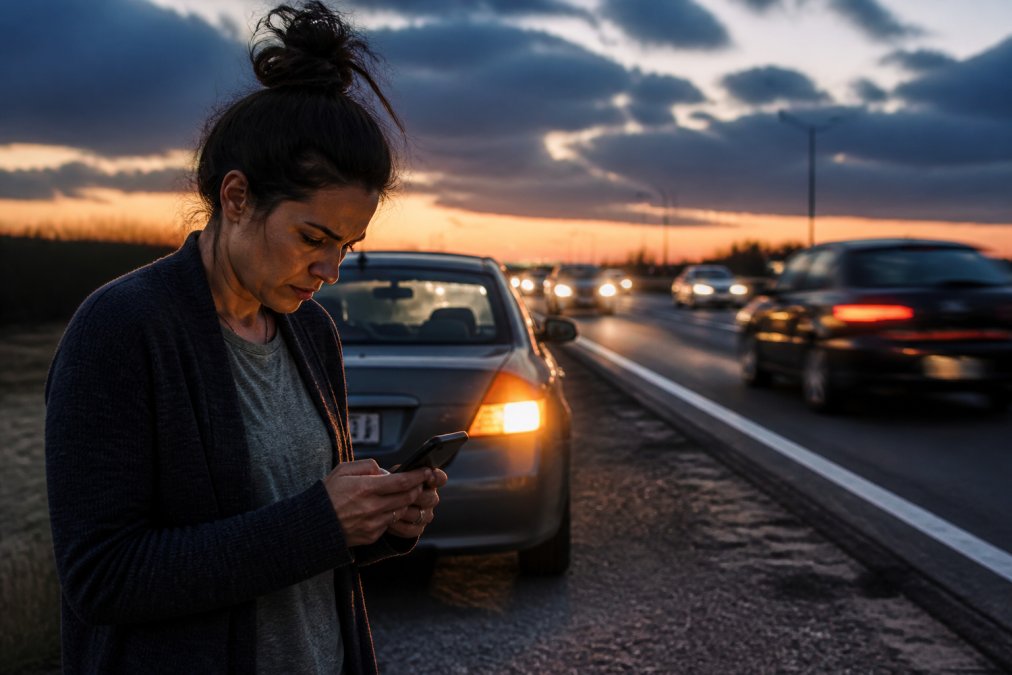
At night, drivers see your hazard lights before they see your car, and they see you last of all. That order matters.
- Leave hazards and the dome light on. The dome light makes the cabin glow, which reads as “occupied vehicle” to approaching drivers.
- If you can reach a lit parking lot, gas station, or storefront on the same side of the road, walk there instead of waiting on a dark shoulder. A tow truck Tulsa dispatcher can find you at an address faster than at “somewhere on US-169.”
- Do not use flares unless you already carry them and know how to place them. A flare in the wrong spot starts a grass fire on an Oklahoma shoulder in August.
- Reflective gear beats a phone flashlight. A phone light blinds oncoming drivers more than it warns them.
Bad Weather: Rain, Ice, and Wind
In rain, snow, or ice, move even farther from the road and never stand in a blind spot. Two local patterns are worth knowing:
- On ice, other drivers lose control before they see you. Get behind a barrier, not just off the shoulder.
- In a downpour, standing water can hide a drop-off at the shoulder edge. Step carefully and keep your phone in a pocket, not your hand.
- In high wind, do not open the hood to “check things.” A hood that catches a gust can slam on your hands or block your view of traffic.
EV and Tesla Breakdowns: What Is Different
Electric vehicles and Teslas should never be towed with two wheels on the ground. Doing so can damage the drivetrain, and repairs get expensive fast. Flatbed towing keeps all four wheels off the road, which is the safe way to move an EV.
- Limp mode. Many EVs drop into a reduced-power mode when the battery is low or a fault is detected. You may still be able to creep to a shoulder or a lot. Use that window; do not wait for the car to shut down in a lane.
- The 12-volt battery. Even a fully charged EV has a small 12-volt battery that runs the computers, lights, and door locks. When it fails, the car can act completely dead even with a full main pack. A jump start service can sometimes get you moving, but not always.
- Charging faults. If a charging session fails and the car will not shift out of park, that is usually a software or handshake issue, not a dead battery. A tow is often the only safe move.
- Regenerative braking. When an EV is off, you lose most of the regen feel. The car coasts differently than a gas car, so plan your stop earlier.
If you drive an EV, keep a small note in your glovebox with your tow mode instructions and the location of the tie-down points. Handing that to the driver saves time and protects the underside of your car.
Frequently Asked Questions
Should I stay in my car if it breaks down in traffic?
It depends on where you are. If your car is in an active traffic lane and you cannot move it, exit through the passenger-side door as soon as it is safe, then stand behind a guardrail or well off the roadway. If you are on the shoulder and traffic is moving normally, staying buckled inside with your seatbelt on is usually safer than standing near the road. NHTSA reports that 3,208 people were killed in crashes involving distracted drivers in 2024, so never assume oncoming traffic sees you.
How do I signal for help if my car breaks down in a lane?
Turn on your hazard lights immediately. If you carry an emergency triangle or reflective gear, place it behind your vehicle when it is safe to do so. Call 911 if you are in an active lane or intersection. If you are on the shoulder, call a non-emergency line or a local towing company like Neptune Towing. Do not stand behind your car waving your arms, as this puts you in the path of oncoming traffic.
Is it safe to push a car out of a traffic lane?
Only if you can do it without stepping into traffic and the vehicle is light enough to move. Pushing a car across an active lane is extremely dangerous. If your car is stalled in a lane and you cannot coast it to the shoulder, stay inside with your seatbelt on, call 911, and wait for emergency towing. Do not attempt to push alone, and never push from the driver’s side where you are exposed to passing vehicles.
When should I call for emergency towing instead of roadside assistance?
Call for emergency towing Tulsa when your vehicle cannot be driven safely, is blocking a lane, or has damage that makes it unsafe to move. Roadside assistance Tulsa handles jump starts, lockouts, tire changes, and fuel delivery if those solve the problem on the spot. If your car will not start after a jump, has a blown tire you cannot change, or is in an intersection, request a tow truck Tulsa immediately and let the dispatcher know your exact location.