
Table of Contents
- Your First Actions When Your Car Breaks Down at Night
- Making Yourself Visible and Safe on the Highway Shoulder
- How to Jump Start a Dead Battery at Night
- When to Call for Roadside Assistance in Tulsa
- Emergency Towing in Tulsa When a Jump Start Won’t Help
- Personal Safety While Waiting for Help
- Winter Breakdowns and Cold Weather Emergencies
- Frequently Asked Questions
Last Updated: September 3, 2026
Your First Actions When Your Car Breaks Down at Night
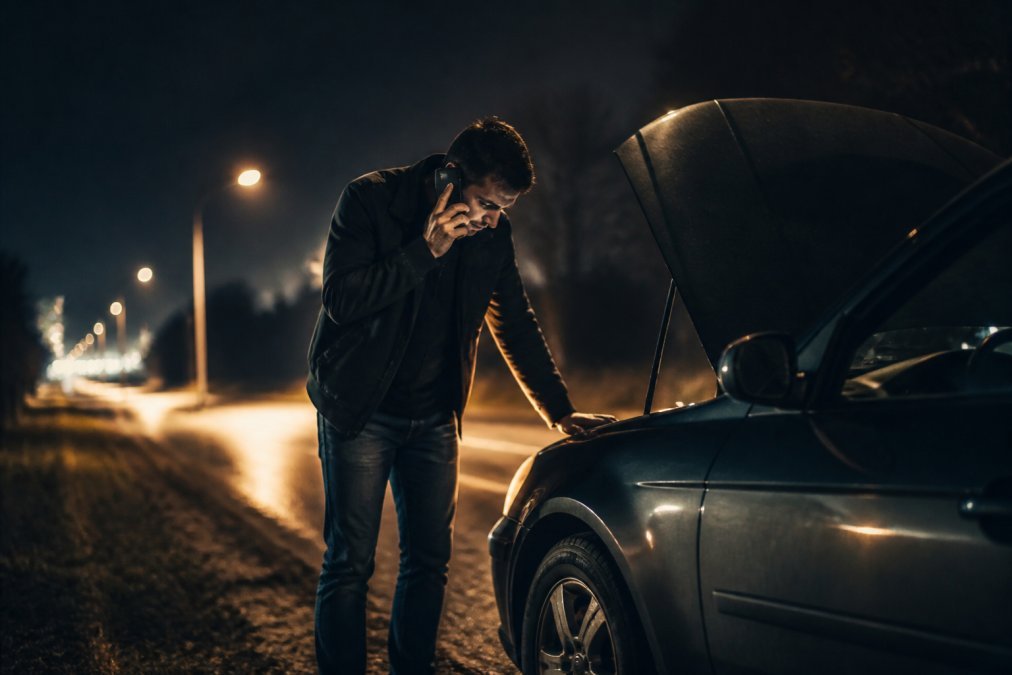
When your car breaks down at night, panic is the first threat. The moments after your engine dies are critical, what you do in the next 60 seconds determines your safety and the safety of oncoming traffic.
Stay calm and stay visible. A disabled vehicle on a dark highway is nearly invisible to drivers traveling at 60+ mph. You have seconds to make yourself and your car obvious to traffic before the next vehicle crests the hill behind you.
Turn on your hazard lights immediately
Your hazard lights are your first line of defense. The moment you realize your car isn’t responding, activate your hazards. Don’t wait. Hazard lights tell every driver behind you that something is wrong. At night, a stationary vehicle without lights looks like an obstacle. With hazard lights flashing, it becomes a warning. Even if your engine is completely dead, hazard lights draw power from your battery independently.
Keep your hazard lights on the entire time you’re stranded, right up until the tow truck arrives.
Pull off the road safely
Getting your vehicle completely off the travel lanes is the second priority. If your car is still moving, steer it as far from traffic as possible. Aim for the shoulder or breakdown lane. Ease off the accelerator and apply gradual pressure to the brakes. Once you’re off the main road, keep your wheels pointed straight.
Stay in your vehicle or exit safely
If you’re on a busy highway in the middle of the night, your vehicle is your safest shelter. It’s visible, enclosed, and keeps you away from traffic. Stay inside with your doors locked and hazard lights on. This is especially important if you’re stranded on I-44, the Broken Arrow Expressway, or any major highway through the Tulsa area.
If your car is in an unsafe location, partially blocking a lane, on a blind curve, or with no shoulder, you may need to exit and move away from traffic. Move at least 100 feet from your vehicle and stand on the side away from traffic (aaa.com). Never stand between your disabled vehicle and oncoming traffic.
Making Yourself Visible and Safe on the Highway Shoulder
Visibility at night is everything. Your hazard lights help, but they’re not enough. Oncoming drivers need multiple visual cues that something is wrong ahead.
Use reflective triangles or emergency flares
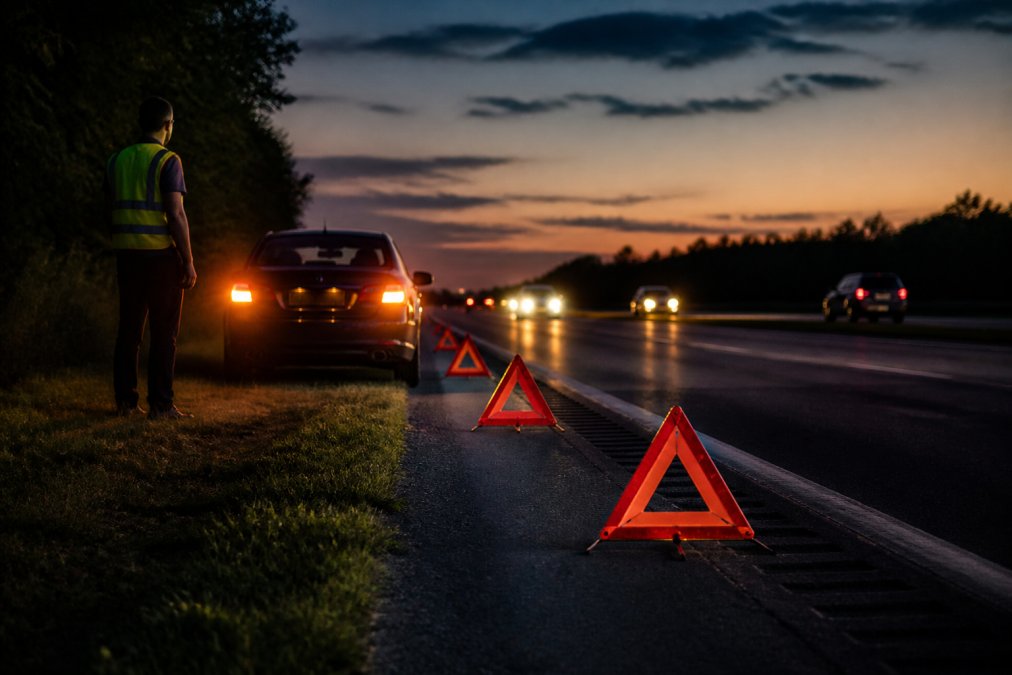
Reflective warning triangles are the gold standard for nighttime vehicle breakdowns. These bright red or orange triangles reflect light from approaching vehicles, creating a visible warning well before drivers reach your disabled car.
If you have warning triangles, place them on the road behind your car, starting about 10 feet back and spacing additional triangles at 10-foot intervals. This gives approaching drivers time to see the warning and change lanes or slow down. On a highway where traffic is moving 65+ mph, you want that warning visible from at least 100 feet away (aaa.com).
Emergency flares work similarly. If you have flares, light one and place it safely on the shoulder. Never hold a lit flare in your hand while standing near traffic. If you’re stranded without triangles or flares, use your phone’s flashlight or any bright light source to signal approaching traffic.
Stay visible to oncoming traffic
Your position matters as much as your vehicle’s visibility. If you’re standing on the shoulder, wear light-colored clothing or use a flashlight to make yourself visible. At night, a person in dark clothing standing on a dark shoulder is nearly invisible until a driver is almost upon you.
If you have a reflective vest, put it on. If not, use your phone’s flashlight pointed toward oncoming traffic. The goal is to be seen from a distance. Never stand in the travel lane. Stay on the shoulder, preferably on the side away from traffic.
How to Jump Start a Dead Battery at Night
A dead battery is the most common reason for a vehicle breakdown. If your car won’t start but all the lights and electronics work, you likely have a dead battery, and a jump start might get you back on the road.
Check if a jump start is the right solution
Before you attempt a jump start, confirm that a dead battery is actually your problem. Turn on your headlights. Do they work? If yes, your battery has some charge. Try the dashboard lights, interior lights, and windshield wipers. If these electrical systems work, your battery is probably fine and your problem is elsewhere.
If your lights don’t work at all or are very dim, you probably have a dead battery. Jump starts only work if your battery can accept a charge. If your battery is old, damaged, or completely dead, a jump start might not help.
Safe steps for a roadside jump start
If you decide to attempt a jump start, find another driver willing to help. Position the helper’s vehicle close to yours, but not touching. Turn off both engines. Attach the red jumper cable clamp to the positive terminal of your dead battery (marked with a + sign). Attach the other red clamp to the positive terminal of the helper’s battery. Attach the black clamp to the negative terminal of the helper’s battery (marked with a – sign). Attach the other black clamp to an unpainted metal surface on your engine block, not directly to the negative terminal of your dead battery. safe night transport.
Start the helper’s engine and let it run for 2-3 minutes (aaa.com). Then start your engine. If it starts, let both engines run for a minute, then carefully disconnect the cables in reverse order. Drive for at least 20 minutes to recharge the battery before turning off the engine. If your car doesn’t start after 3-5 minutes of trying, call for professional roadside assistance.
When to Call for Roadside Assistance in Tulsa
Not every breakdown can be fixed on the roadside. If your car won’t start after a jump attempt, if you have a mechanical failure, or if you’re not comfortable troubleshooting in the dark, it’s time to call for help. Neptune Towing provides 24/7 roadside assistance throughout the Tulsa area, including Bixby, Broken Arrow, and surrounding communities.
What information to have ready
When you call for roadside assistance, have these details ready: your vehicle’s location (highway name and mile marker, or street address), your vehicle’s make and model, a brief description of the problem, and your phone number. If you’re on I-44 near the Riverside area, say so. If you’re on the Broken Arrow Expressway near 71st Street, provide that detail.
If you know your vehicle’s year, color, and license plate number, that helps the driver identify you quickly. If you’re in a dangerous location or feel unsafe, tell the dispatcher immediately.
Sharing your GPS location with the dispatcher
Modern roadside assistance dispatchers use GPS to locate you. Most smartphones have a GPS feature that displays your latitude and longitude. Open your phone’s map application and note the coordinates displayed. When you call, you can provide these numbers to the dispatcher.
If your phone battery is low, don’t spend time looking for coordinates. Just describe your location clearly. A dispatcher can locate you by your cell phone signal if necessary. The key is to stay on the phone with the dispatcher until help arrives.
Emergency Towing in Tulsa When a Jump Start Won’t Help
Some breakdowns can’t be fixed at the roadside. If your engine is smoking, your transmission is failing, your vehicle is in a ditch, or you’ve been in a collision, you need a tow truck.
Mechanical failure and serious breakdowns
A mechanical failure means your vehicle can’t be safely driven. A seized engine, failed transmission, broken axle, or fuel system problem all require towing. A collision that damages the frame, suspension, or steering also requires a tow truck.
If you’re involved in a collision on a Tulsa-area highway, don’t attempt to drive away unless the damage is purely cosmetic. A vehicle with suspension damage, brake damage, or steering damage is dangerous. Call for emergency towing immediately.
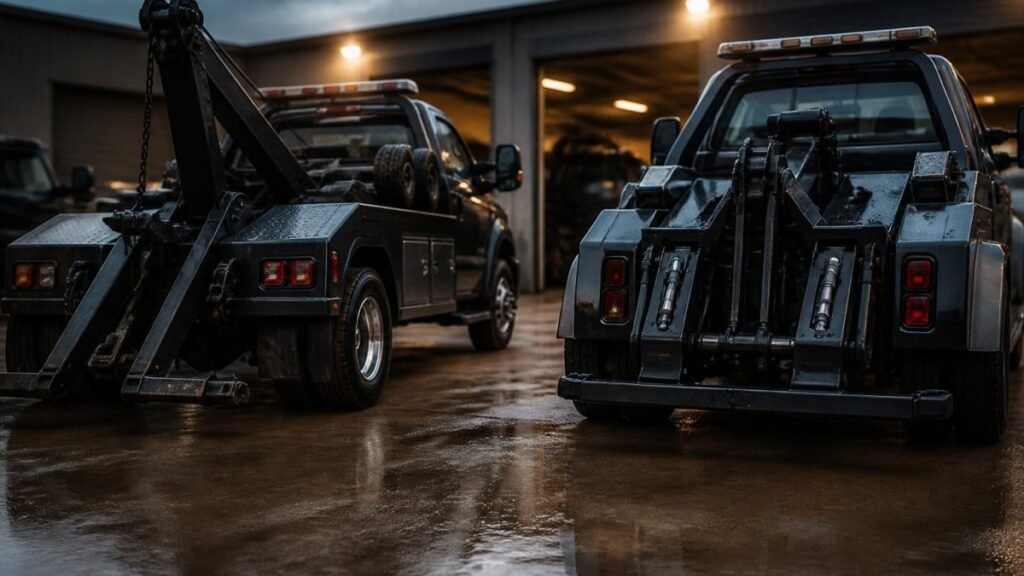
Neptune Towing specializes in damage-free flatbed towing, which is critical for vehicles with mechanical damage. A flatbed tow truck lifts your entire vehicle onto a platform, rather than dragging it on two wheels. This protects your vehicle’s transmission, suspension, and steering from further damage during transport.
Why owner-operated towing matters at night
When you’re stranded at night and your vehicle needs to be towed, you want a towing company you can trust. Owner-operated towing companies like Neptune Towing provide accountability that larger chains don’t. When you call Neptune Towing, you’re dealing with a local business owner who cares about your experience and your vehicle’s safety.
An owner-operator is invested in their reputation. They’re directly responsible for your service, which means they’re more likely to answer quickly, provide honest communication, and handle your vehicle with care. Neptune Towing has been serving the Tulsa area since 2019, building trust with drivers by providing reliable, professional towing and roadside assistance. When your car breaks down at night, you deserve a towing company that puts your needs first, not a company that profits from impounds or storage fees.
Personal Safety While Waiting for Help
The time between your breakdown and the arrival of the tow truck is when you’re most vulnerable. Managing this time safely means managing both your emotions and your awareness.
Panic is a real threat when you’re stranded at night. Take three deep breaths. You’ve called for help. Help is on the way. Your situation is temporary.
Stay in your vehicle with the doors locked. Your vehicle provides shelter, visibility, and a barrier between you and traffic. Keep your hazard lights on and your interior light on so you’re visible to the arriving tow truck.
If someone approaches your vehicle and you don’t recognize them, don’t open your window or unlock your doors. A tow truck driver will have a company vehicle, uniform, and identification. If you’re unsure, call the towing company back and confirm that help has arrived before opening your door.
Keep your phone charged and within reach. If your battery is low, turn off unnecessary apps and dim the screen to conserve power.
Winter Breakdowns and Cold Weather Emergencies
Winter breakdowns in the Tulsa area present additional challenges. Cold temperatures make batteries less effective, thicken engine oil, and can cause fuel lines to freeze.
If your car breaks down in winter, stay in your vehicle with the engine off. Running the engine in a stationary vehicle can allow carbon monoxide to accumulate inside the cabin. Instead, use your vehicle’s heater sparingly and bundle up with whatever clothing you have available.
Keep moving to maintain circulation. Periodically get out and walk around (staying on the shoulder, away from traffic) to keep your blood flowing. If you have blankets, extra clothing, or an emergency kit in your vehicle, use it.
In winter, a dead battery is even more likely because cold reduces battery efficiency. A jump start is worth attempting, but be prepared for the possibility that your battery won’t hold a charge once the engine is running. If you’re stranded in freezing temperatures, professional towing is your best option.
When your car breaks down at night, you need a towing company that understands the urgency and treats your vehicle with care. Neptune Towing is owner-operated and available 24/7 throughout the Tulsa area, including Bixby, Broken Arrow, Glenpool, and surrounding communities. We specialize in damage-free flatbed towing, jump starts, lockout service, and emergency roadside assistance. Call Neptune Towing at (539) 292-3074 when you need help, we’ll get you and your vehicle to safety quickly and professionally.
=== FAQ ANSWERS (audit these too, same rules) ===
[1] Q: What should I do first if my car breaks down at night on the highway?
A: Turn on your hazard lights immediately, then carefully pull off the road onto the shoulder as far as possible. Stay inside your vehicle with doors locked unless it’s unsafe to do so. Turn off the engine and activate your emergency brake. If you’re on a busy highway, stay in the car and call for roadside assistance or emergency services. Your visibility and safety come first.
[2] Q: How do I know if I need a jump start or if I should call for emergency towing in Tulsa?
A: If your engine won’t turn over and your dashboard lights are dim or dead, a dead battery is likely. A jump start may work if you have jumper cables and another vehicle nearby. However, if your engine cranks but won’t start, if you smell burning or see smoke, or if your vehicle has mechanical damage, call for emergency towing instead. An owner-operated towing service can assess the situation safely and get your vehicle to a repair facility without further damage.
[3] Q: How do I stay safe while waiting for a tow truck at night?
A: Stay inside your locked vehicle with the doors closed. Keep your hazard lights on and use reflective triangles or flares to warn other drivers. If someone approaches your car and you feel unsafe, do not unlock your doors. Call 911 if needed. Keep your mobile phone charged and share your GPS location with the dispatcher. Avoid walking along the highway or trying to flag down strangers. Wait for professional help to arrive.
[4] Q: What’s the safest way to jump start a dead battery at night?
A: Only attempt a jump start if you have jumper cables and another vehicle. Position both cars close but not touching, turn off both engines, and connect the red cable to the dead battery’s positive terminal first, then to the good battery’s positive terminal. Connect the black cable to the good battery’s negative terminal, then to unpainted metal on the disabled vehicle’s engine. Start the good car, wait a few minutes, then start yours. If this doesn’t work after two attempts, call for roadside assistance. Never jump start in heavy rain or if you see battery damage.
Frequently Asked Questions
What should I do first if my car breaks down at night on the highway?
Turn on your hazard lights immediately, then carefully pull off the road onto the shoulder as far as possible. Stay inside your vehicle with doors locked unless it’s unsafe to do so. Turn off the engine and activate your emergency brake. If you’re on a busy highway, stay in the car and call for roadside assistance or emergency services. Your visibility and safety come first.
How do I know if I need a jump start or if I should call for emergency towing in Tulsa?
If your engine won’t turn over and your dashboard lights are dim or dead, a dead battery is likely. A jump start may work if you have jumper cables and another vehicle nearby. However, if your engine cranks but won’t start, if you smell burning or see smoke, or if your vehicle has mechanical damage, call for emergency towing instead. An owner-operated towing service can assess the situation safely and get your vehicle to a repair facility without further damage.
How do I stay safe while waiting for a tow truck at night?
Stay inside your locked vehicle with the doors closed. Keep your hazard lights on and use reflective triangles or flares to warn other drivers. If someone approaches your car and you feel unsafe, do not unlock your doors. Call 911 if needed. Keep your mobile phone charged and share your GPS location with the dispatcher. Avoid walking along the highway or trying to flag down strangers. Wait for professional help to arrive.
What’s the safest way to jump start a dead battery at night?
Only attempt a jump start if you have jumper cables and another vehicle. Position both cars close but not touching, turn off both engines, and connect the red cable to the dead battery’s positive terminal first, then to the good battery’s positive terminal. Connect the black cable to the good battery’s negative terminal, then to unpainted metal on the disabled vehicle’s engine. Start the good car, wait a few minutes, then start yours. If this doesn’t work after two attempts, call for roadside assistance. Never jump start in heavy rain or if you see battery damage.