
Table of Contents
- When Your Vehicle Needs Professional Recovery
- Your Car Is Stuck in a Ditch
- Understanding Winch-Out Service for Stuck Vehicles
- Roadside Assistance vs. DIY Recovery Attempts
- When Emergency Towing Is Your Only Safe Option
- What to Do While Waiting for Professional Help
- Frequently Asked Questions
Last Updated: October 10, 2026
When Your Vehicle Needs Professional Recovery
Your car slides off the road during a rainstorm. You’re stuck in a ditch on the outskirts of Tulsa, and your wheels spin uselessly in the mud. This is the moment when signs you need professional recovery become crystal clear. Not every vehicle problem requires a tow truck, but some situations are genuinely dangerous to handle alone.
At Neptune Towing, we respond to recovery calls across Tulsa, Bixby, Broken Arrow, and surrounding communities every single day. We’ve seen drivers try to self-recover vehicles from ditches, embankments, and tight spots, and we’ve watched those attempts go wrong. The difference between a quick professional recovery and a costly mistake often comes down to recognizing when you need help.
Professional vehicle recovery isn’t just about having the right equipment. It’s about knowing how to use that equipment safely, understanding the angles and forces involved, and protecting your vehicle from damage during extraction. When your car is truly stuck, the cost of professional help is always less than the cost of frame damage, suspension damage, or injury.
If your wheels are spinning, your vehicle is tilted at an angle, or you’re in any position where you can’t drive out under your own power, stop trying. Call a professional recovery service. Every minute you spend attempting extraction can cause more damage.
Your Car Is Stuck in a Ditch
A ditch is one of the most common situations where drivers need professional help. Your vehicle slides off the shoulder, drops into a roadside depression, and suddenly you’re looking at a steep angle that your car can’t climb out of.
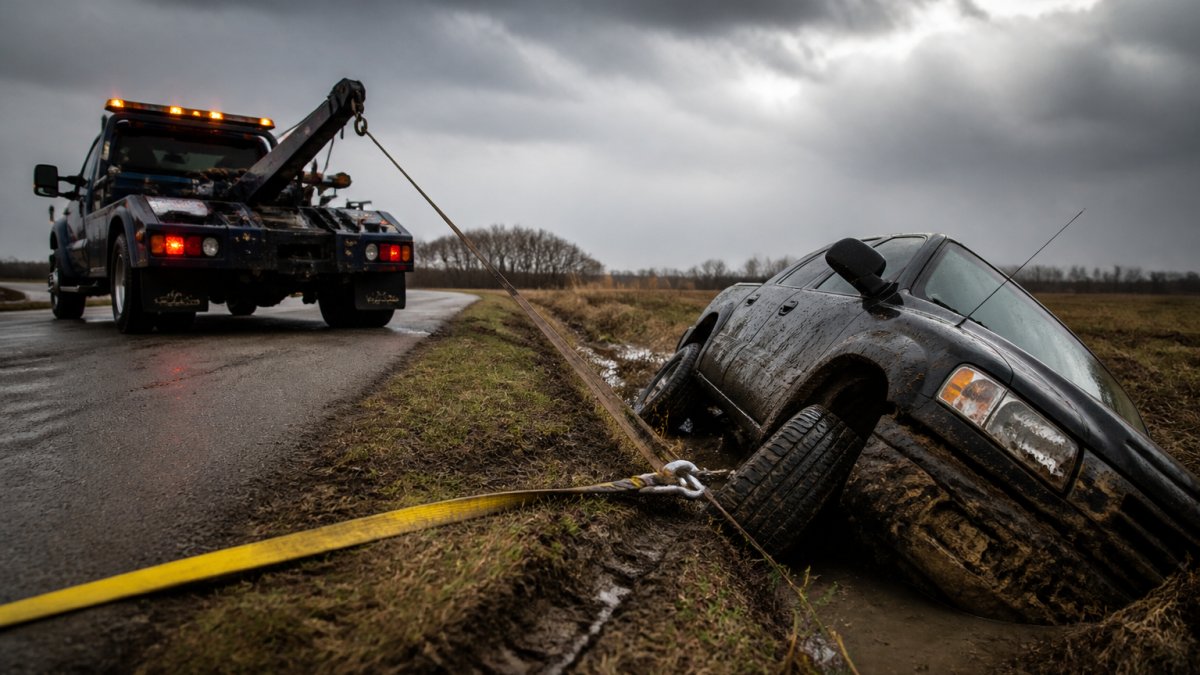
The problem with ditches is that they’re deceptive. From inside your car, the angle doesn’t feel that steep. You think you can gun the engine and drive out.
Ditch recoveries require the right approach. A professional towing service uses recovery straps, winches, and proper anchoring to pull your vehicle straight up and out, not at an angle that would damage the suspension or frame. The angle matters.
If you’re in a ditch anywhere from central Tulsa to the outer communities like Sapulpa or Owasso, this is exactly the situation where you need professional vehicle recovery from someone who knows how to do it safely.
Attempting to rock your vehicle out of a ditch by shifting between drive and reverse can damage your transmission. Stop after two or three attempts and call for help.
Understanding Winch-Out Service for Stuck Vehicles
When someone is struggling with substance use, the signs that professional help is needed often come in layers. Early warning signs, increased tolerance, failed attempts to cut back, or using more frequently than intended, can feel manageable at first.
A professional assessment is the bridge between self-awareness and treatment. During an assessment, a clinician screens for the severity of use, withdrawal risk, medical complications, mental health conditions, and psychosocial factors that all influence what level of care is appropriate. This isn’t a judgment call.
Here’s what happens during a confidential professional assessment:
- Intake screening: Questions about substance use history, frequency, amount, and method of use
- Withdrawal risk evaluation: Assessment of whether medically supervised detoxification is necessary to prevent dangerous withdrawal symptoms
- Medical history review: Existing health conditions, medications, and any complications from substance use
- Mental health screening: Screening for depression, anxiety, trauma, or other conditions that often co-occur with substance use disorder
- Psychosocial assessment: Family situation, employment, housing stability, and social support
- Level of care recommendation: Based on all findings, the clinician recommends outpatient, intensive outpatient, residential, or medically supervised withdrawal care
The assessment process is confidential. Clinicians are bound by privacy laws, including the Health Insurance Portability and Accountability Act (HIPAA) and 42 CFR Part 2, which provides additional privacy protections for substance-use treatment records. You can speak openly without fear that information will be shared with employers, family members, or law enforcement.
Many people delay seeking an assessment because they’re uncertain whether their situation is “serious enough.” The truth is, an assessment doesn’t commit you to anything. It’s information-gathering. It answers the question of whether professional help is needed and, if so, what kind.
Roadside Assistance vs. DIY Recovery Attempts
One of the biggest barriers to seeking professional recovery is not knowing when to seek it. People often wait for a crisis, an overdose, a legal consequence, or complete loss of control, before calling for help. But waiting for crisis is dangerous and unnecessary.
Urgent medical danger vs. signs to schedule an assessment are two different thresholds, and knowing the difference can save a life.
Seek emergency medical help immediately if:
- Overdose: Loss of consciousness, unresponsiveness, blue lips or fingernails, difficulty breathing, or seizures. Call 911. Most states have Good Samaritan laws that protect people who call for help during an overdose from criminal prosecution for drug possession.
- Severe withdrawal: Hallucinations, confusion, rapid heart rate, high fever, or severe tremors. Alcohol and benzodiazepine withdrawal can be life-threatening. Seek emergency care.
- Suicidal thoughts or self-harm: If substance use has led to thoughts of suicide or self-harm, call the 988 Suicide and Crisis Lifeline (call or text 988) or go to the nearest emergency room.
- Severe medical complications: Chest pain, difficulty breathing, or signs of infection (abscesses, endocarditis from injection drug use). These require immediate medical attention.
Schedule a professional assessment if you or a loved one:
- Has tried to cut back or quit but can’t stay stopped
- Experiences cravings or preoccupation with obtaining or using substances
- Needs more of the substance to feel the same effect (tolerance)
- Continues using despite knowing it’s causing harm
- Has neglected work, school, family, or other responsibilities
- Has experienced relationship conflict or broken trust due to use
- Feels anxious, depressed, or emotionally unstable without the substance
- Is using to cope with stress, trauma, or emotional pain
An assessment doesn’t mean you’re “bad enough” or that you’ve lost control completely. It means you’ve recognized a pattern that warrants professional evaluation. Many people benefit from treatment before hitting rock bottom.
Common barriers to seeking help, and how to address them:
- Cost and insurance: Ask providers directly about sliding-scale fees, payment plans, or whether they accept your insurance. Many treatment facilities have financial counselors who can explain coverage options. The SAMHSA National Helpline (1-800-662-4357) is free, confidential, and can connect you to local treatment resources regardless of ability to pay.
- Fear of judgment: Treatment providers are trained to meet people where they are without judgment. Their job is to help, not to shame.
- Uncertainty about what to expect: Knowing what happens during an assessment (see the section above) reduces fear and makes the first call easier.
- Concern about privacy: Treatment records are protected by federal law. Your employer, family, or others cannot access this information without your consent.
- Worry about time commitment: Outpatient treatment can often fit around work and family. Intensive outpatient and residential options exist for people who need more structure.
The decision to seek professional recovery is not a sign of weakness. It’s a sign of clarity. You’ve recognized a problem and you’re taking action to address it. That takes courage.
When Emergency Towing Is Your Only Safe Option
Some situations go beyond recovery. Your vehicle isn’t just stuck, it’s in danger. Maybe it’s on the shoulder of a busy highway. Maybe it’s blocking traffic. Maybe the vehicle itself is damaged and unsafe to drive.
This is when you need emergency towing, not just recovery.
Emergency towing means getting your vehicle off the road and to safety as quickly as possible. Speed matters in these situations. A vehicle blocking a lane on I-44 during rush hour creates a hazard for every driver behind it. A car that’s been hit and damaged may not be safe to drive, even if it starts.
Emergency towing services are available 24/7 in the Tulsa area. When you need help immediately, emergency towing is the service that gets to you fast.
The difference between emergency towing and standard recovery:
- Response time: Emergency calls are prioritized for immediate dispatch
- Traffic safety: The goal is to clear the roadway and prevent secondary accidents
- Vehicle condition: Your car may be damaged, disabled, or unsafe to drive
- Destination: Your vehicle goes directly to a repair facility or safe location
If you’re on a highway, in heavy traffic, or in any situation where your vehicle is a hazard, call for emergency towing. Don’t wait. Don’t try to drive it. Get it off the road and to safety.
What to Do While Waiting for Professional Help
You’ve called for help. Now what? The next 15 to 30 minutes matter for your safety and the safety of other drivers.
First, get yourself to safety:
- Turn on your hazard lights immediately
- If you’re on a highway, exit the vehicle and move away from traffic
- If you’re in a ditch or off-road, stay in your vehicle with the doors locked if you feel unsafe
- Keep your phone charged and your location information ready
Communicate clearly with the dispatcher:
- Describe your exact location (highway name, mile marker, nearby landmarks)
- Explain what happened (stuck in ditch, disabled engine, accident)
- Note any hazards (traffic, weather, fuel leak)
- Provide your vehicle make, model, and color
Prepare information for the tow operator:
- Have your insurance information ready
- Know whether your vehicle is front-wheel drive, rear-wheel drive, or all-wheel drive (this affects how it’s towed)
- If you have a Tesla or electric vehicle, mention it, EV towing requires special equipment to prevent drivetrain damage
Stay calm and wait in a safe location:
- Don’t attempt further recovery attempts while waiting
- Don’t stand in the roadway
- Stay visible so the tow truck can find you
The waiting period is often the hardest part. You’re stranded, frustrated, and wondering how long this will take. Professional towing services in the Tulsa area prioritize quick response times because we know how stressful this is. When you call Neptune Towing, you’re calling a local, owner-operated business that treats your situation with urgency.
Save your local towing service number in your phone before you need it. When you’re stuck on the side of the road, you won’t want to search for a tow truck, you’ll want to call someone you already know and trust.
Getting stranded is stressful, but knowing when to call for professional help makes the situation manageable. If your vehicle is stuck, disabled, or in any position where you can’t safely drive it, signs you need professional recovery are clear. Neptune Towing serves Tulsa, Bixby, Broken Arrow, Glenpool, and surrounding communities with damage-free flatbed towing, emergency recovery, and 24/7 roadside assistance. When you need a tow truck in Tulsa or vehicle recovery service you can trust, call (539) 292 3074. We’re here to help.
Frequently Asked Questions
How do I know if my vehicle needs professional recovery versus a simple tow?
If your vehicle is stuck in mud, a ditch, or off-road terrain, or if it won’t start and can’t be safely moved by hand, you need professional vehicle recovery. Signs include being unable to move the vehicle forward or backward, deep mud or water involvement, or the vehicle being on an unstable slope. A simple tow works for vehicles that can be moved onto a flatbed; recovery means extracting a vehicle from a difficult position using specialized equipment like winches.
Is it safe to use a strap or chain to pull a stuck vehicle myself?
No. Improper recovery attempts with straps or chains risk serious injury, vehicle damage, and liability. Straps can snap under load, chains can break and whip, and incorrect attachment points can tear suspension or frame components. Professional winch-out service uses rated equipment, proper anchor points, and trained operators to extract vehicles safely. What seems like a quick fix can result in thousands in additional damage.
What should I tell a towing company when requesting vehicle recovery?
Provide your exact location (highway mile marker, road name, or landmarks), vehicle description, whether the engine starts, which direction the vehicle is stuck (nose down, on its side, deep in mud), and any hazards nearby (traffic, water, steep drop-off). Tell them if the vehicle is on private or public property. The more detail you give, the faster the recovery team can arrive with the right equipment and plan the safest extraction method.
Can a flatbed tow truck recover a vehicle from mud or a roadside shoulder?
A flatbed tow truck can transport a recovered vehicle, but extracting it from mud or difficult terrain usually requires a wrecker truck with a winch first. The winch-out service pulls the vehicle to solid ground, then the flatbed transports it. Some recovery situations need both pieces of equipment. Professional recovery teams assess the terrain and vehicle position to determine whether winching, air bags, or other methods are needed before transport begins.