
Table of Contents
- Why Tesla Towing Requires Special Care
- Understanding Tow Mode and How to Enable It
- Flatbed Towing for Electric Cars: The Right Way
- Damage-Free EV Towing: What Professional Service Looks Like
- EV Towing in Tulsa: What Local Drivers Need to Know
- Towing a Tesla with a Dead Battery: Real-World Scenarios
- Preparing Your Tesla for Safe Towing Transport
- When You Need Tesla Towing in Tulsa, Bixby, or Broken Arrow
Tesla Towing: A Safety Guide for Tulsa EV Owners
Last Updated: July 25, 2026
Electric vehicles are becoming more common on Tulsa’s roads every year, and Tesla towing requires a completely different approach than traditional vehicles. At Neptune Towing, we’ve handled hundreds of electric vehicle transports across Tulsa, Broken Arrow, Bixby, and surrounding communities. The reality is this: most standard towing methods will damage your Tesla. Wheel lifts, dollies, and improper loading procedures harm the electric drivetrain in ways that traditional cars can withstand. This guide walks you through everything Tulsa EV owners need to know about Tesla towing, from enabling Tow Mode to verifying your tow operator actually knows what they’re doing.
Why Tesla Towing Requires Special Care
Your Tesla isn’t like the pickup truck your neighbor drives down 71st Street. The electric drivetrain, battery pack, and all-wheel drive system require handling that respects how these vehicles are engineered. A single mistake during transport can cost you thousands in repairs.
When a tow truck uses a wheel lift on a Tesla, it’s dragging one set of wheels while the other set is suspended. For an EV with a complex all-wheel drive system, this creates torque and strain that damages the transmission and suspension. The battery pack, mounted low in the vehicle frame, can also be compromised if the vehicle isn’t loaded properly.
Damage-free towing for electric vehicles is absolutely possible when the right equipment and procedures are used. Flatbed towing is the only method that keeps all four wheels off the ground and protects the entire vehicle structure.
Electric Drivetrain Vulnerability
Your Tesla’s drivetrain is fundamentally different from a gas-powered car. When wheels are dragging during transport, even if the vehicle is in Neutral, the drivetrain can experience internal damage. The regenerative braking system can be triggered inappropriately. The differential and drive shafts experience forces they weren’t designed to handle in a towed state.
Tesla’s official towing guidelines for Model Y specify flatbed transport as the safest method. This isn’t just a recommendation, it’s the manufacturer’s documented best practice.
Dragging a Tesla with any wheels rolling, even in Neutral, can damage the drivetrain. This damage may not show up immediately, but it compounds over time.
Common Towing Mistakes That Damage EVs
The most common mistake we see is drivers calling a standard tow truck without specifying they have an electric vehicle. The operator arrives and proceeds with their usual wheel lift approach. By the time the vehicle has traveled five miles, internal damage is already occurring.
Another frequent error is using a dolly setup, which creates uneven load distribution across the battery pack and strains suspension components. Improper securement with chains that put pressure on body panels also compromises structural integrity. The final mistake: not enabling Tow Mode before transport.
Understanding Tow Mode and How to Enable It
Tow Mode is a critical safety feature that prepares your Tesla for transport. When activated, it adjusts your vehicle’s suspension, cooling systems, and power delivery to handle the stress of being towed. Enabling Tow Mode takes less than a minute and should be your first step before any tow truck arrives.
Step-by-Step: Activating Tow Mode on Your Tesla
Step 1: Sit in the driver’s seat with the vehicle powered on. Press the brake pedal to wake the system if the screen is dark.
Step 2: From the main menu, swipe down to access the quick controls panel. Look for the "Service" option or access it through Controls > Service.
Step 3: Select "Tow Mode" and tap it to enable. The vehicle will confirm activation on the touchscreen display.
Step 4: Verify activation on the touchscreen. You’ll notice the suspension may adjust slightly as the vehicle prepares for transport.
Step 5: Shift into Neutral using the stalk on the steering column. The vehicle should remain in Neutral throughout transport.
Step 6: Tell the tow operator that Tow Mode is enabled. This signals that you understand EV towing requirements and expect proper handling.
If your Tesla has a dead battery and you cannot access the touchscreen, the manual release procedure allows you to shift into Neutral without power. Tow Mode cannot be enabled without power, but Neutral can still be accessed.
What Tow Mode Does for Your Vehicle
Tow Mode adjusts suspension geometry to accommodate the forces of being lifted and transported. The cooling systems activate to prevent battery overheating. Most importantly, Tow Mode tells the vehicle’s onboard diagnostics that transport is happening, preventing error codes and system alerts that would otherwise trigger during towing.
The mode also adjusts regenerative braking settings. During towing, this system could be triggered inappropriately. Tow Mode disables this feature during transport.
Flatbed Towing for Electric Cars: The Right Way
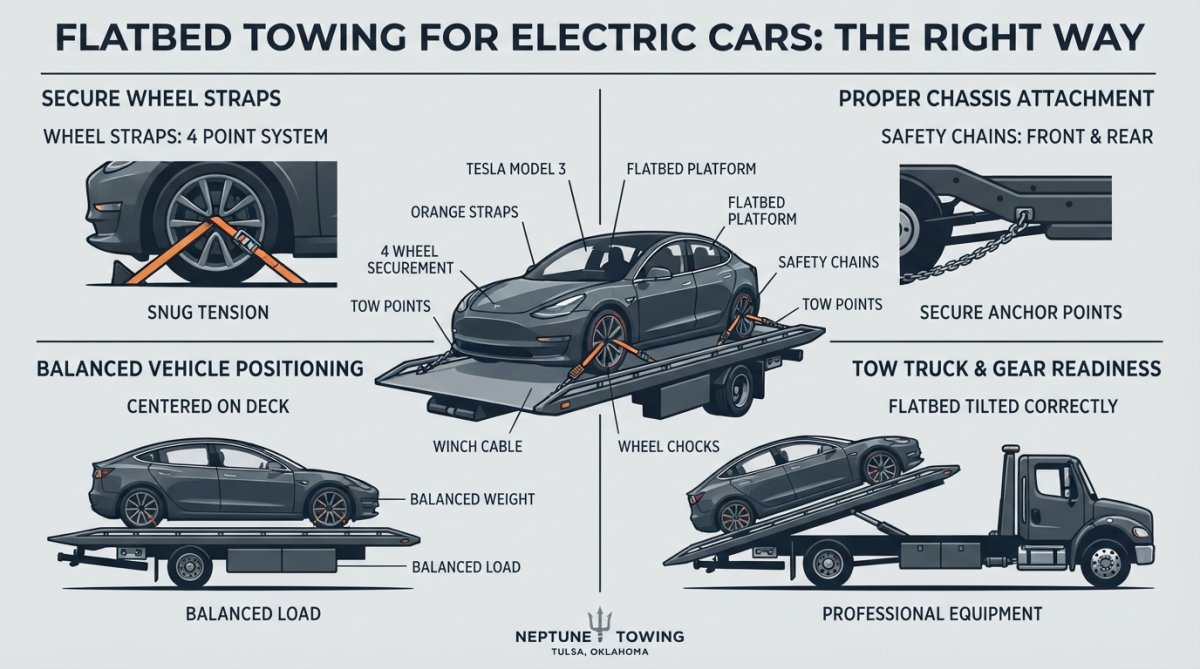
Flatbed towing is the only method that truly protects your Tesla. Every wheel stays off the ground. The entire vehicle rests on the bed of the truck, distributed evenly across the suspension and frame. This is how Tesla vehicles are transported from the factory and between service centers.
When you call for a tow truck in Tulsa, be explicit: "I need flatbed towing for my Tesla." Don’t assume the dispatcher understands. Specify flatbed and confirm it before the truck shows up.
National Highway Traffic Safety Administration guidelines on EV transport recommend flatbed as the safest method for electric vehicles.
Why Flatbed Is the Only Safe Option
Wheel lifts and dollies create uneven weight distribution. When one axle is lifted and another is suspended, the battery pack experiences forces it wasn’t designed to handle. The frame can twist slightly under this stress.
Flatbed towing distributes the vehicle’s weight evenly across the entire bed. All four wheels are off the ground simultaneously. The frame experiences no twisting or uneven stress. The battery pack sits level and supported. The drivetrain experiences no rotational forces because no wheels are rolling.
Flatbed towing also eliminates the risk of the vehicle rolling backward or shifting during transport. For Teslas and other EVs, flatbed is the only method that aligns with manufacturer specifications and protects your vehicle’s resale value.
What to Expect During Flatbed Transport
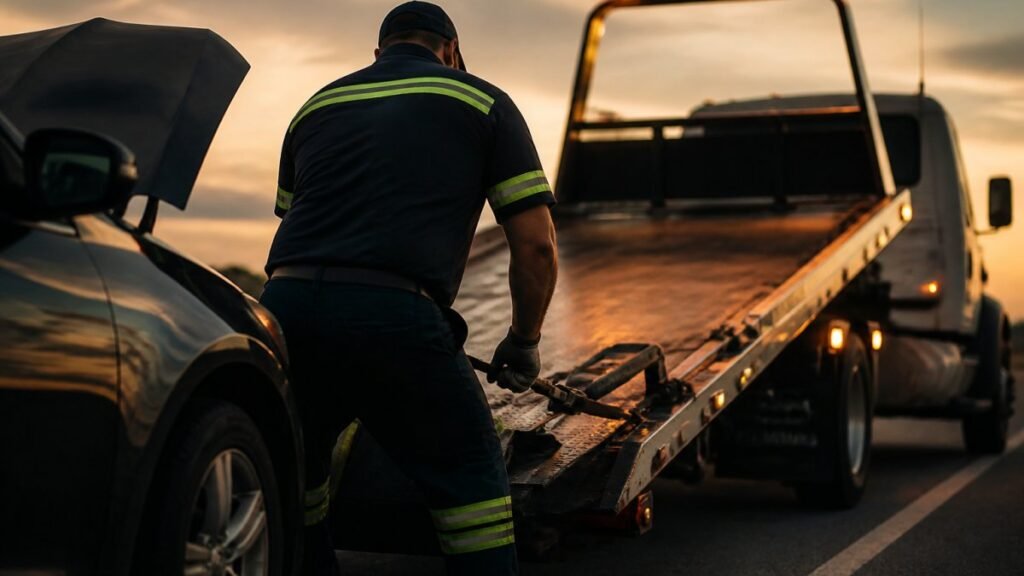
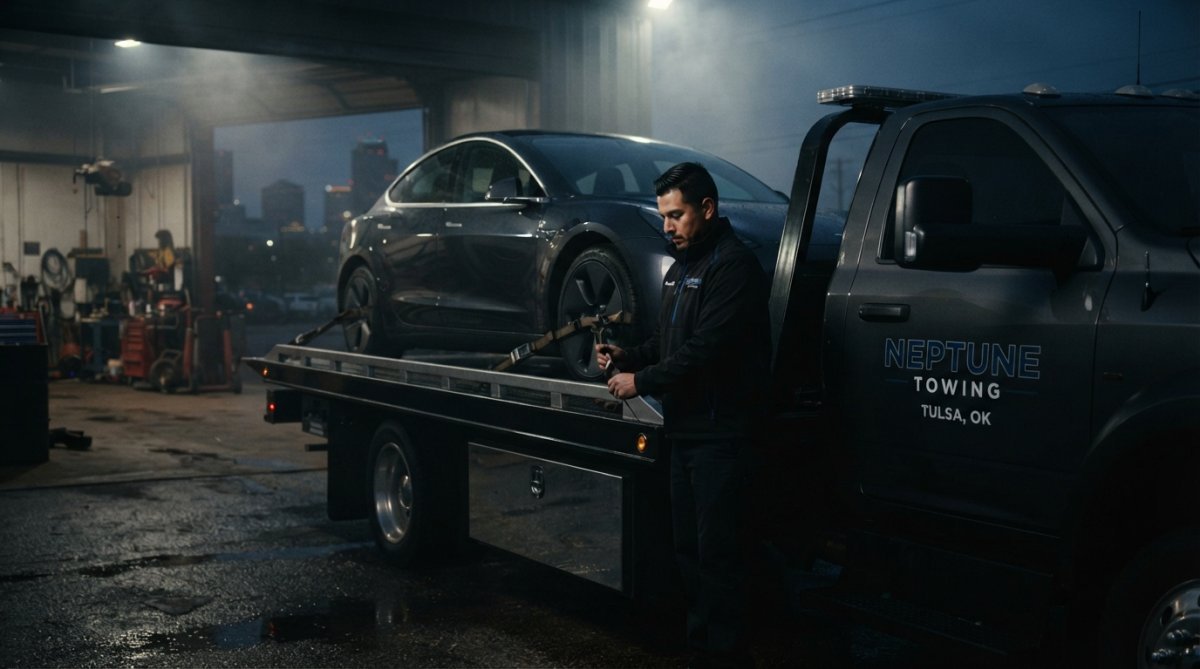
When a flatbed tow truck arrives for your Tesla, the operator will drive the truck close to your vehicle and lower the flatbed deck to ground level. They’ll carefully guide your Tesla onto the bed.
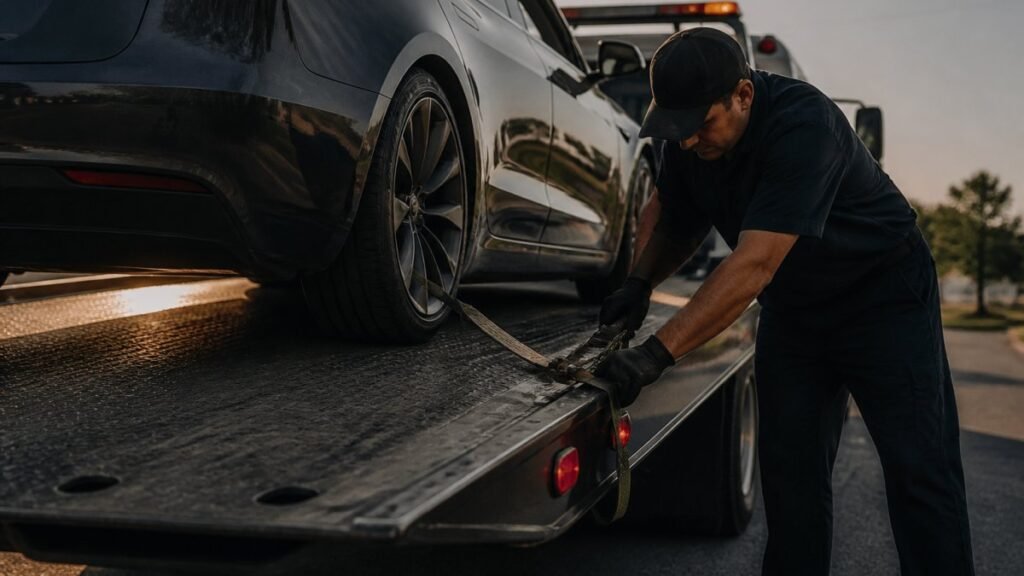
Once your vehicle is on the flatbed, the operator secures it with straps and chains. Proper securement means the vehicle is held firmly in place without excessive pressure on any single point. The straps should distribute pressure across the frame, not just the body panels.
The operator will then raise the flatbed to transport height and secure it in place. Throughout the journey, whether traveling on I-44 toward a repair shop in Broken Arrow or across Tulsa to a service center, your vehicle remains level and stable.
Damage-Free EV Towing: What Professional Service Looks Like
Damage-free towing isn’t just a slogan. It’s a commitment to specific procedures and equipment that protect your vehicle. When you’re stranded on the side of I-44 or stuck in a parking lot in Bixby, you need to know that the operator who arrives understands how to handle your Tesla without causing harm.
Real damage-free towing means the operator has trained specifically on electric vehicle transport. They understand why flatbed is necessary, how to secure an EV properly, and what Tow Mode is and why it matters.
At Neptune Towing, we’ve invested in flatbed equipment specifically designed for electric vehicles. Our operators have hands-on experience with Teslas and other EVs. When you call Neptune Towing for emergency towing in Tulsa or roadside assistance, you’re getting someone who knows your vehicle.
Proper Loading and Securement Procedures
Loading a Tesla onto a flatbed requires care and precision. The operator should drive the vehicle slowly onto the bed, ensuring all four wheels are positioned correctly. The vehicle should be centered on the flatbed to distribute weight evenly.
Once positioned, securement begins. High-quality straps, not chains alone, are used to hold the vehicle. Straps distribute pressure across a wider area and don’t create pressure points that could damage the frame or body panels. The straps are attached to the frame, not the body. Professional operators know exactly where the frame attachment points are located on a Tesla.
The front and rear are secured first, then the sides. The vehicle should be held firmly but not excessively tight. The goal is stability, not pressure.
Damage-free towing means the operator secures your Tesla to the frame (not the body), uses straps in addition to chains, and keeps the vehicle centered and level on the flatbed throughout transport.
How to Verify Your Tow Operator Knows EVs
Before a tow truck arrives, ask questions that reveal whether the operator understands electric vehicle towing:
"Do you use flatbed for Teslas?" A knowledgeable operator will immediately say yes. If they say "we can use a wheel lift," hang up and call someone else.
"Will you enable Tow Mode before transport?" The operator should know what Tow Mode is and understand that it needs to be enabled before the vehicle is moved.
"How do you secure the vehicle?" A professional will describe securing the vehicle to the frame with straps and chains, keeping it centered on the flatbed.
"Have you towed Teslas before?" Experience matters. An operator who has towed dozens of Teslas knows the procedures.
When the tow truck arrives, observe the operator’s approach. Do they inspect your vehicle before loading? Do they ask questions about the condition? Do they explain what they’re doing? These are signs of professionalism.
EV Towing in Tulsa: What Local Drivers Need to Know
Tulsa’s towing landscape includes many operators, but not all understand electric vehicles. The difference between a standard towing company and one that specializes in EV transport can be thousands of dollars in potential damage.
Neptune Towing has been serving Tulsa, Jenks, Bixby, Broken Arrow, and surrounding communities since 2019. We started with a simple principle: provide honest, professional towing service that treats every vehicle and every customer with respect. As electric vehicles became more common on Tulsa roads, we invested in flatbed equipment and trained our team specifically for EV transport.
When you call Neptune Towing for emergency towing or roadside assistance, you’re not getting a dispatcher who routes you to whoever happens to be available. You’re getting owner-operated service from someone who understands your vehicle and your situation.
Finding a Towing Service That Understands Tesla
Start by calling and asking directly. Call and ask the questions listed above. Listen to how they respond. Do they sound knowledgeable? Do they explain why flatbed is necessary?
Check whether the company has flatbed equipment. Some towing companies rely only on wheel lifts and dollies. If that’s their primary equipment, they’re not equipped for EV towing.
Ask about experience. How many Teslas have they towed? Look for local companies. A locally owned towing company in Tulsa has a reputation to maintain in your community. They’re more invested in doing the job right.
24/7 EV Roadside Assistance in the Tulsa Area
Breakdowns don’t happen during business hours. Your Tesla might overheat on I-44 during rush hour. Your battery might fail in a parking lot at midnight. You might need roadside assistance on a holiday when most businesses are closed.
24/7 availability matters. When you’re stranded, you need help now, not tomorrow morning. Neptune Towing operates around the clock, every day of the year. If you need a tow truck in Tulsa at 2 a.m. on a Sunday, we’re available.
Roadside assistance goes beyond just towing. Jump starts, lockout service, tire changes, fuel delivery, and vehicle recovery are all part of comprehensive roadside assistance. When you call for help, you need someone who can address your immediate problem, not just hook up your vehicle and tow it away.
Our dispatch system is designed for fast response. When you call Neptune Towing, you reach a real person who understands your situation. We don’t route you through an automated system or transfer you multiple times. We get your location, understand what you need, and dispatch the right equipment and operator for your specific situation.
Towing a Tesla with a Dead Battery: Real-World Scenarios
What happens when your Tesla’s battery dies completely? You can’t access the touchscreen. You can’t enable Tow Mode. You can’t shift into Neutral using the normal controls. This scenario creates unique challenges that require specific knowledge to handle safely.
The good news: a dead battery doesn’t prevent safe towing. Your Tesla has manual release procedures that allow the vehicle to be shifted into Neutral without power. The battery pack itself doesn’t need to be powered for the vehicle to be transported safely on a flatbed.
Manual Release and Tow Mode When Power Is Gone
When your Tesla’s battery is completely dead, the first step is to enable the manual release. This mechanical procedure allows you to shift the vehicle into Neutral without power.
To perform manual release on a Tesla Model 3 or Model Y:
-
Locate the manual release lever inside the vehicle. It’s typically found under the gear stalk or in a compartment near the shift area. Your owner’s manual specifies the exact location for your model.
-
Pull or press the manual release lever firmly. This disengages the shift lock and allows you to move the gear stalk.
-
Move the gear stalk to the Neutral position. Even without power, this mechanical action will shift the vehicle into Neutral.
-
Confirm that Neutral is engaged. You may see a visual indicator on the touchscreen if power returns, or you may rely on the physical feedback from the shift mechanism.
Once the vehicle is in Neutral, it can be safely loaded onto a flatbed. The fact that Tow Mode couldn’t be enabled is not a problem. Tow Mode is a protective feature, but it’s not required for safe flatbed transport. What matters is that the vehicle is in Neutral and on a flatbed with all four wheels off the ground.
When you call for a tow truck and your battery is dead, inform the operator immediately: "My Tesla has a dead battery. I’ve shifted it into Neutral using the manual release. It’s ready to be loaded on a flatbed." This communication prevents confusion and ensures the operator understands the situation.
Tesla owner’s manual procedures for manual shift release provide detailed instructions specific to your model year. If you’re unsure about your vehicle’s manual release procedure, consult your owner’s manual before an emergency occurs.
Never allow a tow operator to use a wheel lift on a Tesla with a dead battery. The lack of power doesn’t change the fact that wheel lifts damage the drivetrain. Flatbed is still the only safe option, regardless of battery status.
Preparing Your Tesla for Safe Towing Transport
Before a tow truck arrives, there are specific steps you should take to prepare your vehicle for safe transport. These steps protect your Tesla and ensure the towing process goes smoothly.
Pre-Tow Checklist for Tesla Owners
Charge your battery if possible. If your vehicle has any charge remaining, charge it to at least 20-30% before towing. This ensures you can enable Tow Mode and shift into Neutral using the normal controls. If your battery is completely dead, you’ll use the manual release procedure instead.
Enable Tow Mode. Once your battery is charged sufficiently, enable Tow Mode through the touchscreen. This prepares your vehicle’s systems for transport.
Shift into Neutral. Using the gear stalk, shift your vehicle into Neutral. Leave it in Neutral throughout the towing process.
Disable Autopilot and any active driving features. If your vehicle has any autonomous driving features active, disable them. You want the vehicle in a passive state.
Remove personal items. Take out anything valuable or important from your vehicle. During towing, there’s always a small risk of damage or loss.
Note any existing damage. Before the tow truck arrives, photograph or note any existing damage to your vehicle. This protects you if the tow operator causes damage.
Have your keys ready. Make sure you have your key fob or key card available. The tow operator may need to move the vehicle slightly during loading or unloading.
Document the mileage. Note your vehicle’s current mileage. This is useful for insurance purposes and helps verify that the vehicle wasn’t driven excessively during transport.
| Preparation Step | Why It Matters |
|---|---|
| Charge battery to 20-30% | Enables Tow Mode and normal Neutral shift |
| Enable Tow Mode | Protects vehicle systems during transport |
| Shift into Neutral | Prevents drivetrain stress during loading |
| Disable driving features | Prevents systems from activating during transport |
| Remove personal items | Protects valuables from loss or damage |
| Photograph existing damage | Protects you from false damage claims |
| Have keys ready | Allows operator to move vehicle if needed |
| Document mileage | Provides reference point for transport verification |
Communication With Your Tow Operator
When you call for a tow truck, provide clear information about your vehicle and situation. State it explicitly: "I have a Tesla that needs flatbed towing."
"My battery is charged and Tow Mode is enabled" (or "My battery is dead and I’ve used manual release"). This tells the operator what state your vehicle is in and what they should expect.
"I’m located at [specific address]." Provide a clear location. If you’re on a highway, provide mile marker information. If you’re in a parking lot, provide the business name and parking lot location.
"I need to be towed to [destination]." Tell the operator where your vehicle needs to go. Are you heading to a repair shop in Broken Arrow? A Tesla Service Center? A friend’s house?
When the tow truck arrives, walk the operator through your vehicle’s condition. Show them that Tow Mode is enabled. Explain that the vehicle is in Neutral. If your battery is dead, explain that you’ve used the manual release procedure.
Ask the operator to confirm their procedure before they begin loading. "You’ll use the flatbed to load my Tesla and secure it with straps and chains, correct?" This gives the operator a chance to confirm they understand the proper procedure.
During loading, watch the process. If the operator does anything that concerns you, attempting to use a wheel lift, loading the vehicle unevenly, securing it improperly, speak up immediately. It’s your vehicle. You have the right to ensure it’s handled correctly.
When You Need Tesla Towing in Tulsa, Bixby, or Broken Arrow
When you’re stranded with a disabled Tesla, you need help from someone who understands your vehicle. The difference between a standard towing company and one that specializes in EV transport can mean the difference between a simple tow and thousands in damage.
Neptune Towing has been serving Tulsa and surrounding communities since 2019. We’re not a national chain. We’re a locally owned, owner-operated business. When you call Neptune Towing, you’re calling a company that lives in your community and has a reputation to maintain.
Why Owner-Operated Towing Makes a Difference
When you call a large national towing company, you’re calling a dispatcher who routes your call to whoever is available. That operator may or may not have experience with electric vehicles. They may or may not understand why flatbed is necessary.
When you call Neptune Towing, you’re calling an owner who personally cares about your experience. Our owner-operated model means accountability. If something goes wrong, you’re not dealing with a faceless corporation. You’re dealing with someone who lives in Tulsa and whose reputation depends on treating you right.
Owner-operated also means consistency. You’re getting people trained to our standards and committed to our approach: damage-free towing, honest communication, and customer-first service. We’ve invested in flatbed equipment specifically designed for EV transport. Our team has trained extensively on Tesla towing procedures.
What to Expect When You Call for Help
When you call Neptune Towing, you reach a real person who can help immediately. We don’t route you through an automated system. We don’t transfer you multiple times. You speak with someone who understands your situation and can dispatch help.
Provide your location and explain that you have a Tesla that needs flatbed towing. If your battery is dead, mention that. If you have Tow Mode enabled, mention that. The more information you provide, the better we can prepare.
Our dispatch system is designed for speed. Once we understand your situation, we dispatch a flatbed tow truck to your location. For most areas in Tulsa, Broken Arrow, Bixby, Glenpool, Owasso, Sapulpa, and surrounding communities, response time is typically fast.
When the tow truck arrives, the operator will introduce themselves and explain the procedure. They’ll ask about your vehicle’s condition. They’ll confirm that the vehicle is in Neutral or use the manual release procedure if the battery is dead. They’ll load your Tesla onto the flatbed carefully and securely.
Throughout the process, the operator will keep you informed. You’ll know what’s happening and why. You’ll see your vehicle handled with the care it deserves.
Once your Tesla is secured on the flatbed, the operator will transport it to your destination, whether that’s a repair shop, a Tesla Service Center, or your home. Your vehicle arrives safely, undamaged, and ready to be repaired or serviced.
Frequently Asked Questions
What is Tow Mode in a Tesla and how do I activate it?
Tow Mode is a Tesla feature that disables the electric parking brake and allows the vehicle to be towed safely without damaging the drivetrain. To activate it, access your vehicle's touchscreen menu, navigate to Service Mode or Tow Mode (depending on your model year), and follow the prompts. This prevents the wheels from locking and protects your EV's transmission system during transport. Always enable Tow Mode before your tow operator arrives, unless the battery is completely dead, in which case a professional towing service can manually release the brake.
Can a Tesla be towed with all four wheels on the ground?
No. Teslas should never be towed with all four wheels on the ground, as this can cause severe drivetrain damage. The electric motor and single-speed transmission are not designed for this type of towing. Flatbed towing is the only safe method, your Tesla should be fully loaded onto the flatbed so all four wheels are off the ground. This protects your vehicle's powertrain and battery pack from stress and potential thousands of dollars in repair costs.
What should I do if my Tesla runs out of battery and needs a tow?
If your Tesla's battery is completely depleted, call a professional towing service immediately, do not attempt to push or tow the vehicle yourself. A qualified EV towing operator will use a flatbed to transport your vehicle safely. Even with a dead battery, the manual brake release mechanism can be accessed by a trained technician. This is why calling an owner-operated, experience-focused towing company in Tulsa matters: they know how to handle dead-battery scenarios without causing additional damage.
Does Tesla Roadside Assistance cover towing, and what if I need a local tow truck instead?
Tesla Roadside Assistance covers towing for Tesla owners, but response times can vary. If you need immediate help in Tulsa, Bixby, Broken Arrow, or surrounding areas, a local towing service like Neptune Towing can often arrive faster and provide damage-free EV towing with personal attention. Many insurance policies also cover towing, check your policy to see what's included. Having a trusted local tow truck number saved in your phone ensures you're never stuck waiting for help, regardless of which service you use.
When your Tesla breaks down on I-44 or you’re stranded in a Tulsa parking lot, you need a towing company that understands electric vehicles. Neptune Towing specializes in damage-free EV towing using flatbed equipment and proper securement procedures. We’re owner-operated, available 24/7, and committed to treating your vehicle with the care it deserves. Call (539) 292-3074 for emergency towing and roadside assistance throughout Tulsa, Broken Arrow, Bixby, and surrounding communities.
This article was written using GrandRanker