
Quick Summary
A car accident demand letter is a formal letter sent to the at-fault driver’s insurance company requesting payment to settle your injury claim. It describes the accident, the other driver’s fault, your injuries, your losses, and a specific settlement amount.
- Gather police reports, photos, medical records, itemized bills, and proof of lost wages first.
- Send your demand letter once your treatment is mostly finished and your costs are clear.
- Itemize economic damages and explain non-economic damages with concrete examples of daily life impact.
- Check the at-fault driver’s liability policy limits before naming a settlement figure.
- Send by certified mail with return receipt and keep copies of everything you sent.
Table of Contents
- What a Car Accident Demand Letter Is and Why It Matters
- When to Send a Demand Letter to the Insurance Company
- Step 1: Gather Your Evidence and Medical Records
- Step 2: Write the Facts, Liability, and Injury Sections
- Step 3: Itemize Damages and Set a Settlement Demand
- Using a Car Accident Settlement Letter Template
- Sending Your Car Accident Demand Letter to the Insurance Company
- Booking Your Next Step After a Tulsa-Area Collision
- Frequently Asked Questions
What a Car Accident Demand Letter Is and Why It Matters
A car accident demand letter is a formal letter sent to the at-fault driver’s insurance company that asks for payment to settle your injury claim. It lays out what happened, who was at fault, what injuries you suffered, and how much money you are asking for. Think of it as your opening offer, and the document an adjuster reads first when deciding whether to pay.
A strong letter does more than ask for money. It gives the adjuster a clear, organized story that supports your claim, which makes it harder to brush off.
What a demand letter typically covers:
- The accident facts and date, time, and location
- Who was at fault and why
- Your injuries and medical treatment
- Your financial losses, such as medical bills and lost wages
- A specific settlement amount you are requesting
The drivers who handle claims best are the ones who keep clear records from the start.
When to Send a Demand Letter to the Insurance Company
Send your demand letter once you know the full extent of your injuries and your treatment has reached a point where your costs are clear. Sending it too early can leave out costs that show up later.
Good timing signs:
- Your medical treatment has mostly finished, or your doctor can explain your long-term prognosis
- You have received most of your medical bills
- You know your repair costs and lost wages
- You have photos, a police report, and witness information gathered
If you are still in active treatment, you can still prepare the letter. Just be ready to update it once more costs come in.
Step 1: Gather Your Evidence and Medical Records
Strong evidence makes your letter hard to dispute. Start collecting it as soon as possible after the crash.
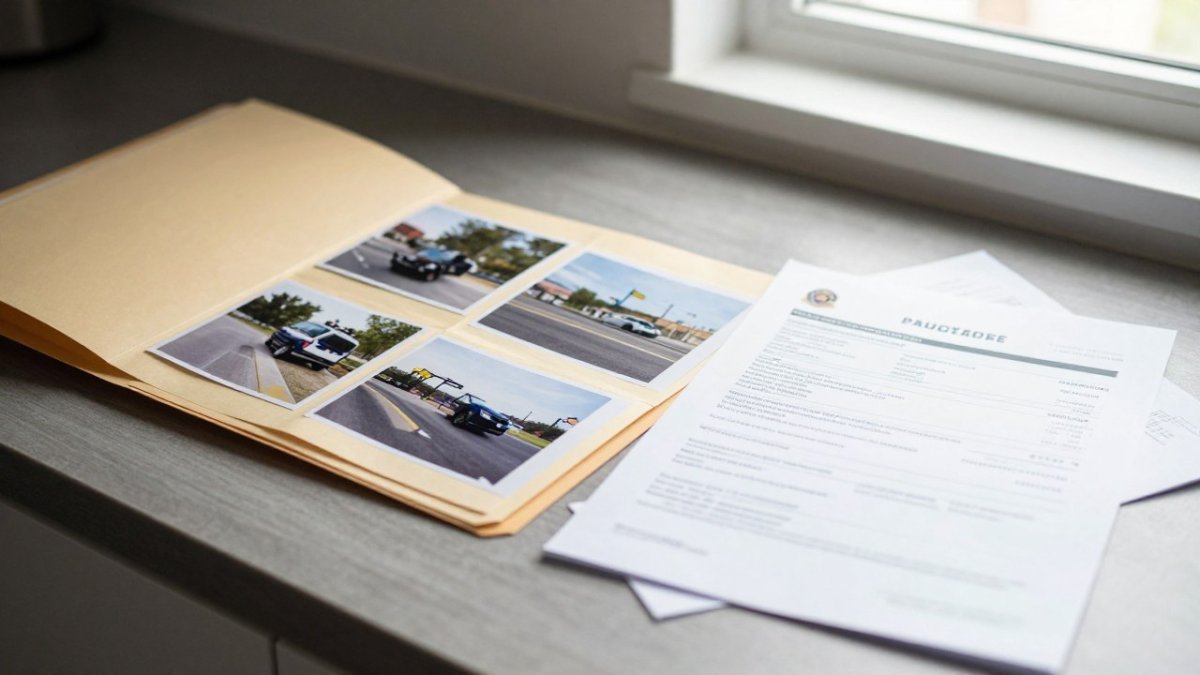
Key evidence to gather:
- The police report and crash report number
- Photos of the scene, vehicle damage, and your injuries
- Contact information for witnesses
- Medical records, including emergency room notes and specialist reports
- Itemized medical bills and receipts
- Repair estimates or total loss paperwork for your vehicle
- Pay stubs or employer letters showing lost wages
Keep copies of everything. Store originals in a safe place. For a clear breakdown of which evidence actually establishes fault, see what evidence actually establishes fault.
Step 2: Write the Facts, Liability, and Injury Sections
Your letter should be organized and easy to follow. Adjusters read many of these, so clear writing helps yours stand out.
Facts section: Describe the crash in plain, chronological order. Include the date, time, location, and what each driver was doing before impact.
Liability section: Explain why the other driver was at fault. Point to specific actions, like running a red light or following too closely, and cite the police report or witness statements.
Injury section: List each injury, how it happened, and the treatment you received. Connect each injury directly to the crash.
Keep the tone factual. Avoid exaggeration, because adjusters will check every claim against your records.
Step 3: Itemize Damages and Set a Settlement Demand
This is the section adjusters scrutinize hardest, because it is where your story turns into a number. Break down every loss so the adjuster can trace each dollar back to a document, then frame a demand that leaves room to negotiate without looking inflated.
Economic damages (the easy part to document):
- Past medical expenses, itemized by provider and date of service
- Expected future medical care, such as follow-up visits, physical therapy, or imaging your doctor has recommended
- Vehicle repair costs from a written estimate, or the actual cash value figure if the car was totaled
- Rental car or substitute transportation costs during repairs
- Lost wages, supported by pay stubs or an employer letter, plus any reduced earning capacity your doctor can explain
- Out-of-pocket costs such as prescriptions, medical equipment, and mileage to appointments
Non-economic damages (where most letters fall short):
Pain and suffering, emotional distress, and loss of enjoyment of life are real categories, but they are not billed like medical treatment.
How policy limits and fault can cap your demand:
Before you name a figure, find out the at-fault driver’s liability coverage limits.
Setting the number:
Add your documented economic losses, add a reasoned non-economic figure, and state a specific total. Many people set the demand somewhat above the number they expect to settle for, which leaves room to negotiate.
Watch out: if you are still in active treatment, do not lock in a final number for future care you cannot yet document.
The table below pulls together the damage categories and the key things to check before you set a figure.
| Damage type | What to document | Key note |
|---|---|---|
| Past medical expenses | Itemized bills by provider and date | List each provider and service date |
| Future medical care | Follow-up visits, physical therapy, imaging | Only what your doctor has recommended |
| Vehicle repair or total loss | Written estimate or actual cash value | Use the estimate or cash value figure |
| Rental or transportation | Rental car or substitute transport costs | Covers the period during repairs |
| Lost wages | Pay stubs or employer letter | Add reduced earning capacity if documented |
| Out-of-pocket costs | Prescriptions, equipment, mileage | Keep receipts for each item |
| Non-economic damages | Concrete examples of daily life impact | Explain the number, don’t just state it |
| Policy limits | At-fault driver’s liability limits | Check before naming a demand figure |
Using a Car Accident Settlement Letter Template
A template gives you a starting structure, so you do not have to build the letter from scratch. A car accident letter sample can show you how to arrange your facts and damages, but make sure every detail matches your own situation.
A simple template outline:
[Your Name]
[Your Address]
[Date][Insurance Company Name]
Claim Number: [Number]Re: Settlement demand for accident on [Date] at [Location]
Dear [Adjuster Name]:
On [Date], [describe the accident in two or three sentences]. The at-fault driver, [Name], was responsible because [reason].
As a result, I suffered [injuries], and received treatment from [providers]. My medical expenses total $[amount]. My vehicle damage totals $[amount], and I lost $[amount] in wages.
I am requesting a settlement of $[amount]. Please respond within [number] days.
Sincerely,
[Your Signature]
Replace every bracketed field with your own facts and keep the letter honest and specific.
Sending Your Car Accident Demand Letter to the Insurance Company
How you send the letter matters almost as much as what it says, because a dispute over whether the insurer received it, or when, can stall your claim for weeks. A clear delivery record can also help an injury litigator assess the claim’s timeline and identify any gaps in the insurer’s response, including through BOSTON AUTO LAW.
Choose your delivery method deliberately:
- Certified mail with return receipt gives you a signed proof of delivery and a tracking number. It is the most defensible option if the insurer later claims it never arrived.
- Email to the assigned adjuster works for speed, but save the sent message and any read receipt, and follow up with a mailed copy so there is a paper trail.
- Insurer claims portals are increasingly common. After uploading, save the confirmation screen or email and note the date and time.
Document what you sent, not just that you sent it:
Keep a copy of the signed letter, a list of every attachment, the tracking number, and the delivery confirmation. If you send by email, save the full message with attachments in a folder you will not lose.
Sharing records without over-sharing:
Attach only the records that support your claim, the bills, treatment notes, and repair estimates tied to this crash. You are not required to hand over unrelated medical history, and sending it can invite the adjuster to argue your injuries predated the collision.
What happens after the insurer responds:
- An offer: compare it line by line against your itemized damages, respond in writing with the specific gaps, and counter rather than accepting or rejecting outright.
- A denial: ask for the reason in writing, supply any missing documentation, and correct factual errors before escalating.
- A request for more records: send what is reasonable and relevant, and note what you are withholding and why.
- No response: follow up in writing referencing your original send date and delivery confirmation, and keep a copy of the follow-up.
Keep notes on every phone call, date, time, who you spoke with, and what was said. Be polite, but do not agree to a settlement amount or sign a release until you fully understand your injuries and costs.
If your car is undrivable after the crash, getting it moved safely comes first. Neptune Towing provides vehicle recovery, flatbed towing, and winch-outs across Tulsa and nearby communities, and we do not impound vehicles, so you can focus on your claim instead of worrying about where your car ended up.
Booking Your Next Step After a Tulsa-Area Collision
If your car is stuck, damaged, or unsafe to drive after a crash, get it moved to a safe location first. Neptune Towing offers vehicle recovery, flatbed towing, and winch-outs across Tulsa and nearby communities.
Call Neptune Towing at (539) 292 3074 to get your vehicle moved safely, then start gathering the evidence you will need for your claim.
Frequently Asked Questions
How long do I have to send a car accident demand letter?
Deadlines depend on your state and the type of claim. Check with your state’s official court or insurance department website for the rules that apply to you.
Do I need an attorney to write a demand letter?
You can write one yourself, but an attorney can review your case, calculate fair damages, and handle negotiations. Many personal injury attorneys offer free consultations.
What if the insurance company rejects my demand?
Respond in writing, provide any missing documents, and consider a counteroffer. If talks stall, you may need to file a lawsuit or seek legal help.
Can I change my demand after sending it?
Yes. If new medical bills or treatment come in, you can send an updated letter with the revised totals.
Frequently Asked Questions
How do I write a demand letter for a car accident?
Start with a clear summary of the accident: date, location, how it happened, and who was at fault. Then describe your injuries and the treatment you received, list your economic losses such as medical bills, vehicle repair costs and lost wages, and close with a specific settlement demand and a response deadline. Attach copies of your police report, photographs and medical records, not originals. Keep the letter factual and organized in chronological order so the adjuster can verify each point against the file.
Can I write my own demand letter?
Yes, you can write and send your own car accident demand letter. Many people handle smaller claims this way. The letter should stick to facts, avoid guessing about fault, and include supporting documents. If your injuries are serious, your medical treatment is ongoing, or the insurer has disputed liability, a licensed attorney may be able to review your letter before it goes out. Whether you hire help or not, keep copies of everything you send.
What should I not say in a demand letter?
Avoid admitting any fault, guessing about what caused the crash, or exaggerating injuries. Do not describe your injuries in vague terms or claim things you cannot document. Leave out emotional commentary about the other driver. Do not state a settlement amount you cannot support with bills and records. Stick to what you saw, what you were told, and what your medical providers and receipts show.
What should I include in a car accident demand letter to an insurance company?
Include your name and contact information, the claim number, the date and location of the accident, a factual account of how it happened, the at-fault driver’s information, a description of your injuries and treatment, an itemized list of medical expenses, vehicle repair or rental costs, lost wages, and a specific settlement demand with a deadline for response. Attach supporting documentation such as the police report, witness statements, photographs, and medical records.