
Last Updated: October 29, 2026
Quick Summary
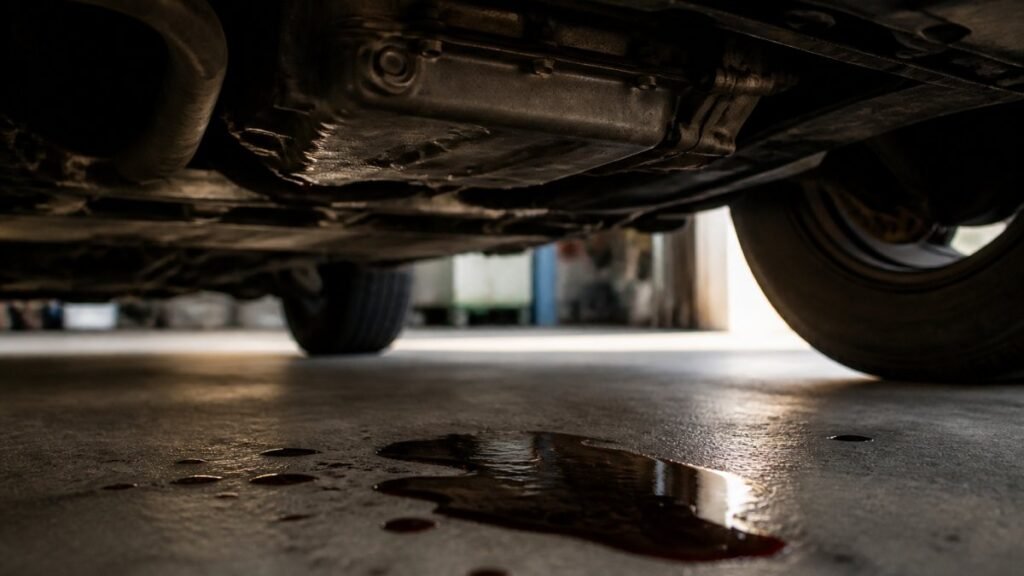
To identify transmission fluid leaks under your car, look for a reddish or brown puddle under the middle or front of the vehicle, then confirm it by smell, consistency, and location. Clean the area, park on white paper, and recheck for a fresh drip, since color alone doesn’t prove the source.
- Fresh transmission fluid is typically bright red or pink, while older fluid turns dark red or brown.
- Burnt transmission fluid smells sharp and acrid, which warns of overheated fluid.
- Park on clean, flat concrete and slide white paper under the middle and front of the car.
- Fluid runs along the underbody, so the drip point can be a foot or more from the actual leak.
- Stop driving and call for a tow if you see a steady drip, smell burnt fluid, or feel slipping.
Table of Contents
- Start With What’s Actually Under Your Car
- Transmission Fluid Leak Color and Smell: Reading the Clues
- A Safe Step-by-Step Driveway Inspection
- Where Transmission Fluid Leaks Come From
- Telling Transmission Fluid Apart From Engine Oil, Coolant, and Brake Fluid
- Is It Safe to Drive With a Transmission Fluid Leak?
- How Mechanics Detect Transmission Leaks
- When to Stop Driving and Call for a Tow in Tulsa
- Frequently Asked Questions
Start With What’s Actually Under Your Car
Learning how to identify transmission fluid leaks under your car starts with one simple fact: not every puddle is a transmission problem.
Here’s what most guides get wrong. According to Craig and Landreth Auto’s guide to transmission fluid leak clues, a reddish or brown stain is a clue, not proof of a transmission leak or a particular failed part.
This guide walks you through the steps to take in a driveway: inspect safely, read the clues, trace the source, and decide whether to drive or call for help.
Transmission Fluid Leak Color and Smell: Reading the Clues
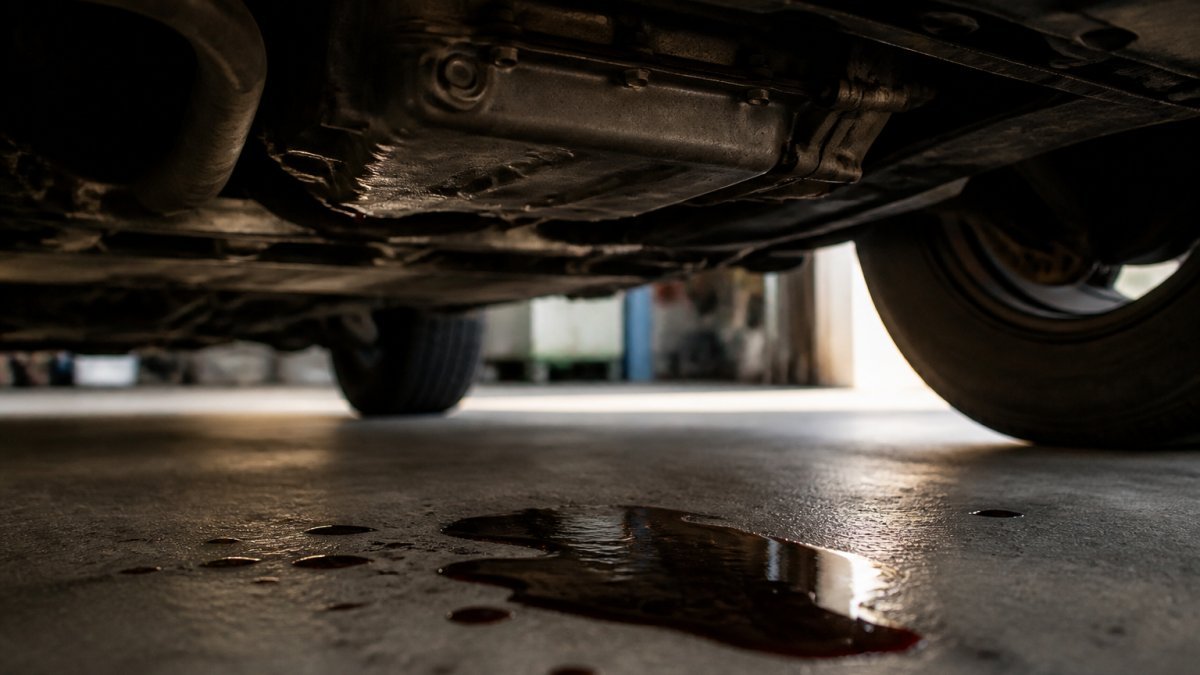
Transmission fluid leaks usually show up as a reddish or brown puddle under the middle or front of the car, often with a slick, oily feel. Fresh fluid is typically bright red or pink.
But this is where drivers get tripped up. Modern transmissions don’t all use red fluid, and some vehicles use fluid that looks amber, yellow, or even clear.
What the Color Tells You (and What It Doesn’t)
- Bright red: likely newer fluid, possibly transmission or power steering
- Dark red or brown: older fluid, could be transmission or engine-related
- Amber or clear: some modern transmission fluids, or brake fluid
Color narrows things down. It doesn’t confirm the source. Two different fluids can look identical on concrete.
The Smell Test: Burnt Versus Fresh
Smell is the clue most people skip. Fresh transmission fluid has a mild, oily scent. Burnt transmission fluid smells sharp and acrid, like scorched oil. That burnt smell often points to fluid that has overheated, which is a bigger warning sign than a simple drip.
A Safe Step-by-Step Driveway Inspection
Here’s a safe way to inspect for a transmission fluid leak at home. You don’t need a lift, but you do need to be methodical.
- Park on clean, flat concrete. Asphalt hides color, and dirt absorbs the drip before you can read it. If your driveway is stained, lay down a sheet of cardboard or a flattened box under the middle of the car.
- Let the car sit undisturbed. A few hours or overnight gives slow seeps time to pool. A leak that only shows up after the car has been driven and parked hot is a different clue than one that drips cold.
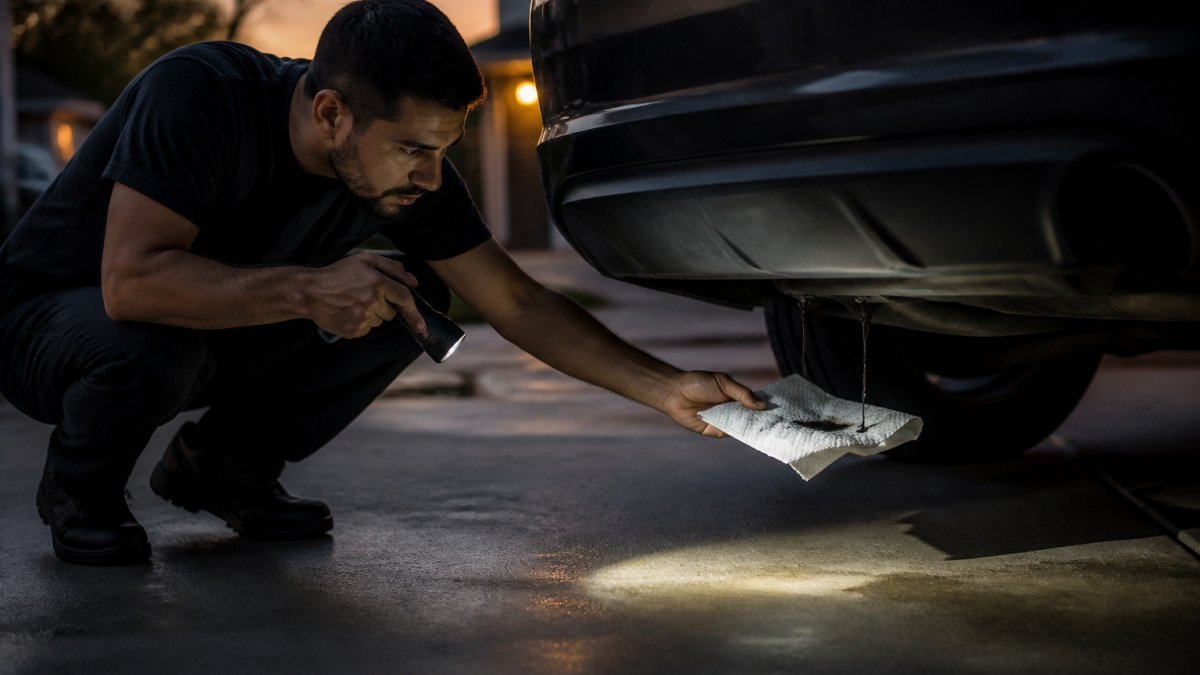
- Slide white paper under the likely drip zone. A paper towel or sheet of printer paper under the middle and front of the car lets you see the true color and consistency of the fluid instead of a shadow on concrete.
- Use a bright flashlight and look up, not just down. Shine it along the underside of the transmission pan, the cooler lines, and the bellhousing area. Fluid runs, so the wet spot on the ground is rarely directly under the leak point.
- Check the fluid level only by your vehicle’s specified procedure. This is where most driveway guides fall short. Some cars are checked with the engine running and the transmission in Park or Neutral, some in gear, and some at a specific fluid temperature. Check your owner’s manual before you pull the dipstick, because checking it the wrong way gives you a false reading.
- Clean the area and recheck. Wipe down the wet components with a rag, drive a short loop, park on clean paper again, and look for a fresh drip. A new spot confirms an active leak. A dry patch after a day usually means you can relax.
Never crawl under a car held up only by a jack. A jack is for lifting, not for holding. If you need to get underneath, use ramps or jack stands on level ground, or let a qualified shop put it on a lift. A car that shifts off a jack is not a risk worth taking for a driveway diagnosis.
Not Every Car Has a Dipstick
Many newer vehicles, and a growing number of sealed automatic transmissions, have no conventional transmission dipstick at all. On those, there’s no owner-serviceable way to check the level, and the fill and check procedure often requires a scan tool and a specific fluid temperature. Securing a professional transmission service ensures that the complex internal components of these sealed systems are maintained correctly without risking damage from improper fluid levels.
Confirming a Suspected Leak Before You Panic
A single spot isn’t always a leak. It could be old fluid from a past service, spilled oil from an oil change, or plain water from the AC condenser, which drips near the front of the cabin and is often mistaken for a leak. Clean the area, drive a short distance, and check again on fresh paper. A growing, recurring drip confirms a leak.
Where Transmission Fluid Leaks Come From
Most transmission leaks start at a handful of common points. Knowing where to look saves time, but knowing how to trace the fluid is what actually finds the leak.
- The transmission pan gasket: the seal around the pan, a frequent leak source, especially after a fluid service
- The drain plug: loose, cross-threaded, or missing a washer, letting fluid seep out
- Pan bolts: loose or unevenly torqued bolts let fluid escape around the edges
Trace the Leak, Don’t Just Read the Puddle
A common mistake is assuming the leak is directly above the puddle. Fluid doesn’t fall straight down once the car is moving. It runs along the pan, follows a crossmember, blows back along the underbody, and drips at the lowest point it can find. That drip point can be a foot or more away from the actual leak.
Here’s how to trace it:
- Start at the highest wet point. With a flashlight, follow the wet trail upward and forward until the surface turns dry. The boundary between wet and dry is usually close to the source.
- Look for gravity’s path. Fluid runs downhill along brackets, lines, and seams. A wet bellhousing with a dry pan points toward a front seal, not the pan gasket.
- Check fittings and connections first. Cooler line fittings and pan bolts are the easiest places to start because a loose fitting or bolt is a simple fix, and it’s the most common cause of a sudden new leak.
- Separate a seep from an active leak. A damp, dusty film around a seal is a seep and often just needs monitoring. A wet, dripping, or pooling area is an active leak and needs attention now.
- Confirm after cleaning. Wipe the area dry, drive briefly, and recheck. Fresh fluid at a specific point confirms the source; fluid that reappears somewhere else means you’re still chasing a runner.
If you can’t find the source after a clean-and-recheck, a shop can add a UV dye to the fluid and use a blacklight to make the trail glow. It’s the same trace-the-fluid logic, just with a shortcut for hard-to-see seeps.
A leak that only appears after the car sits overnight often points to a seal that drains down slowly. A leak that shows up only after driving, especially a spray or mist along the underbody, often points to a cooler line or a seal under pressure. Matching the leak’s behavior to the part is half the diagnosis, and it’s the part most driveway guides skip.
Telling Transmission Fluid Apart From Engine Oil, Coolant, and Brake Fluid
Transmission fluid leaks are easy to confuse with other leaks. Use this table to compare.
| Fluid | Typical Color | Smell | Common Location |
|---|---|---|---|
| Transmission fluid | Red, brown, amber | Oily, sometimes burnt | Middle or front under car |
| Engine oil | Black or dark brown | Sharp, oily | Under the engine |
| Coolant | Green, orange, pink | Sweet | Front, near radiator |
| Brake fluid | Clear to yellow | Chemical | Near wheels or master cylinder |
Engine oil is usually darker and sits under the engine. Coolant often has a sweet smell and bright color. Brake fluid is clear or yellow and shows up near the wheels. When in doubt, match the color, smell, and location together.
Is It Safe to Drive With a Transmission Fluid Leak?
Sometimes yes, often no. A slow seep might let you reach a nearby shop. A steady drip or a burnt smell means stop.
Driving with low transmission fluid can cause serious internal damage. Transmissions are expensive to repair, and running them dry is one of the fastest ways to destroy one. You can read more in our guide on why flatbed towing is safer for your vehicle.
How Mechanics Detect Transmission Leaks
Shops use a few reliable methods to find transmission leaks, such as cleaning the area, adding UV dye that glows under a special light, and checking the pan, gasket, and seals. The goal is the same as yours: find the leak source, not just the puddle. A good mechanic traces the fluid to its highest point before recommending a repair.
When to Stop Driving and Call for a Tow in Tulsa
Stop driving and call for a tow if you see a steady drip, smell burnt fluid, notice low fluid, or feel the transmission slipping. Those signs mean the risk of damage is climbing fast.
If you’re stuck on the side of I-44, the Broken Arrow Expressway, or a side street in Jenks or Bixby, don’t push your luck. Our article on signs your vehicle needs professional recovery breaks it down. Before you call anyone, it helps to know how to choose a towing company in Tulsa so you don’t get burned, and our Tulsa tow truck pricing guide explains what to expect.
At Neptune Towing, we’re owner-operated and local. We don’t impound vehicles, and we focus on damage-free towing with proper loading and securement. When you need a tow truck in Tulsa, call (539) 292 3074.
Frequently Asked Questions
What color is transmission fluid when it leaks?
Fresh transmission fluid is usually bright red and slightly oily. As it ages it turns dark red, then brown, and eventually nearly black. A reddish or brown stain under a parked vehicle is a clue, not proof: engine oil, power steering fluid, and some coolants can also look red or brown. Wipe the drip onto a white paper towel and check the smell. Transmission fluid has a distinct oily, sometimes burnt odor, and burnt fluid points to a transmission that has been running hot.
Where do most transmission fluid leaks come from?
The transmission pan gasket and drain plug are the most common sources, because heat and time harden the gasket and loosen bolts. Fluid can also escape from the pan itself if it is rusted, from the front or rear seals, from cooler lines, and from the dipstick tube. On front-wheel-drive cars, the axle seals at the transmission are another frequent leak point. A leak that only appears after the car sits overnight often comes from a seal; one that drips while running is more likely a line or gasket.
Is it safe to drive with a transmission fluid leak?
A slow seep that leaves a small spot but keeps the fluid at the correct level is usually drivable to a shop, but check the level first and watch for slipping, delayed engagement, or a burnt smell. A steady drip, a puddle, or any change in how the transmission shifts means stop driving. Low fluid causes heat and clutch damage fast, and a transmission rebuild costs far more than a tow. If you are unsure, park it and call for a flatbed.
How do mechanics find a transmission fluid leak?
Mechanics clean the transmission and surrounding area, add a UV dye to the fluid, then run the vehicle and inspect it with a blacklight. The dye glows at the exact leak point, which separates a pan gasket leak from a seal or cooler line leak. They also check the fluid level and condition on the dipstick, look for a burnt smell, and inspect the pan bolts and drain plug. That is why a proper diagnosis beats guessing from the color of the puddle alone.
A transmission leak won’t fix itself, and ignoring it can turn a small repair into a big one. If your car isn’t safe to drive, don’t risk it. Neptune Towing offers 24/7 emergency service, damage-free flatbed towing, and honest, upfront communication from a local owner-operator. We treat every vehicle with care, from daily drivers to EVs and classics. Get started with Neptune Towing and get your car to a shop safely. Call (539) 292 3074.