
Table of Contents
- How Tow Truck Pricing Actually Works
- Roadside Assistance in Tulsa: What It Costs and When to Call
- Flatbed Towing in Tulsa: Why It Costs More and When You Need It
- EV Towing and Tesla Transport: Specialized Pricing Explained
- Hidden Fees to Watch Out For (And How We Avoid Them)
- How to Get an Accurate Tow Quote Before You Commit
- Conclusion
- Frequently Asked Questions
Last Updated: September 16, 2026
How Tow Truck Pricing Actually Works
Tulsa tow truck pricing guide requests spike every time the weather turns, and for good reason. According to IBISWorld’s 2026 automobile towing industry analysis, the U.S. towing industry is projected to reach $12.0 billion in 2026, growing at a steady 1.7% CAGR. At Neptune Towing, we’ve answered thousands of calls from drivers on I-44, the Broken Arrow Expressway, and side streets in Jenks who just want one thing: a straight answer about what a tow costs before the truck shows up.
Here’s the short version. Most local tows are built from two numbers: a base hook-up fee and a per-mile rate.
Base Hook-Up Fee vs. Mileage Rate
The base hook-up fee covers the truck arriving, positioning, and loading your vehicle, it doesn’t change whether you’re two blocks from home or twenty.
What Changes the Final Number
Distance is obvious. The rest catch people off guard:
- Vehicle type and weight. A compact car and a lifted diesel pickup don’t load the same way or fit the same deck.
- Time of day. After-hours surcharges are real and legitimate, but they should be quoted upfront.
- Tow method. A wheel-lift truck is faster and cheaper. A flatbed costs more because of the equipment and the extra loading time.
- Recovery difficulty. A car sitting in a parking lot is a standard hook-up. A car buried in a ditch off US-169 is a winch-out.
Ask for a service estimate before you agree to anything. A legitimate dispatcher can give you a base fee, a mileage rate, and any surcharges in one sentence. If the person on the phone won’t commit to numbers, that’s your sign to keep calling.
Roadside Assistance in Tulsa: What It Costs and When to Call
Roadside assistance covers jobs that don’t require a tow: dead batteries, keys locked inside, flat tires, and empty fuel tanks.
How Roadside Calls Are Priced
- A flat service call rate covering the technician’s time and equipment.
- A time-of-day modifier. Overnight, weekend, and holiday calls carry a premium because the operator is on call, and a legitimate dispatcher quotes it upfront.
- A parts or materials charge in specific cases, a gallon or two of fuel, for example. That’s a pass-through cost, not a markup game.
- A distance consideration if you’re far outside the normal service radius.
Jump Start Service and Lockout Help
A jump start service sends a technician with a portable booster pack, not a stranger’s jumper cables.
Tire Changes and Fuel Delivery
A tire change is straightforward when you have a usable spare: the technician jacks the vehicle, swaps the wheel, torques the lugs, and you’re on your way.
When Roadside Beats a Tow, and When It Doesn’t
Call for roadside assistance when:
- The battery is weak but the vehicle still cranks, or a boost will get you to a shop.
- You locked your keys inside and the vehicle is otherwise fine.
- You have a usable spare and a flat tire.
- You ran out of fuel within reach of a station.
Call for a tow when:
- The vehicle won’t start even after a boost.
- A tire is shredded, the spare is unusable, or you have two flats.
- The problem is mechanical, steering, brakes, suspension, or a warning light that means the car shouldn’t be driven.
- You’re in an unsafe spot and need the vehicle moved off the roadway entirely.
Don’t accept a jump start from a stranger with jumper cables on a dark shoulder of the Creek Turnpike. Modern vehicles have sensitive electronics, and a reversed connection can fry a control module. The repair cost dwarfs the price of a professional jump start, and a professional carries insurance for exactly that reason.
When you call, tell the dispatcher what you drive and what’s actually happening. “My car won’t start” and “my car clicks once and everything goes dark” point to different problems, and the second answer helps the technician bring the right equipment the first time.
If you’re stranded in Jenks, Bixby, Broken Arrow, Owasso, Sapulpa, or Glenpool, the same flat-rate structure applies, no surprise mileage line item for being outside the city limits. That’s a practical advantage of calling a local towing company that runs the whole metro.
Flatbed Towing in Tulsa: Why It Costs More and When You Need It
Flatbed towing costs more because the equipment costs more to buy, insure, and operate, and loading onto a tilted deck takes longer than a wheel-lift.
EV Towing and Tesla Transport: Specialized Pricing Explained
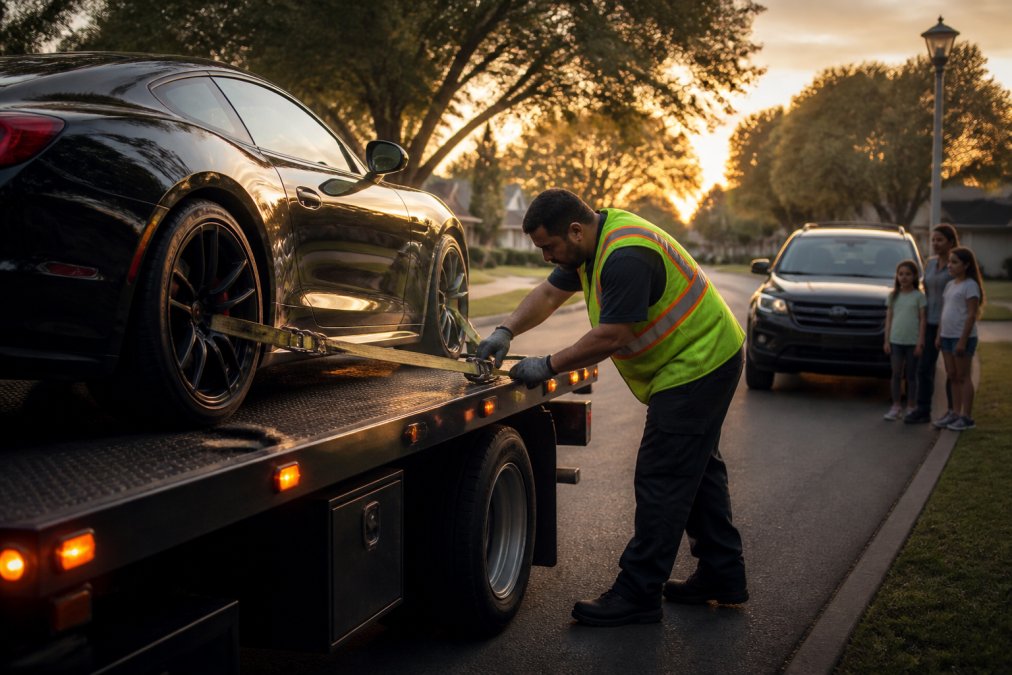
For any electric vehicle, insist on a flatbed and ask the dispatcher how the operator plans to secure it. A confident, specific answer is a good sign. A vague one is not.
Hidden Fees to Watch Out For (And How We Avoid Them)
Predatory billing is a real problem in this industry, which is why we tell every caller our numbers before we roll.
The Fees That Surprise People Most
- Fuel surcharge added after the fact instead of quoted upfront.
How After-Hours and Holiday Surcharges Actually Work
Ask two questions when you call after hours:
- Is there an after-hours or holiday premium on this call?
- Is the number you just gave me the total, or will anything else be added?
How Insurance Reimbursement Changes What You Pay
- Pay the tow company directly at the time of service, then file a claim for reimbursement.
- Submit the receipt, which is why you should always ask for an itemized invoice, not a handwritten total.
- The insurer reimburses up to your policy limit, often a flat dollar amount per tow or per year rather than the full bill.
Ask for an itemized invoice every time, even on a small roadside call. It’s the document your insurer needs, and it’s the document that protects you if a charge doesn’t match what you were quoted.
Payment Methods and What to Expect at the Scene
The best protection against hidden fees isn’t a checklist, it’s a dispatcher who will give you a total number before the truck rolls and put it in writing. If they won’t, keep calling. There’s no shortage of tow trucks in this metro, and the honest ones are easy to find once you know what to ask.
How to Get an Accurate Tow Quote Before You Commit
- Your exact location, including the cross street or mile marker
- The make, model, and year of your vehicle
- Whether the vehicle rolls, steers, and brakes
- Where you want it delivered
- Whether it’s an EV, AWD, or low-clearance vehicle
| What You Need | Why It Matters | What to Have Ready |
|---|---|---|
| Exact location | Determines mileage and access | Cross street or mile marker |
| Vehicle details | Sets equipment and pricing tier | Make, model, year |
| Vehicle condition | Standard tow vs. winch-out | Does it roll and steer? |
| Destination | Calculates total distance | Shop address or home |
| Vehicle type | Flatbed vs. wheel-lift | EV, AWD, or low-clearance |
Ask whether the quote includes the mileage rate or just the hook-up fee. Those are two different numbers, and confusing them is the single most common reason a final bill comes in higher than expected.
Conclusion
The gap between a fair tow bill and an outrageous one usually comes down to transparency, and too many drivers only find out which one they got after the truck has left.
Frequently Asked Questions
What is a fair price for a tow truck in Tulsa?
Fair pricing in Tulsa follows a clear structure: a base hook-up fee plus a per-mile rate. Local factors like distance, vehicle type, and time of day affect the final number. Always ask for a full breakdown before the truck arrives.
What factors influence the cost of a tow truck in Tulsa?
Distance is the biggest variable, followed by vehicle type and condition. A standard sedan on a wheel-lift costs less than a low-clearance sports car or an EV that needs a flatbed. Time of day matters too; after-hours surcharges apply on nights, weekends, and holidays. Winch-out recovery from a ditch or mud adds labor. Traffic on I-44 or the IDL can also affect dispatch timing and total cost.
Does my insurance cover the cost of a tow truck?
Many auto insurance policies include roadside assistance or towing reimbursement, but coverage varies. Check your policy for a roadside rider or towing benefit. If you have coverage, ask the dispatcher for an itemized receipt with the date, time, mileage, and service type. Most insurers reimburse after you pay out of pocket, so keep your paperwork. Some policies pay the tow company directly if you call the number on your card first.
How does distance affect the total price of a tow?
After the base hook-up fee, towing companies charge a per-mile rate. A short hop from downtown Tulsa to a nearby shop might only add a few miles. A longer transport from Bixby to Owasso or Broken Arrow to Sapulpa adds more. Long-distance transport to another city costs significantly more. Ask for the total mileage estimate upfront so there are no surprises.
What is the difference between a hook-up fee and mileage charges?
The hook-up fee covers the labor and equipment to connect your vehicle to the tow truck, including wheel-lift or flatbed setup. It is a flat charge regardless of distance. Mileage charges apply per mile driven after hook-up. Some companies quote only the hook-up fee to sound cheaper, then add mileage later. A transparent quote includes both the hook-up fee and the estimated mileage charge so you see the full picture.
Why do emergency towing rates differ from scheduled transport?
Emergency towing happens when you are stranded, often on a highway shoulder or in a parking lot after hours. It requires immediate dispatch, which may mean overtime labor, priority routing, and after-hours surcharges. Scheduled transport is planned in advance, often during business hours, and can be batched with other jobs. That flexibility lowers the cost. If your vehicle is safe and you can wait, a scheduled tow is usually less expensive.