
Table of Contents
- Stay Calm and Get to a Safe Spot First
- How to Find Your Location on a Highway
- Send Location to Roadside Assistance Step by Step
- What to Tell a Tow Truck Dispatcher When You Call
- Roadside Assistance Location Details That Speed Up Dispatch
- Troubleshooting When You Can’t Pinpoint Your Location for a Tow Truck
- Conclusion
- Frequently Asked Questions
Last Updated: October 6, 2026
Stay Calm and Get to a Safe Spot First
Knowing how to identify your tow truck location starts with one thing: getting yourself out of danger before you worry about anything else.
Here at Neptune Towing, we’ve handled calls across Tulsa, Jenks, Bixby, and Broken Arrow since 2019, and the safest calls always follow the same order.
- Turn on your hazard lights immediately
- Move to the right shoulder if your car will roll
- Stay in the car if you’re on a busy highway like I-44 or US-169
- Exit on the passenger side only if you can get well away from traffic
Once you’re safe, take a breath. Now you can work on pinpointing where you are.
How to Find Your Location on a Highway
Finding your location on a highway comes down to two things: reading what’s around you and using the tools already in your pocket. You don’t need to be a map expert.
Read the Signs Around You
Highways are built to tell you where you are. You just have to look.
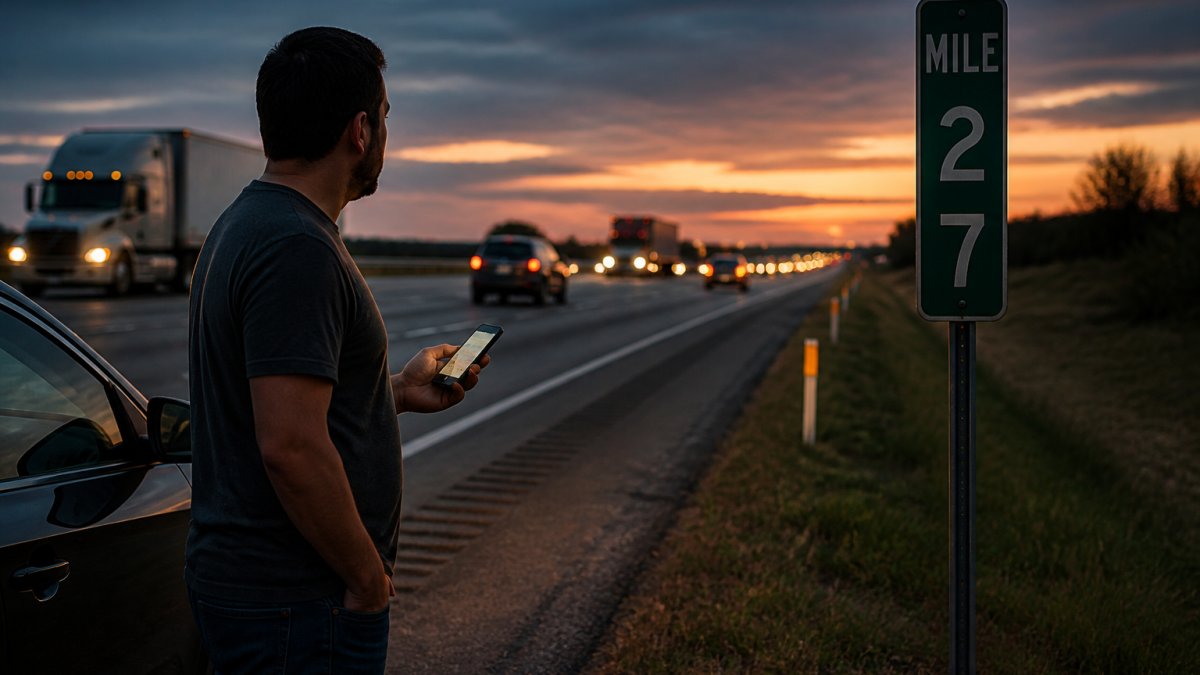
- Mile markers are the single most useful detail. They sit on the right shoulder, usually on a small green post.
- Exit numbers often match the mile marker, so “Exit 224” tells the dispatcher roughly where you are.
- Highway shields show the road name, like I-44, US-169, or SH-51.
- Direction of travel matters. Eastbound and westbound lanes can be miles apart.
A common mistake is assuming your street address is enough. On a highway, it rarely is. The dispatcher needs the road, the direction, and a nearby marker.
The Highway Reporting Sequence
When you call, work through these six items in order. This sequence works on any highway in the area.
- Road name, I-44, US-169, SH-51, the Creek Turnpike, whatever shield you last saw.
- Direction of travel, eastbound, westbound, northbound, southbound. On a divided highway this is the difference between a two-minute find and a twenty-minute search.
- Nearest exit or mile marker, “just past Exit 224” or “near mile marker 223” both work.
- Lane or position, right shoulder, left shoulder, median, or still in a live lane.
- A recognizable landmark, the Arkansas River bridge, a specific overpass, a named business, a water tower.
- Vehicle description, make, model, color, and plate.
If you can only remember two of those, give the road and the direction. That alone narrows the search to one side of one highway.
Use Your Phone’s Map App for GPS Coordinates
Your phone can give you exact numbers in seconds. Open Google Maps or Apple Maps, and a blue dot will show your position. Tap and hold that dot, and the app drops a pin with GPS coordinates you can read aloud.
Those coordinates are the most precise location detail you can give. They work even when there’s no street address nearby, which happens a lot on rural stretches outside Glenpool or Owasso.
If your signal is weak, screenshot your map before you call. The pin stays visible on the screenshot even if your connection drops mid-call.
Stay Safe While You Check Your Phone
Looking down at a phone on the shoulder of a highway is one of the most dangerous things a stranded driver can do. A few habits keep you out of harm’s way while you gather your location:
- Stay in the vehicle with your seatbelt on if you’re on a busy highway like I-44 or US-169, and check your phone from the driver’s seat.
- If you must exit, use the passenger-side doors so you’re stepping away from traffic, not into it.
- Never stand between your car and the traffic lane to read a sign or a screen.
- Don’t walk down the shoulder to find a mile marker. Read the one nearest you from inside the car, or ask the dispatcher to help you estimate from the last exit you passed.
If you’re on a bridge, in a tunnel, or on a curve where drivers can’t see you, staying buckled in is the safer call. A tow truck can find you, but it can’t undo a bad decision made in the first two minutes.
Once you’re safe and you have your road, direction, and nearest marker, you’re ready to make the call.
Send Location to Roadside Assistance Step by Step
Sending your location to roadside assistance takes about 30 seconds, and it removes almost all the guesswork from dispatch. Here’s exactly how to do it on the two most common phones.
On iPhone (Apple Maps):
- Open the Maps app and tap your blue location dot
- Tap “Share My Location” or use the share sheet
- Choose Messages and send it to the dispatcher’s number
On Android (Google Maps):
- Open Google Maps and tap your blue dot
- Tap “Share location” and pick how long to share it
- Send it via text to the number you’re given
The universal method that works on any phone:
- Open your texting app
- Start a new message to the dispatcher’s number
- Tap the attachment or plus icon
- Choose “Location” and send
One quick note on privacy: live location sharing is temporary, and you control when it stops. Share only with the dispatcher, and turn it off once the truck arrives.
Don’t share your live location with a number you didn’t call yourself. Only send it to the dispatcher you’re actively speaking with.
What to Tell a Tow Truck Dispatcher When You Call
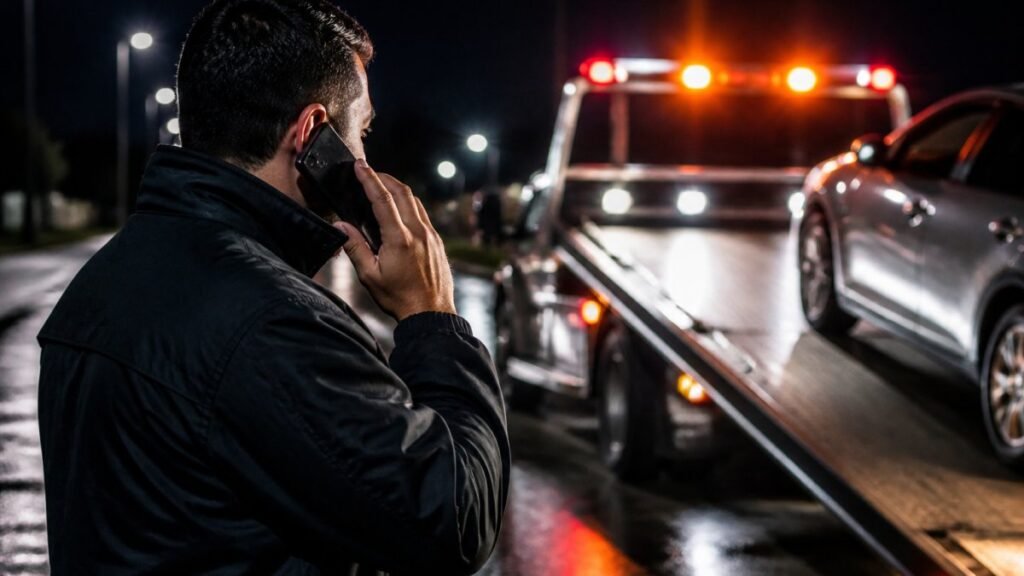
What to tell a tow truck dispatcher matters more than most drivers realize. The right details get a truck rolling faster. The wrong ones cause delays and repeat calls.
Start with your location, then work through this list:
- Your exact location or nearest cross street
- Highway name and direction of travel
- Vehicle make, model, color, and license plate
- What’s wrong, like a flat, dead battery, or no start
Your tow truck location is the detail dispatchers care about most, and giving the street address or nearest cross street is the fastest way to help them find you. Everything else helps the driver arrive prepared with the right equipment.
A Call Script You Can Read From
You don’t have to memorize anything. Read this out loud, filling in the blanks, and the dispatcher will have everything they need in under a minute:
“Hi, I need a tow. I’m on [road name] heading [direction], just past [nearest exit or mile marker]. I’m on the [right shoulder / left shoulder / in a parking lot]. I’m driving a [year, make, model, color] with a [license plate]. The problem is [flat tire / dead battery / won’t start / accident]. There are [number] people with me, including [kids / pets / someone with mobility needs]. My callback number is [number]. I’m [safe / still in a lane].”
That one paragraph covers location, vehicle, problem, hazards, passengers, accessibility, and callback, the six things a dispatcher actually needs to dispatch the right truck to the right spot.
Details Beyond Location That Change the Dispatch
Most drivers focus on where they are. The details below are what determine which truck gets sent and what equipment the driver brings:
- Hazards, Are you in a live lane? Is there debris, a fluid leak, or a fire risk? Say so first, before anything else.
- Passengers and pets, A driver with three kids and a dog needs a different plan than a solo driver. Mention them up front.
- Accessibility needs, If someone in the vehicle uses a wheelchair, has limited mobility, or can’t safely exit on the shoulder, tell the dispatcher. It changes how the driver approaches the scene.
- Vehicle type, A Tesla or other EV needs flatbed towing, not a wheel-lift. Say the word “EV” or “Tesla” so the right truck is sent. The same goes for all-wheel-drive vehicles.
If You’re Not Sure What to Say
Keep it simple. “I’m on westbound I-44 just past the Riverside Drive exit, mile marker 223, in a silver Honda Civic with a flat tire.” That one sentence tells a dispatcher almost everything.
If you’re flustered, the dispatcher will walk you through it. They ask these questions all day. Answer what you can, and if you don’t know something, say so, guessing at a location is worse than admitting you’re not sure.
A dispatcher would rather hear six small details than one vague sentence. Specifics beat confidence every time.
Roadside Assistance Location Details That Speed Up Dispatch
Roadside assistance location details are the difference between a fast pickup and a frustrating wait. Small, specific facts cut real minutes off your wait time.
- Lane position: Are you on the shoulder, in a parking lot, or on a side street?
- Which side of the road: Northbound or southbound? This matters on divided highways.
- Nearest exit or intersection: “Just past the 71st Street exit” beats “somewhere on 169.”
- A landmark: A named business, a bridge, or a water tower all help.
- Vehicle position: Facing which way? Parked or in a ditch?
Here’s a quick reference for what to gather before you dial:
| Detail | Why It Helps | Where to Find It |
|---|---|---|
| Mile marker | Pins your spot on the highway | Right shoulder post |
| Direction of travel | Narrows which side you’re on | Your lane and signs |
| Nearest exit | Gives a searchable reference | Overhead signs |
| Cross street | Works well on city roads | Street signs |
| GPS coordinates | Most precise option | Map app pin |
| Vehicle description | Helps the driver spot you | Your own car |
The more of these you can give, the less time the driver spends searching.
Troubleshooting When You Can’t Pinpoint Your Location for a Tow Truck
Sometimes the map won’t load, the signal drops, or you genuinely have no idea where you are. When you can’t pinpoint your location for a tow truck, don’t panic.
- No signal at all: Walk a short distance toward higher ground or an open area, but stay off the road.
- Map app frozen: Force-close it and reopen. Screenshot your last known position.
- No address nearby: Give the last exit you passed and the direction you were heading.
- Unsure of the road: Read the highway shield on the nearest sign out loud to the dispatcher.
- Phone about to die: Give your location first, then your callback number, then details.
The dispatcher can often work backward from the last exit you remember. If you were heading east on I-44 and passed the Peoria exit, that single fact narrows the search a lot.
If you can, note the last exit sign you saw before you broke down. That one detail often does more than anything else when GPS fails.
Conclusion
A breakdown is stressful, but it doesn’t have to be confusing. Get safe, find your markers, share your location, and give the dispatcher clear details.
When you need a tow truck in Tulsa or roadside assistance near you, Neptune Towing is ready. We’re owner-operated, we provide damage-free towing on a flatbed, and we don’t impound vehicles. You deal directly with a local owner, not a call center.
Frequently Asked Questions
How do I tell a tow truck driver where I am?
Give the dispatcher your street address or the nearest cross street first, then add the road name, direction of travel, and a landmark like a mile marker, exit number, or business sign. If you can, share a live location pin from your phone’s map app. The more precise your pickup point, the faster the tow truck finds you.
Can I send a map pin to a tow truck driver?
Yes. Open your map app, press and hold your location until a pin drops, then tap Share and text it to the dispatcher’s callback number. This works on both iPhone and Android. A pin is especially useful on highways where there is no street address. Always confirm the dispatcher received it before ending the call.
What if I don’t know the road or highway I’m on?
Check the last road sign you passed, look for a mile marker, or name the nearest exit or landmark. If you still can’t tell, share a live location from your phone or read your GPS coordinates aloud. Even one detail like a nearby business or bridge name helps dispatch locate the vehicle.
What information does a tow truck dispatcher need besides my location?
Be ready to give your vehicle’s make, model, color, and license plate, plus whether it’s in a safe spot, if it’s an EV or low-clearance vehicle, and a callback number. Mention any passengers, pets, or hazards. These roadside assistance location details help the operator arrive prepared with the right equipment.