
Table of Contents
- Comparing the Top Roadside Assistance Plans for EV Drivers
- 1. AAA: Best for Nationwide Coverage and EV Perks
- 2. Better World Club: A Green Choice for EV Owners
- 3. Good Sam: Unlimited Towing Distance for Long Trips
- 4. Oklahoma Farm Bureau Roadside Rescue: A Local Option
- 5. Progressive: A Low-Cost Add-On for Policyholders
- 6. Erie Insurance: Budget-Friendly with Unlimited Calls
- 7. Geico: Convenient App-Based Roadside Service
- EV Towing Tulsa: Why Flatbed Towing Matters for Your Battery
- Making the Right Choice for Your EV
- Frequently Asked Questions
Last Updated: September 6, 2026
Comparing the Top Roadside Assistance Plans for EV Drivers
Electric vehicle ownership brings worries gas drivers rarely think about. When your battery dies on I-44, a standard tow truck can cause drivetrain damage. Choosing the right roadside assistance plan for your EV matters as much as picking the right charging station.
The market has responded to this need. Industry research from Agero’s survey of over 2,500 drivers shows roadside assistance is a top-of-mind priority for modern drivers, with clear demand for specialized support services. At Neptune Towing, we understand this firsthand across Tulsa, Jenks, Bixby, and Broken Arrow. EV owners need flatbed towing, proper battery handling, and providers who understand the unique requirements of electric drivetrains.
Quick Picks:
- Best Overall: AAA, nationwide coverage with EV-specific perks
- Best for Green Drivers: Better World Club, sustainability-focused with EV expertise
- Best Local Option: Oklahoma Farm Bureau Roadside Rescue, tailored to state residents
- Best Budget Add-On: Erie Insurance, unlimited calls for around $5 per year
1. AAA: Best for Nationwide Coverage and EV Perks
AAA remains the gold standard for roadside assistance plans, and for good reason. Membership plans start at less than $6 per month, according to AAA’s roadside assistance pricing, making it accessible for most drivers.
What sets AAA apart is the scale of their service network. Whether commuting through Tulsa or road-tripping across Oklahoma, you’re never far from a AAA-affiliated provider. Their 24/7 dispatch handles jump-starts, lockouts, and towing.
The main drawback is annual billing, a larger upfront commitment. But for EV drivers who want peace of mind anywhere, AAA’s coverage radius is hard to beat.
2. Better World Club: A Green Choice for EV Owners
Better World Club has carved out a niche as the environmentally conscious alternative to traditional motor clubs. Their Basic Auto plan costs approximately $57 per year for EV drivers, as reported by SmartFinancial’s analysis of EV roadside coverage.
They actively target the EV market with specialized plans, understanding that EVs and hybrids need different battery service and towing techniques than gas-powered cars.
The tradeoff is a smaller network than AAA. Around the Tulsa metro, that’s rarely an issue; on cross-country trips, you might find fewer covered providers in rural stretches.
3. Good Sam: Unlimited Towing Distance for Long Trips
Good Sam takes a different approach: unlimited towing distance to the nearest service center. For EV drivers who worry about range anxiety on long Oklahoma highways, that’s a meaningful safety net.
Their plans cover both vehicle and driver, which is unusual. Emergency fuel, battery assistance, flat tire changes, and lockouts come standard.
Pricing varies by coverage level, so you’ll need a quote. Customer satisfaction ratings are consistently high, which counts when you’re stranded at 2 AM.
4. Oklahoma Farm Bureau Roadside Rescue: A Local Option
For Oklahoma residents, the Oklahoma Farm Bureau’s Roadside Rescue program offers something national providers can’t: genuine local knowledge. This member benefit includes 24/7 emergency fuel, battery jump-starts, lockout assistance, and towing for disabled vehicles.
It delivers up to 3 gallons of emergency fuel, a lifesaver if you misjudge your range on a rural route, and integrates with other Farm Bureau member benefits.
The limitation: you must be an active Farm Bureau member. For Tulsa-area EV owners who qualify, it’s a solid local safety net; for others, a standalone plan makes more sense.
5. Progressive: A Low-Cost Add-On for Policyholders
Progressive offers towing coverage for as little as $13 per year as an add-on to your existing auto insurance policy, according to Insurify’s breakdown of towing coverage options. Some plans include up to 200 miles of towing coverage per year, which is generous for the price.
The convenience is significant: one bill, one app, and one customer service line. Jump-starts, flat tire changes, and lockouts are included.
The downside: it only works if you’re already a Progressive policyholder, and insurance add-ons typically have stricter limits than standalone memberships. Read the fine print on towing distance before you need it.
6. Erie Insurance: Budget-Friendly with Unlimited Calls
Erie Insurance takes the budget crown at around $5 per year. The standout feature is unlimited service calls, so you won’t hesitate to call for a jump start.
Coverage includes towing up to 20 miles, jump-starts, flat tire support, and lockouts. For Tulsa commuters, 20 miles covers most trips to a repair shop.
The limitation is that 20-mile radius. If your EV dies on a longer highway stretch, you could exceed it before reaching a qualified service center. For most local driving, it’s adequate.
7. Geico: Convenient App-Based Roadside Service
Geico’s roadside assistance add-on is remarkably easy to use. The mobile app requests service with a few taps, and dispatch operates 24/7 nationwide.
Towing, labor, battery service, lockouts, and tire changes are included. For Geico policyholders, it’s a seamless addition.
The main limitation: it’s only available to current Geico customers. If you’re already with Geico, it’s worth adding; otherwise, switching insurers for this isn’t worth the hassle.
EV Towing Tulsa: Why Flatbed Towing Matters for Your Battery
Most plan comparisons stop at features like “towing up to 100 miles.” They rarely explain the most important detail for an EV owner: how your vehicle gets towed. It’s the difference between a minor inconvenience and a repair bill in the thousands.
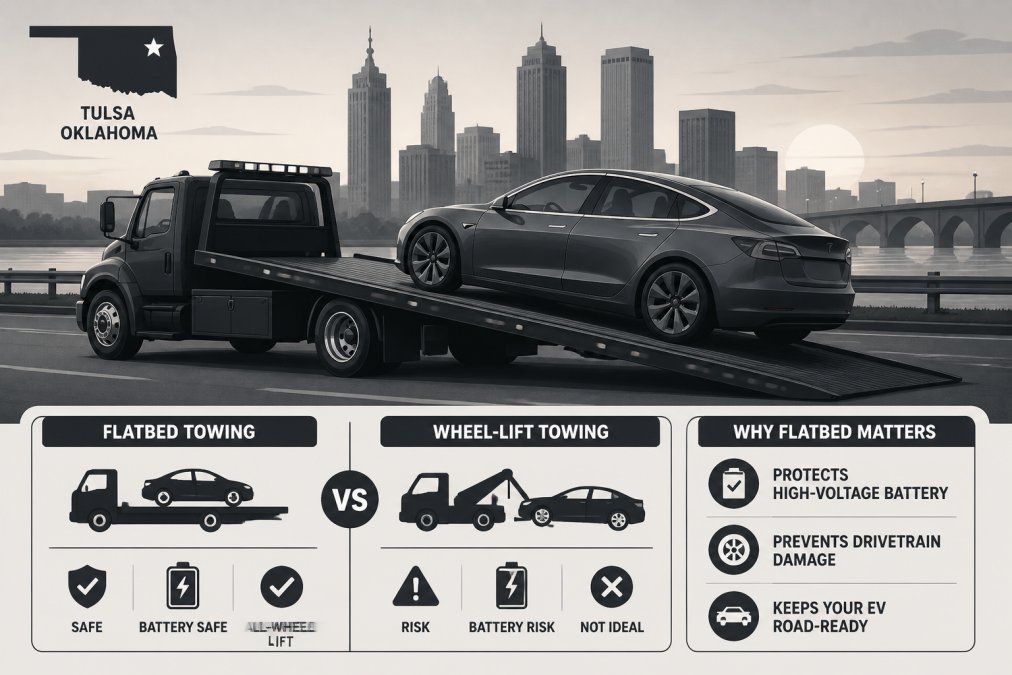
Here’s the problem: EVs use a direct-drive system connected to the wheels. Unlike a gas engine that idles in neutral, an EV’s motor can still spin when the drive wheels turn. When a wheel-lift truck hoists your Tesla, Nissan Leaf, or Ford F-150 Lightning, the spinning wheels force the motor to rotate without lubrication, generating heat that damages bearings and potentially the gearbox.
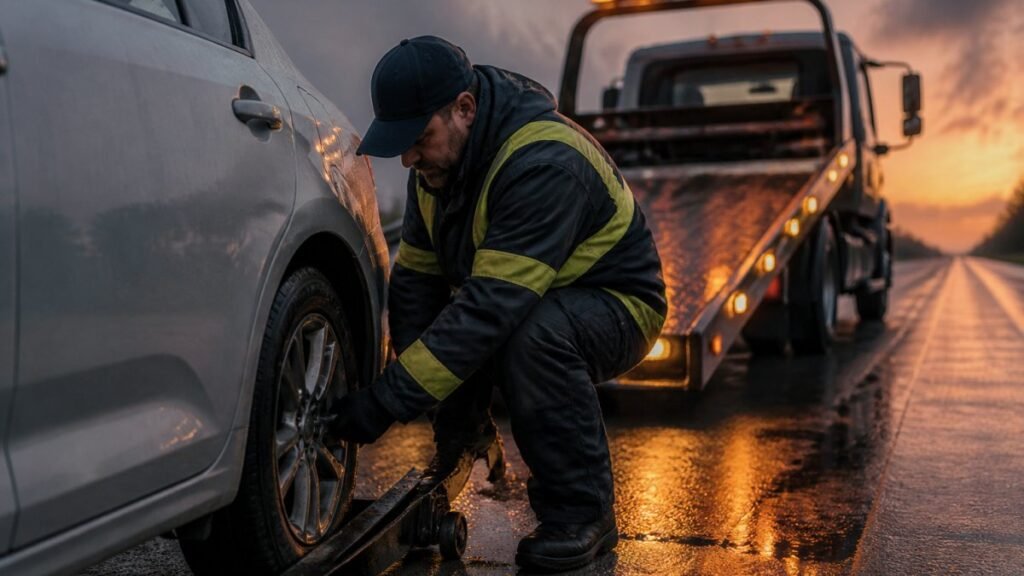
That’s why every major EV manufacturer, including Tesla, mandates flatbed towing in its owner’s manual. A flatbed tow truck lifts the entire vehicle onto a level platform, keeping all four wheels off the ground. This is the only damage-free method for transporting an EV.
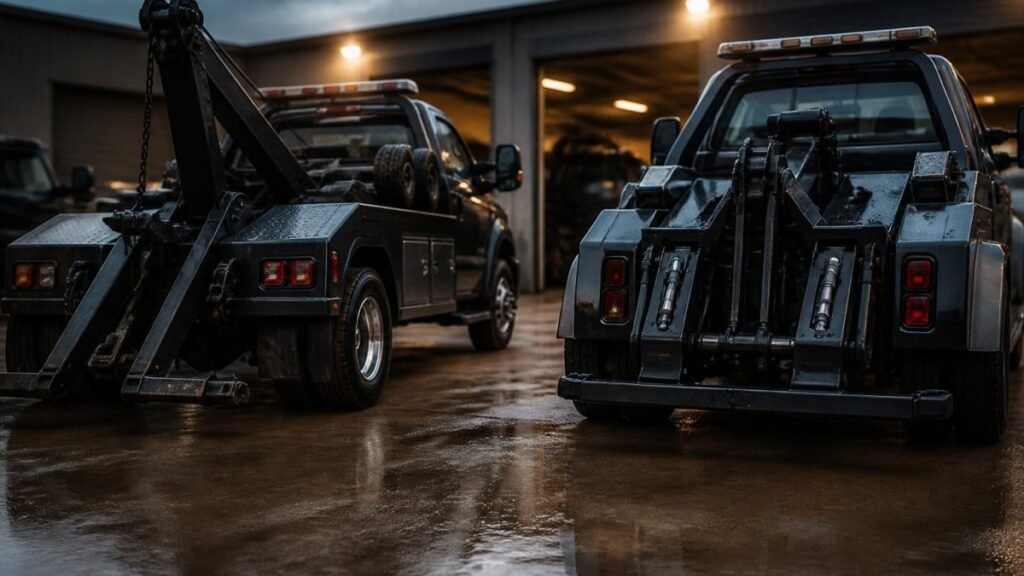
When you call a roadside assistance plan, you don’t choose the truck that shows up. If their network dispatches a wheel-lift truck to the Broken Arrow Expressway or a rural stretch of Highway 51, the driver might not understand EV towing, and you could be forced to decline and wait all over again.
This is where knowing your local towing company matters. Neptune Towing is an owner-operated towing service in Tulsa that uses flatbeds exclusively for EVs and Teslas. When you call us for emergency towing Tulsa drivers can rely on, we arrive with the right equipment, from proper tie-down points to keeping the battery secure.
Improper EV tows can lead to significant drivetrain damage. For example, a Tesla Model 3 towed with a wheel-lift after a minor fender bender on I-44 could suffer drivetrain damage that an insurance company might initially balk at covering. Such repairs can be costly, whereas a flatbed tow, which costs the same, would prevent such damage.
:::warning
Never let a standard tow truck hook up your EV unless it’s an absolute emergency. Wheel-lift towing can cause irreversible damage to the electric motor and drivetrain. Always request flatbed towing for Teslas and other electric vehicles.
::: installing home EV chargers.
Your roadside plan is a promise to send help, but the quality depends on who they send. Check whether your plan’s local providers have flatbeds and EV experience. If not, find a plan that does, or keep a trusted local flatbed company like Neptune Towing saved in your phone.
Making the Right Choice for Your EV
Choosing the right roadside plan for your EV in Oklahoma comes down to more than comparing monthly prices. It’s about understanding three distinct ways to get coverage, each with trade-offs most national guides ignore.
Option 1: Your Auto Insurance Policy (The Add-On)
This is often the cheapest and most convenient route. Companies like Progressive, Geico, and State Farm offer it as an add-on for a few dollars per month. The advantages are simplicity and cost: one bill, one app, one number, no separate membership card.
The trade-offs are significant. These add-ons are usually limited to 15 to 20 miles of towing. If your EV dies on a remote western Oklahoma highway, 20 miles might not reach a qualified service center, and you’ll pay the difference. Coverage is tied to your policy, so switching insurers means losing it, and you miss perks like trip interruption or rental reimbursement.
Option 2: Standalone Motor Club Memberships (The Comprehensive Choice)
This route suits drivers who want predictable, nationwide coverage not tied to insurance. AAA is the most well-known, but others like Better World Club exist. These memberships bill annually, offer a set number of calls with longer towing distances, and often cover you in any car, not just your own.
The downside is upfront cost for a full year, even if unused. And you still need to verify the club’s local Tulsa network has flatbeds capable of handling your EV.
Option 3: Manufacturer-Provided Roadside Assistance (The Hidden Safety Net)
This is the most overlooked option. New EVs almost always come with manufacturer roadside assistance. Tesla, Ford, Chevrolet, and Hyundai include complimentary coverage for the first few years, a benefit many owners forget.
These plans have limitations. They’re valid only during the warranty period, often 3 to 5 years or a mileage limit, and tied to the vehicle, not the driver. Coverage is basic, with limited towing to the nearest authorized dealership. If your EV dies far from one on a road trip, you could face a massive bill for extra distance.
The Local Reality in Tulsa
No national guide will tell you this: your plan is only as good as the truck that shows up. A membership card doesn’t help if the dispatched provider lacks a flatbed or doesn’t understand Tesla towing. Oklahoma’s charging infrastructure is growing but still sparse, making a rural breakdown between Tulsa and Oklahoma City very different from one in the metro.
That’s why we advise drivers to do two things: understand exactly what your plan covers and its limitations, and have a backup plan. Know a local towing company you can trust to handle your EV properly, regardless of what your plan says.
At Neptune Towing, we are that backup plan across Tulsa, Jenks, Bixby, Broken Arrow, and Owasso. As an owner-operated business, we answer our own phones and show up when we say we will. We provide damage-free flatbed towing for Teslas and all EVs, and we never impound vehicles. When you need a tow truck Tulsa drivers can count on, you call us.
Frequently Asked Questions
How does roadside assistance for an electric car differ from a gas vehicle?
The main difference is towing procedure. EVs must be transported on a flatbed to prevent severe drivetrain damage, as hooking a cable under the wheels can generate electricity and destroy the motor. Roadside assistance plans for EVs also increasingly include mobile charging for drivers who run out of power. A standard plan might not cover the specialized equipment or procedures required, so you need to confirm your provider is equipped for EV towing.
Is AAA worth it for electric vehicle owners?
For many EV owners, AAA is worth it because of its large service network and 24/7 availability. Membership plans start at less than $6 per month and cover services like battery jump-starts, lockouts, and towing. However, its EV-specific support, including mobile charging, can vary by region. If you frequently drive long distances in Oklahoma, the nationwide coverage and extensive network of providers that understand flatbed towing requirements can provide valuable peace of mind.
What should I look for in an EV roadside assistance plan in Oklahoma?
Prioritize plans that explicitly state they use flatbed towing to avoid drivetrain damage. Check the towing distance limits, as some plans cap it at 20 miles. Confirm if mobile charging is offered, and review the service radius and dispatch time for your area. Also, consider whether the plan is a standalone membership, like AAA, or an add-on to your auto insurance. A local towing company in Tulsa may also offer specialized EV towing services.
Does my standard auto insurance policy cover EV-specific roadside needs like Tesla towing?
A standard policy often provides basic roadside assistance, but it may not cover the specific needs of an EV. For example, Tesla towing requirements mandate a flatbed, and some insurance add-ons may not guarantee that equipment or have technicians trained for it. Check your policy for exclusions related to EVs. You may need a specialized plan, like Better World Club, or a local provider that explicitly offers EV towing to ensure your vehicle is handled safely.
What happens if my EV runs out of charge on an Oklahoma highway?
Your first call should be to a roadside assistance provider that offers mobile charging. Some plans include this service for as little as $25 per year. If mobile charging isn’t available or isn’t feasible, the vehicle will need to be towed on a flatbed to the nearest charging station. Given the charging infrastructure gaps in some parts of Oklahoma, it’s wise to know the location of charging stations along your route and have a plan with a service radius that covers your travel.
Choosing the right roadside assistance plan is only half the equation. The other half is knowing who will actually respond when your EV dies on the highway. Neptune Towing pairs damage-free flatbed towing with transparent pricing and fast dispatch across Tulsa and surrounding communities. Call (539) 292 3074 and get the help you need from a local owner who treats your vehicle like his own.