
Table of Contents
- What Is the Move Over Law in Tulsa?
- Move Over Law Requirements in Oklahoma
- Move Over Law Penalties in Oklahoma
- Move Over Law Exceptions in Oklahoma
- Emergency Vehicle Laws in Oklahoma
- How to React When You See Flashing Lights
- Move Over Law Enforcement in Tulsa
- Why Roadside Safety Matters: A Local Perspective
Move Over Law Tulsa: What Drivers Need to Know
Last Updated: July 22, 2026
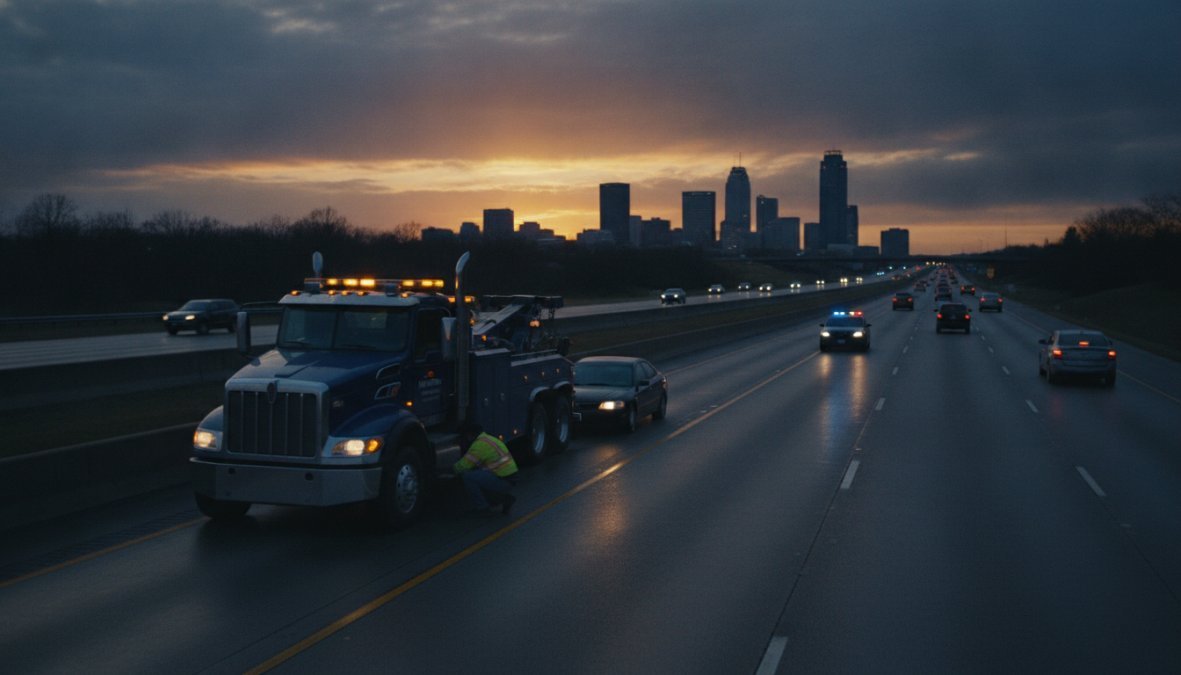
When you see a tow truck with amber lights flashing on the shoulder of I-44 near Tulsa, the Move Over Law Tulsa requires you to slow down and change lanes if safe to do so. This is a legal requirement in Oklahoma designed to protect emergency responders, roadside workers, and towing professionals exposed to traffic. At Neptune Towing, we’ve seen firsthand how dangerous the roadside can be, which is why understanding this law matters for every driver in the Tulsa area.
What Is the Move Over Law in Tulsa?
The Move Over Law in Oklahoma requires drivers to yield the right-of-way to stopped emergency vehicles and roadside assistance vehicles. When you see flashing lights ahead, whether amber, red, or blue, you must move to an adjacent lane away from the vehicle or slow to a safe speed below the posted limit.
This law exists because roadside work is dangerous. Emergency responders, law enforcement, construction workers, and towing professionals step into active traffic to help stranded motorists or investigate accidents. A distracted or speeding driver can cause catastrophic collision in seconds. The law applies on all Oklahoma roadways, including Interstate 44, Highway 51, Memorial Drive through central Tulsa, and rural roads in Sapulpa, Broken Arrow, and Glenpool.
How Oklahoma’s Move Over Law Works
When you approach a stopped vehicle with flashing lights, you have two options: move to an adjacent lane, or reduce your speed significantly. "Safe speed" typically means slowing 20 miles per hour below the speed limit or lower, depending on traffic and visibility. If moving to another lane isn’t possible due to traffic or road conditions, you must slow down. The flashing lights trigger the requirement, amber lights on a tow truck, red and blue on a police vehicle, or red on a fire truck all activate the Move Over Law.
Why This Law Matters for Tulsa Drivers
Roadside incidents happen daily across the Tulsa metro area. A blown tire on I-44, a dead battery on Harvard Avenue, an accident on 21st Street, in each scenario, someone steps into traffic. Drivers who are distracted, speeding, or unaware of the law create deadly hazards. A vehicle at highway speed can cover the distance between "I see the emergency vehicle" and "I hit it" in seconds. Slowing down and moving over gives everyone precious seconds to react and reach safety.
Move Over Law Requirements in Oklahoma
Vehicles Covered by the Law
The Move Over Law applies to several categories of stopped or slowly moving vehicles:
Emergency vehicles: Police cars, sheriff’s vehicles, state highway patrol vehicles, fire trucks, and ambulances with flashing emergency lights.
Tow trucks and roadside assistance vehicles: Flatbed tow trucks, wrecker trucks, and recovery vehicles actively assisting disabled vehicles with hazard or amber lights activated.
Maintenance and construction vehicles: Oklahoma Department of Transportation (ODOT) vehicles, road construction equipment, and utility service vehicles stopped on the roadside with flashing lights.
The key factor is flashing lights. If a vehicle is stopped or moving slowly on the shoulder with activated warning lights, the Move Over Law applies.
If you’re unsure whether a stopped vehicle requires you to move over, the safest approach is to assume it does. Slowing down costs seconds but could save a life.
When You Must Slow Down and Move Over
The Move Over Law applies whenever you encounter a stopped or slowly moving vehicle with activated flashing lights on the roadside: highway incidents with police and emergency vehicles, disabled vehicles with tow trucks actively loading, police conducting traffic stops on the shoulder, fire trucks or ambulances at scenes, and construction equipment or ODOT vehicles with hazard lights. The law applies in all weather conditions and at all times. You must begin slowing down or moving over as soon as you can safely do so.
Move Over Law Penalties in Oklahoma
Traffic Citations and Fines
A violation is a traffic citation resulting in fines and potential court costs. A first violation typically results in a citation with fines and points on your driving record, affecting insurance rates and driving privileges. A second violation within a certain timeframe results in higher fines and additional penalties. If your violation causes an accident or injury to a roadside worker, consequences escalate dramatically, potentially including substantial fines and jail time.
Insurance Implications of a Move Over Violation
A Move Over Law violation affects your auto insurance. When you receive a traffic citation, your insurance company receives notice through state motor vehicle records. Insurance companies use violations to adjust rates. A single moving violation can increase your annual premium by 10-20% or more, depending on your insurer and driving history, typically lasting three to five years.
If your violation resulted in an accident, the insurance impact is more severe. Your insurer may classify you as higher-risk, leading to substantial rate increases or policy cancellation.
A single Move Over Law violation can cost thousands in increased insurance premiums over following years. The seconds it takes to slow down and move over saves far more than it costs.
Move Over Law Exceptions in Oklahoma
When You Cannot Safely Move Over
The law requires you to move over or slow down when safe to do so. If moving to an adjacent lane would create a more dangerous situation, such as occupied traffic in the next lane, you are not required to change lanes. Instead, you must slow down to a safe speed. On two-lane roads with oncoming traffic and no safe passing opportunity, you cannot move over. Road construction or congestion may make lane changes impossible. These exceptions are narrow and apply only when moving over would create a safety hazard greater than the current situation.
Emergency Vehicle Laws in Oklahoma
First Responders and Highway Safety
Oklahoma law grants emergency vehicles special privileges on roadways. Police cars, fire trucks, and ambulances may exceed posted speed limits, run red lights, and drive against traffic when responding to emergencies. However, these privileges come with an implicit contract: drivers must yield to emergency vehicles and create safe conditions. The Move Over Law is your part of that contract. When you see flashing lights, you’re obligated to yield space and safety.
Emergency responders depend on driver compliance. A state highway patrol officer working a traffic stop on I-44’s shoulder is exposed to traffic at 70 miles per hour. A firefighter assisting at an accident is vulnerable. Your compliance directly affects their safety.
Construction Zones and Roadway Safety
Construction zones present unique hazards. Workers are often on the roadside, equipment is positioned in or near traffic lanes, and visibility may be reduced. Oklahoma law extends the Move Over Law to construction vehicles and maintenance equipment with activated warning lights. When you see orange cones, construction vehicles, or ODOT equipment with flashing lights, move over or slow down. Speeding through a construction zone puts workers at risk and violates Oklahoma law.
How to React When You See Flashing Lights
Step-by-Step Response Guide
Step 1: Identify the vehicle. As soon as you see flashing lights ahead, assess the situation.
Step 2: Signal your intention. Activate your turn signal well in advance to alert other drivers.
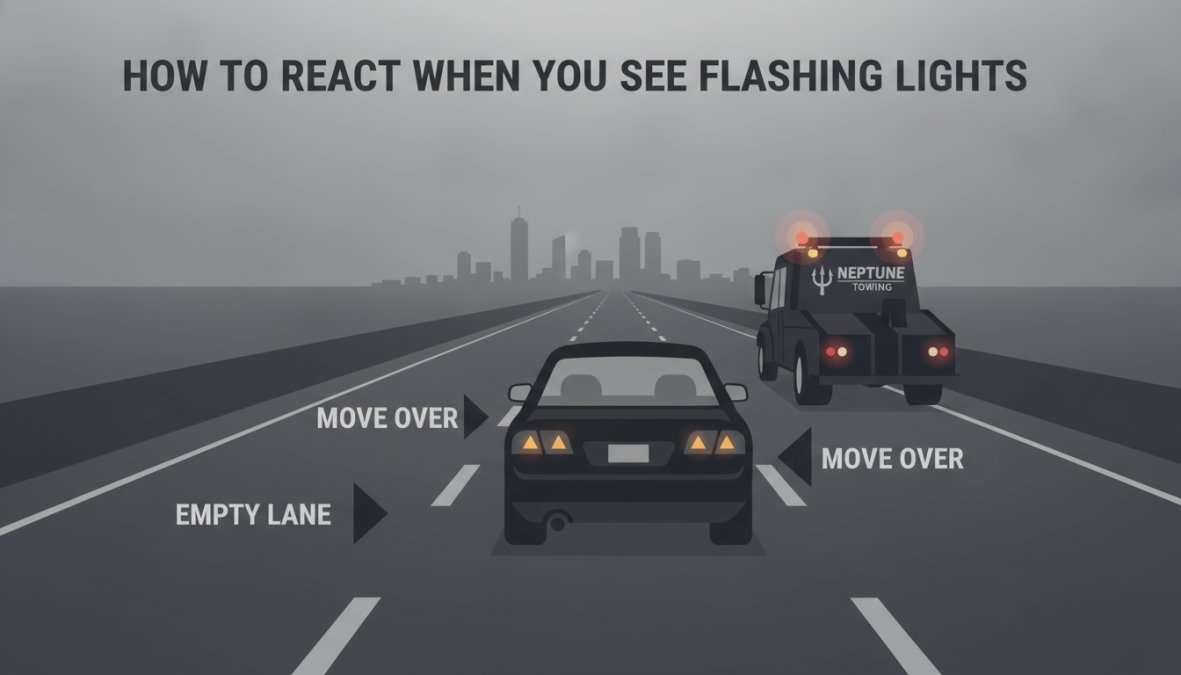
Step 3: Move over if safe. If you can safely change lanes away from the emergency vehicle, do so. Check mirrors and blind spots to ensure the adjacent lane is clear.
Step 4: Slow down if you can’t move over. If moving to another lane isn’t safe, reduce your speed significantly, drop 20 miles per hour below the posted limit or more.
Step 5: Maintain distance. Don’t attempt to pass the emergency vehicle or get closer.
Step 6: Resume normal driving only when safe. Once you’ve passed the emergency vehicle, gradually resume normal speed.
What to Do If You Break Down on the Highway
If your vehicle breaks down on a Tulsa-area highway, move it onto the shoulder if possible and turn on your hazard lights immediately. Stay in your vehicle with your seatbelt fastened unless there’s immediate danger. Call for help and provide your location clearly. When the tow truck arrives, our driver will position it safely and activate warning lights. Stay in your vehicle or move to a safe location away from traffic.
The safest place to wait for roadside assistance is inside your vehicle with doors locked and hazard lights on. Stay off the roadside and away from traffic.
Move Over Law Enforcement in Tulsa
Oklahoma Highway Patrol and Local Enforcement
The Oklahoma Highway Patrol (OHP) is the primary enforcer on interstate highways and state roads throughout Tulsa County and surrounding areas. Local police departments in Tulsa, Broken Arrow, Bixby, Jenks, Glenpool, Owasso, and Sapulpa enforce the law on city streets and local roads. Enforcement focuses on high-traffic areas where violations are most likely and dangerous. Officers can issue citations for failure to comply; you don’t have to hit the emergency vehicle to be cited.
Real-World Scenarios on Tulsa Highways
Scenario 1: Tow truck on I-44. A flatbed tow truck with amber lights is on the shoulder actively loading a disabled vehicle. You must move to the left lane if safe, or slow down significantly.
Scenario 2: Police traffic stop on Highway 51. An OHP trooper has pulled over a vehicle and stands on the shoulder with red and blue lights flashing. You must move over or slow down.
Scenario 3: Construction zone on 21st Street. Orange cones and construction equipment with flashing amber lights mark a work zone with visible workers. You must slow down.
Scenario 4: Accident on Memorial Drive. Fire trucks, ambulances, and police vehicles are on scene with lights flashing. You must slow down significantly and move over if possible.
Why Roadside Safety Matters: A Local Perspective
Roadside safety is personal for those who work on Oklahoma highways. When our tow truck is on the shoulder of I-44 with amber lights flashing, we’re exposed to traffic moving at 70 miles per hour. We depend on drivers like you to comply with the Move Over Law. The same principle applies to every emergency responder and roadside worker in Oklahoma. This law also protects you by reducing your own collision risk and improving visibility.
| Situation | Required Action | Why It Matters |
|---|---|---|
| Emergency vehicle with flashing lights on shoulder | Move over or slow down significantly | Protects responders and reduces collision risk |
| Tow truck actively loading a vehicle | Move over or slow down | Protects towing crew and stranded motorist |
| Police traffic stop on roadside | Move over or slow down | Protects officer from passing traffic |
| Construction zone with workers present | Slow down; obey posted speed limits | Protects workers and reduces accident severity |
| Disabled vehicle on shoulder with hazard lights | Slow down and move over if safe | Protects stranded driver and approaching traffic |
Understanding the Move Over Law is part of being a responsible driver in Oklahoma. When you see flashing lights ahead, slow down and move over. That simple action could save a life.
If you’re stranded on an Oklahoma highway or need roadside assistance in the Tulsa area, Neptune Towing is ready to help. We operate 24/7 across Tulsa, Broken Arrow, Bixby, Jenks, Glenpool, Owasso, Sapulpa, and surrounding communities. Our damage-free flatbed towing, jump start service, lockout assistance, and professional roadside help keep drivers safe. Call Neptune Towing at (539) 292-3074 for immediate assistance. We’re locally owned and owner-operated, treating every customer with respect and honesty.
Frequently Asked Questions
What is the Move Over Law in Tulsa, Oklahoma?
The Move Over Law in Oklahoma requires drivers to slow down and move to an adjacent lane when they see emergency vehicles, tow trucks, or roadside assistance vehicles with flashing lights on the roadway. If you cannot safely change lanes, you must reduce speed and proceed with caution. This law applies throughout Tulsa and all Oklahoma communities and is designed to protect first responders and roadside workers.
What are the penalties for violating the Move Over Law in Oklahoma?
Violating Oklahoma's Move Over Law can result in a traffic citation and fines. Beyond the immediate penalty, a Move Over violation can increase your insurance rates and create a traffic record that affects your driving history. The exact penalty depends on the circumstances and whether the violation resulted in an accident. It's a serious traffic violation that law enforcement and the Oklahoma Highway Patrol actively enforce.
What vehicles does the Move Over Law apply to in Oklahoma?
Oklahoma's Move Over Law applies to emergency vehicles including police cars, fire trucks, and ambulances. It also covers tow trucks and roadside assistance vehicles displaying flashing lights. The law extends to highway maintenance and construction vehicles in work zones. Any vehicle with hazard signals or amber lights indicating an emergency or roadside stop is covered under the statute.
What should I do if I need roadside assistance in Tulsa?
If you break down on a Tulsa highway or need emergency help, call a local towing service like Neptune Towing at (539) 292-3074 for immediate roadside assistance. Turn on your hazard lights and move to the shoulder if safe. Avoid standing in traffic. Professional roadside assistance is available 24/7 throughout Tulsa, Bixby, Broken Arrow, and surrounding communities to help with jump starts, tire changes, lockouts, fuel delivery, and vehicle recovery.
This article was written using GrandRanker

