
Table of Contents
- What Is the Move Over Law Oklahoma?
- Move Over Law Oklahoma Requirements for Drivers
- Oklahoma Move Over Law Penalties and Fines
- Oklahoma Move Over Law History and Background
- First Responder Safety Oklahoma: Why This Law Matters
- Tow Truck Safety Oklahoma: What You Should Know
- Exceptions and Special Situations
- Safety Tips for Highway Driving Around Emergency Vehicles
Move Over Law Oklahoma: What Drivers Need to Know
Last Updated: July 20, 2026
When you’re driving down I-44 near Tulsa or heading through Broken Arrow, you’ve probably seen tow trucks, police cars, or highway maintenance crews working on the shoulder. The Move Over Law Oklahoma exists to protect these workers and first responders. Violating it can result in serious penalties, but more importantly, ignoring this law puts real people at risk.
At Neptune Towing, we see the consequences of unsafe driving around roadside workers every day. Our operators work on Oklahoma highways in all conditions, and we’ve witnessed how quickly a distracted driver can turn a routine tow into a tragedy. This guide covers everything you need to know about the Move Over Law Oklahoma, why it matters, and how to stay safe.
What Is the Move Over Law Oklahoma?
The Move Over Law Oklahoma is a state statute designed to protect emergency responders, tow operators, and highway maintenance workers by requiring drivers to slow down and change lanes when approaching stationary vehicles with flashing lights. Oklahoma’s Move Over Law is codified in Title 47 of the Oklahoma Statutes and was strengthened through Senate Bill 89 and House Bill 1113, which expanded protections beyond law enforcement to include tow trucks, emergency medical services, and highway maintenance vehicles.
Senate Bill 89 and House Bill 1113
Senate Bill 89 and House Bill 1113 represent significant updates to Oklahoma’s Move Over Law, expanding protections and clarifying driver responsibilities. These bills reflect growing recognition that roadside workers face serious danger. According to the National Highway Traffic Safety Administration, hundreds of emergency responders and roadside workers are struck and killed annually while performing their duties.
Vehicles and Personnel Covered
The Move Over Law Oklahoma covers far more than just police cars. When you see flashing lights on the shoulder, the law applies to:
- Law enforcement vehicles (police cars, Oklahoma Highway Patrol)
- Emergency medical services (ambulances, paramedic units)
- Fire department vehicles (fire trucks, rescue units)
- Tow trucks (including private towing companies)
- Highway maintenance vehicles (ODOT trucks, road construction equipment)
- Utility service vehicles (electric company, gas company repair trucks)
The key trigger is flashing lights. If a vehicle is stopped or moving slowly on the roadside with flashing lights activated, the Move Over Law Oklahoma applies.
Move Over Law Oklahoma Requirements for Drivers
When you encounter a stationary vehicle with flashing lights on an Oklahoma highway, you have specific legal obligations.
Lane Change and Speed Reduction
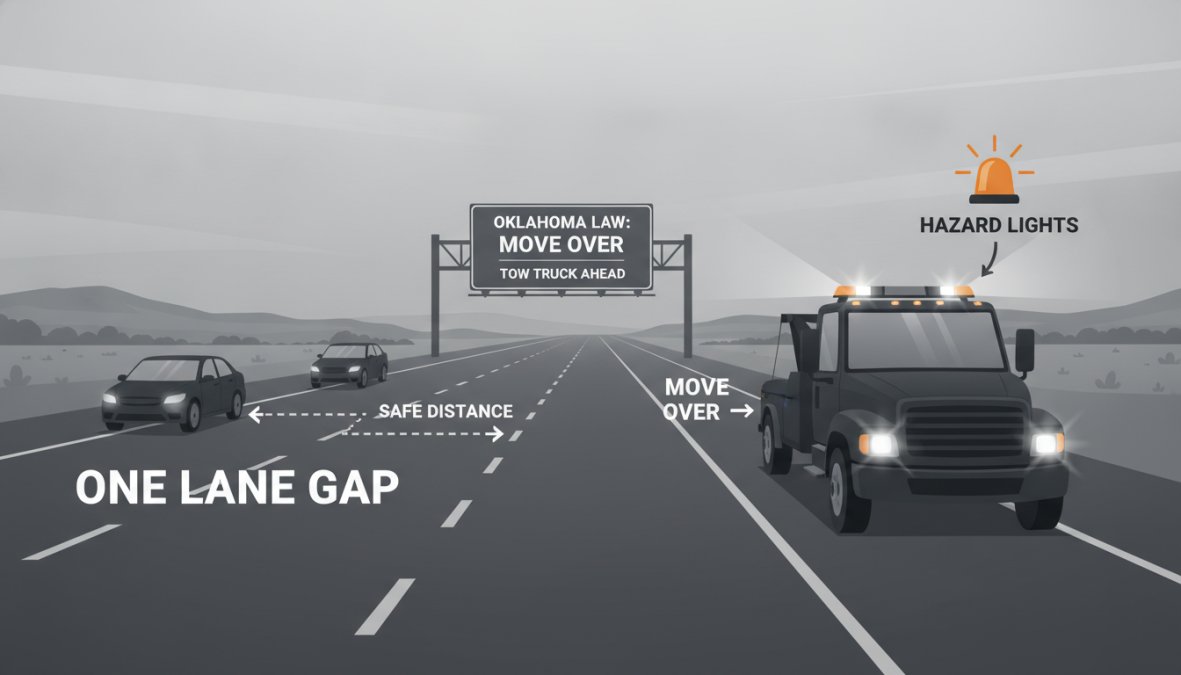
The primary requirement is that you must change lanes away from the stopped vehicle if it is safe to do so. If you cannot safely change lanes, you must reduce your speed and proceed with due caution.
In practical terms:
- On multi-lane roads: Move to the lane farthest from the emergency or roadside vehicle
- On two-lane roads: Slow down significantly and be prepared to stop if necessary
- In heavy traffic: If you cannot change lanes safely, reduce speed and maintain safe distance
- At night: Reduce speed even more, as visibility is limited
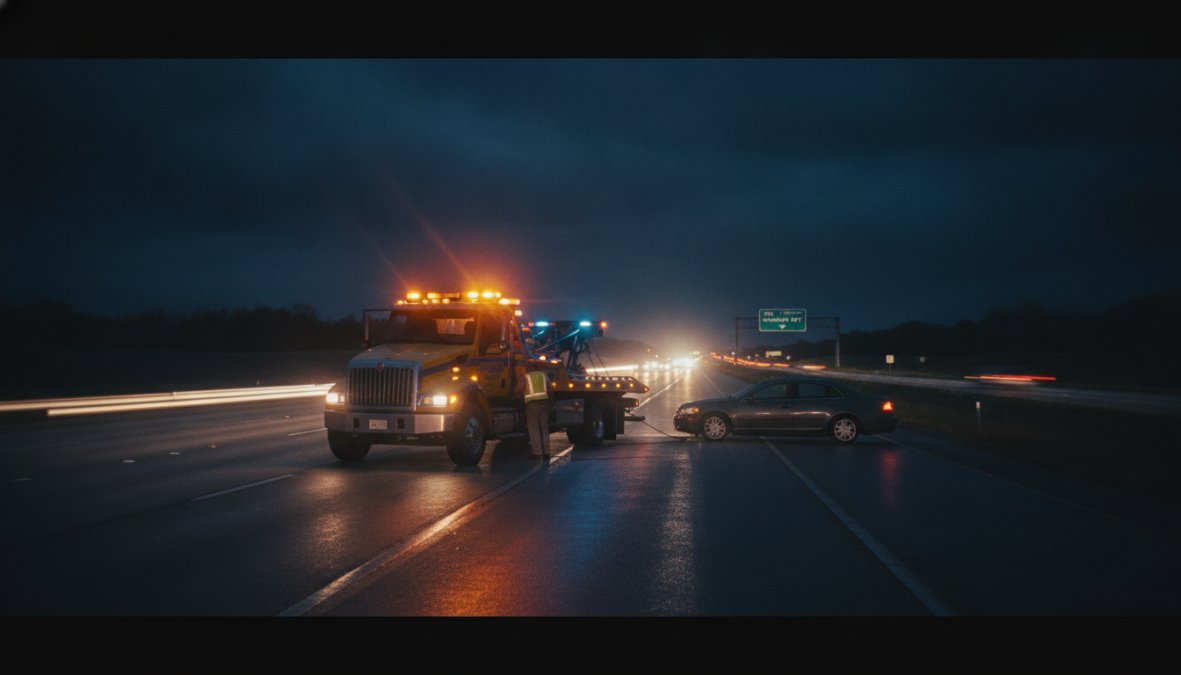
A tow truck operator standing on the shoulder of I-44 securing a vehicle is exposed to traffic traveling at highway speeds. A driver who fails to move over or slow down can cause a collision that injures or kills that worker.
Failing to move over or slow down for a stopped vehicle with flashing lights puts human lives at immediate risk. Tow operators, police officers, and emergency responders have been struck and killed by inattentive drivers who didn’t take the law seriously.
Due Caution and Safe Distance
"Due caution" means you must exercise reasonable care and attention. When approaching a vehicle with flashing lights, due caution requires you to:
- Reduce speed before you reach the vehicle
- Scan ahead for hazards and be ready to change lanes or stop
- Avoid sudden movements that could startle other drivers
- Maintain safe distance from the stopped vehicle and any personnel working near it
- Keep both hands on the wheel and stay focused on the road
The law also applies when you’re traveling in the opposite direction on a divided highway. You still need to slow down and exercise due caution.
Oklahoma Move Over Law Penalties and Fines
Oklahoma takes violations of the Move Over Law seriously. Penalties increase based on whether it’s your first offense or a repeat violation, and whether the violation results in property damage or injury.
First Offense and Civil Penalties
A first violation is typically classified as a civil penalty resulting in a traffic ticket that becomes part of your permanent driving record. First offense penalties include increased insurance premiums (typically for 3-5 years), court costs, and possible defensive driving course requirements. Insurance companies view Move Over Law violations as evidence of reckless driving, and premiums may increase by several hundred dollars annually.
Second Offense and Traffic Ticket Consequences
A second violation within a certain timeframe results in more serious consequences, including significantly higher fines, possible license suspension, mandatory traffic safety course, and substantial insurance premium increases. Some drivers have faced license suspension for 30 days or more.
If you receive a Move Over Law violation, address it promptly. Some violations can be reduced or dismissed if you complete a defensive driving course or if there are mitigating circumstances. Consult with a traffic attorney if you’re unsure about your options.
Oklahoma Move Over Law History and Background
The Move Over Law Oklahoma evolved in response to real tragedies and growing awareness of the dangers roadside workers face.
Why the Law Exists and First Responder Safety
The Move Over Law Oklahoma was created because roadside workers and first responders were being struck and killed by inattentive drivers. When a tow truck operator is securing a disabled vehicle on the shoulder of a highway, they are exposed to oncoming traffic and cannot predict which drivers will be distracted or careless. The Move Over Law creates a legal requirement that drivers take action to protect these workers.
First responder safety reflects a broader commitment across the United States to protect roadside workers. Research from the National Highway Traffic Safety Administration shows that thousands of emergency responders are struck by vehicles annually while performing roadside duties. This data drove Oklahoma legislators to strengthen protections through Senate Bill 89 and House Bill 1113.
First Responder Safety Oklahoma: Why This Law Matters
Understanding the reasoning behind the Move Over Law Oklahoma helps drivers appreciate why it’s important to follow it.
Real-World Risks on Oklahoma Highways
Oklahoma highways see significant traffic volume, especially on I-44 between Tulsa and Oklahoma City, along I-35, and on major state highways. These corridors are where most roadside emergencies occur and where risks to workers are highest.
Tow operators work in all weather conditions, rain, snow, fog, and darkness. Visibility is often poor. A driver traveling at 65 mph covers the length of a football field in just over three seconds. That’s not much time to react if you’re distracted. At Neptune Towing, our operators work on these highways regularly and have seen situations where a driver’s momentary distraction nearly caused a collision.
Tow Truck Safety Oklahoma: What You Should Know
Tow trucks are specifically covered under the Move Over Law Oklahoma, reflecting the serious risks tow operators face every day.
Protecting Tow Operators and Road Workers
When a towing company positions a tow truck on the roadside to safely access a vehicle, the operator is working near moving traffic, often in poor visibility or bad weather. The operator may be standing behind or beside the disabled vehicle, underneath it, or working with heavy equipment that requires concentration. They cannot hear approaching traffic due to engine noise.
A driver who doesn’t move over or slow down puts the tow operator in immediate danger. Over the past decade, dozens of tow operators have been struck and killed by vehicles while working roadside. Many of these accidents could have been prevented if the driver had simply followed the Move Over Law.
Every time you see a tow truck on the shoulder with its lights flashing, remember that there’s a person working near that truck who is counting on you to move over and slow down. That person deserves to do their job safely.
Roadside Assistance and Emergency Response
Roadside assistance includes jump starts, lockouts, tire changes, and fuel delivery, all happening on the side of the road, often on busy highways. Service providers are even more exposed than tow operators because they’re often standing directly in or very close to the travel lane. They need drivers to move over and slow down so they can work safely.
Exceptions and Special Situations
While the Move Over Law Oklahoma is broad, there are some situations where requirements may differ.
If you’re on a narrow two-lane road with oncoming traffic, you may not be able to safely change lanes. In this case, reduce speed and proceed with due caution. Do not attempt a dangerous lane change just to comply with the letter of the law.
If visibility is extremely poor, heavy fog, darkness, or sudden storms, you may not see flashing lights until you’re very close. Reduce speed immediately and be prepared to stop.
Construction zones and temporary traffic control situations sometimes require drivers to follow specific instructions from flaggers or temporary signs. Follow their instructions, as they take priority over general Move Over Law requirements.
If you’re unable to safely change lanes due to traffic congestion, slow down and maintain safe distance. The law recognizes that sometimes it’s not physically possible to move over.
Safety Tips for Highway Driving Around Emergency Vehicles
Knowing the Move Over Law is one thing. Putting it into practice safely requires awareness, attention, and good driving habits.
Recognizing Flashing Lights and Hazard Signals
The Move Over Law Oklahoma is triggered by flashing lights. Learning to recognize different types helps you respond appropriately.
Red and blue flashing lights indicate law enforcement (police cars, Oklahoma Highway Patrol).
Red flashing lights indicate fire department or emergency medical services vehicles.
Amber or yellow flashing lights indicate tow trucks, highway maintenance vehicles, utility service vehicles, or other roadside workers.
Hazard signals (all four turn signals flashing) indicate a disabled vehicle. While they don’t trigger the Move Over Law the same way, they signal that a vehicle is stopped and you should slow down.
When you see any flashing lights ahead, reduce speed immediately. This gives you time to assess the situation and change lanes if safe.
Don’t assume a vehicle with flashing lights is moving. Roadside workers and emergency responders are stationary while they work. Assume they’re not moving and adjust your speed and lane position accordingly.
Practical Steps to Move Over Safely
Moving over safely requires awareness of other traffic, proper signaling, and smooth lane changes.
Step 1: Scan ahead for any signs of stopped vehicles, flashing lights, or roadside workers.
Step 2: Reduce speed early. Begin reducing speed as soon as you see flashing lights ahead.
Step 3: Check your mirrors and blind spot before changing lanes.
Step 4: Signal your intention to alert other drivers.
Step 5: Change lanes smoothly with gradual motion, avoiding sudden jerks.
Step 6: Maintain safe distance as you pass the stopped vehicle.
Step 7: Return to normal speed once you’ve safely passed.
If you’re on a two-lane road and can’t change lanes:
Step 1: Reduce speed significantly well before reaching the stopped vehicle.
Step 2: Prepare to stop if necessary.
Step 3: Pass carefully, giving the roadside worker as much space as possible.
Step 4: Resume normal speed once you’ve safely passed.
| Scenario | Action | Why It Matters |
|---|---|---|
| Multi-lane highway with emergency vehicle ahead | Change to farthest lane, maintain safe speed | Maximizes distance from roadside workers |
| Two-lane road with oncoming traffic | Reduce speed significantly, prepare to stop | Prevents collision with roadside worker or oncoming vehicle |
| Poor visibility (fog, rain, darkness) | Reduce speed before you see vehicle | Gives you time to react if vehicle appears suddenly |
| Heavy traffic, can’t change lanes | Slow down, maintain safe distance | Protects worker while acknowledging traffic constraints |
| Construction zone with flagger | Follow flagger’s instructions | Temporary traffic control takes priority |
When you encounter a tow truck on the shoulder with its lights flashing, remember that there’s a real person working near that truck. That person is helping a stranded driver get back on the road safely and deserves protection. Follow the Move Over Law Oklahoma, slow down, and move over when it’s safe to do so. If you ever find yourself stranded and needing roadside assistance, Neptune Towing is ready to help. We provide damage-free towing, jump starts, lockout service, tire changes, fuel delivery, and emergency towing throughout the Tulsa area. Call (539) 292 3074 for fast, professional roadside assistance whenever you need it.
Frequently Asked Questions
What exactly is the Move Over Law Oklahoma, and when does it apply?
Oklahoma's Move Over Law requires drivers to change lanes away from stationary vehicles with flashing lights on roadways. This includes emergency vehicles, tow trucks, highway maintenance crews, and first responders. The law applies whenever these vehicles are stopped on the shoulder or roadway with warning lights activated. If you cannot safely change lanes, you must reduce speed and proceed with due caution. This protects the people working on the roadside and prevents accidents.
What are the penalties for violating Oklahoma Move Over Law?
First offense violations result in civil penalties under Oklahoma Statutes Title 47. A second offense within five years carries more serious consequences, including potential traffic ticket fines and court involvement. The specific fine amounts are determined by the court, but violations are taken seriously because they endanger first responders and roadside workers. If you're cited for a Move Over Law violation, contact your local law enforcement or court for exact penalty details in your jurisdiction.
Does the Move Over Law apply to tow trucks in Oklahoma?
Yes, tow truck safety Oklahoma is a core part of the Move Over Law. Tow trucks with flashing lights are specifically protected under the statute. When you see a tow truck on the shoulder with hazard signals activated, you must move over or slow down. Tow operators work in dangerous conditions on highways around Tulsa and throughout Oklahoma. Respecting the Move Over Law protects these workers and helps emergency towing services operate safely while assisting stranded drivers.
What should I do if I see an emergency vehicle or tow truck on the roadside?
First, recognize the flashing lights and hazard signals. If safe, change lanes away from the stationary vehicle immediately. If you cannot safely change lanes due to traffic, reduce your speed significantly and maintain safe distance. Stay alert and avoid distractions. Never stop your vehicle near the emergency scene unless directed by law enforcement. These actions protect first responders, tow operators, and yourself. Remember that roadside assistance workers face serious risks, so your compliance with the Move Over Law can save lives.
This article was written using GrandRanker