

Table of Contents
- Why Flatbed Towing Beats Wheel-Lift for Classic Cars
- Classic Car Transport Best Practices: A Step-by-Step Prep Checklist
- How Damage-Free Towing Works on a Hydraulic Tilt-Bed
- Low-Clearance Loading: Winch Operation and Load Angle
- What to Look for in a Towing Service Tulsa Collectors Trust
- DIY Trailer vs. Professional Flatbed Towing: A Cost-Benefit Look
- Frequently Asked Questions
Last Updated: September 11, 2026
Why Flatbed Towing Beats Wheel-Lift for Classic Cars
Flatbed towing for classic cars is the practice of transporting a vintage or collector vehicle on a level, stationary platform rather than towing it with two wheels on the ground. The reason is simple: the U.S. automobile towing industry is expected to generate $12.0 billion in revenue in 2026, and a growing share of that work involves vehicles that cannot tolerate the stress of a wheel-lift hookup (IBISWorld Automobile Towing in the US Industry Analysis).
At Neptune Towing, we’ve handled everything from daily drivers on the Broken Arrow Expressway to weekend-only show cars out of garages near downtown Jenks. The classics are the ones that make you slow down and think.
Wheel-lift equipment raises two tires off the ground and drags the rest of the car on its own suspension. That’s fine for a 2015 sedan. It’s a gamble on a 1965 anything.
How Wheel-Lift Towing Damages Vintage Drivetrains
Wheel-lift damage rarely shows up in the first mile. It shows up weeks later, as a leak, a vibration, or a transmission that never quite shifts right again.
- Drivetrain stress: Towing a rear-drive classic with the rear wheels down spins the driveshaft and transmission internals without oil pressure in some configurations.
- Suspension wear: Leaf springs and original bushings were never designed to carry a lifted load angle.
- Front spoiler and air dam contact: Low noses scrape on the ramp transition, not on the road.
- Frame flex: Older unibody and ladder-frame cars flex more than modern chassis under the same load.
Classic Car Transport Best Practices: A Step-by-Step Prep Checklist
Preparing a vintage vehicle for transport takes about 20 minutes and prevents most avoidable damage. Do this before the truck arrives, not while the operator waits in your driveway.
- Photograph the car from all four corners plus the roof. Note any existing chips, scratches, or cracks. These photos are your baseline if a question comes up later.
- Remove or secure loose items: hood ornaments, hubcaps, antennae, mirrors, and anything in the trunk.
- Check tire pressure and condition. A dry-rotted tire can fail during loading, and a soft tire changes ground clearance on the ramp.
- Note the fuel level. A full tank adds weight; an empty tank can leave the fuel pump dry on a long tilt.
- Disconnect the battery if the car will sit for more than a few hours in transit.
- Confirm the tie-down points with the operator before loading begins.
- Walk the load once the car is secured and again before the truck pulls away.
Battery Disconnects, Alarm Systems, and Loose Trim
Battery disconnects matter more than most owners realize. On older cars with mechanical fuel pumps, it’s just a safety step. On anything with an aftermarket alarm, GPS tracker, or modern retrofit, it prevents the alarm from draining the battery flat during a multi-hour tow.
Disconnecting the negative terminal is usually enough, but on classics with a factory clock or memory radio, pull the fuse instead so you don’t lose settings. Ask the operator which method they prefer.
Loose trim is the other quiet killer. Chrome spears, side mirrors, and grille badges that feel solid in the driveway can catch wind at highway speed. Tape or remove them.
On cars with a factory alarm, pull the alarm fuse rather than the battery cable. You keep the ECU memory and clock settings intact while still killing the drain.
The Handover Inspection: A Checklist to Run Before the Truck Leaves
A handover inspection is a short, shared walk-around with the operator before the truck pulls away. It takes five minutes and settles any question about the car’s condition when it left your hands.
Run it in this order:
- Body panels. Walk the full perimeter with the operator. Point out existing chips, dents, and paint flaws so there’s a shared record.
- Glass and trim. Note any windshield cracks, missing badges, or loose moldings.
- Underside. Crouch and look at the front lip, exhaust, and oil pan. Photograph anything that sits low.
- Tie-down points. Confirm out loud which points the operator will use and that they’re over-tire, not over-frame.
- Securement check. Watch the straps go on. Confirm wheel nets or soft straps are seated on the tires, not the rocker panels.
- Load angle. Confirm the bed is fully flat before the truck moves.
- Paperwork. Get the operator’s name, company name, and contact number in writing.
Both of you should photograph the loaded car from the same four corners. If anything is disputed later, you have matching images from the same moment.
A handover inspection isn’t about distrust. It’s about making sure you and the operator are looking at the same car the same way. Most damage disputes come down to a missing shared record, not a missing strap.
What to Have Ready When the Truck Arrives
A few small things speed the process up and reduce handling of the car:
- Keys, including any trunk or glovebox key.
- Any wheel lock key if the car has locking lug nuts.
- A note about known quirks: a sticky hood latch, a door that only opens from inside, a kill switch location.
- Your phone, charged, for photos and the operator’s contact info.
It’s the difference between a tow that feels routine and one where everyone is guessing.
How Damage-Free Towing Works on a Hydraulic Tilt-Bed
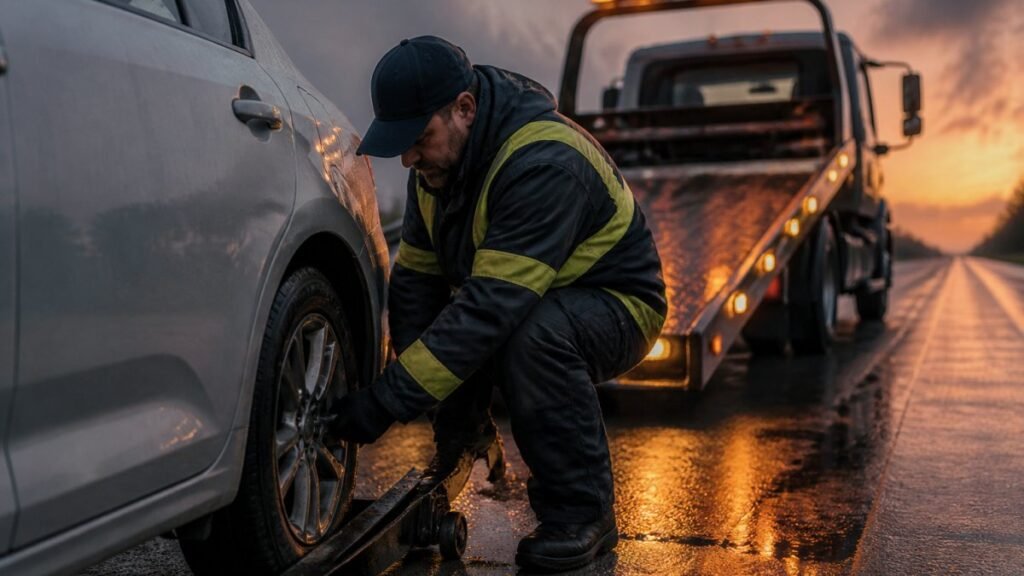
Damage-free towing on a hydraulic tilt-bed works by eliminating the two things that damage cars: ground contact and load angle. The bed tilts to the ground, the car rolls on under its own weight or a gentle winch pull, and the bed levels out flat before the truck moves.

Industry trends for 2026 point to flatbeds equipped with specialized tie-down systems as the standard for EV and classic transport alike (Beacon Funding 2026 towing trends). The equipment matters, but the operator’s technique matters more.
Soft-Strap Tie-Downs, Wheel Nets, and Chassis Protection
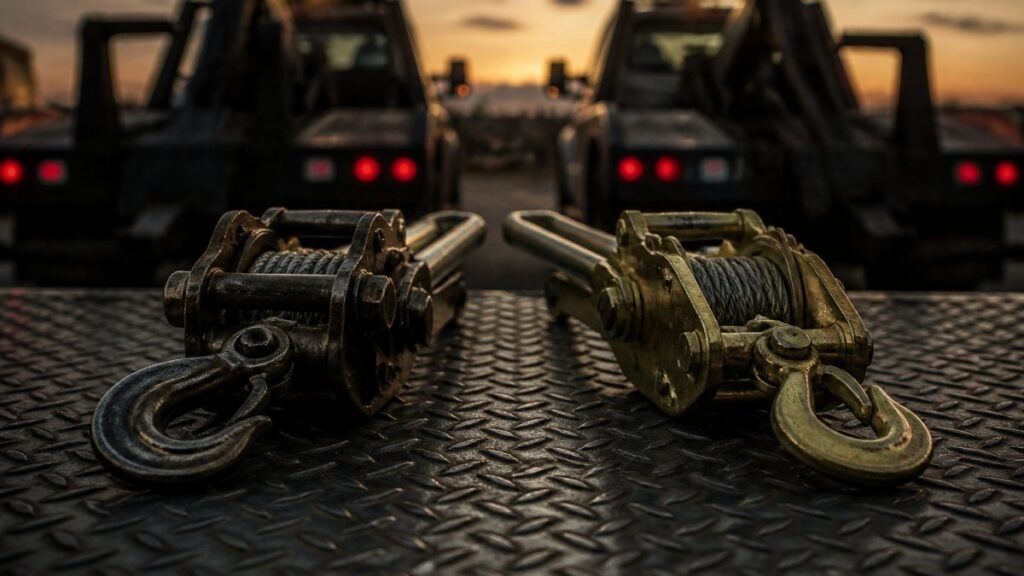
Soft-strap tie-downs and wheel nets secure a vehicle by its tires rather than its frame, the single biggest reason flatbed transport is safer for a classic. Straps over the tires don’t touch paint, chrome, or undercarriage components.
- Wheel nets cradle each tire and hold it against the deck. Best for cars with delicate suspension or exposed brake lines.
- Soft-strap over-tire straps work well for most collector cars and are faster to set.
- Axle straps are a fallback for vehicles with no usable wheel clearance, but they can stress suspension bushings.
- Chassis protection comes from keeping straps off the frame rails and rocker panels entirely.
Never let an operator strap over the frame rails of a unibody classic. The straps will crush pinch welds and can bend the floor pan. Insist on over-tire securement.
Low-Clearance Loading: Winch Operation and Load Angle
Low-clearance loading is where most flatbed damage happens, and it’s almost always a load-angle problem. If the ramp is too steep or the winch pulls too fast, the front spoiler, exhaust, or oil pan makes contact before the car is even on the bed.
The Geometry That Actually Matters
The angle that damages a car isn’t the ramp angle by itself. It’s the breakover angle, the angle between the ramp and the deck as the car transitions from one to the other. A car with three inches of front clearance can handle a steeper ramp if the breakover is gentle; a car with five inches can scrape if it’s sharp. professional lockout services.
Three things control breakover on a flatbed:
- Bed tilt. A hydraulic tilt-bed can be set at a shallower angle than a fixed-ramp bed. Ask the operator to tilt it as low as the equipment allows.
- Ramp extensions. Bolt-on or slide-out extensions stretch the ramp run and flatten the transition. Many operators carry them; not all do.
- Approach blocks. Wooden blocks or rubber ramps placed at the base of the ramp lift the front tires earlier and reduce the initial angle.
A car with under four inches of ground clearance usually needs at least two of those three (sema.org). A car with under three inches needs all three, plus a slow winch pull.
Winch Operation: Slow, Steady, and Watched
The winch is where impatience shows up. A fast pull jerks the car, compresses the front suspension, and drops the nose right as the front tires meet the deck. A slow, steady pull keeps the suspension settled and gives the spotter time to call a stop.
What a careful load looks like:
- The operator sets the bed angle and checks clearance at the front lip with a flashlight before the car moves.
- A spotter stands at the front corner of the car, watching the spoiler, exhaust, and oil pan.
- The winch runs at low speed with the operator’s hand on the control, ready to stop.
- The car rolls onto the deck in one continuous motion, no stop-and-start.
- Once the front tires are on the deck, the operator checks the rear clearance before continuing.
Specific Contact Points to Watch
Different classics fail at different spots. These are the ones we see most often:
- Front air dams and spoilers on late-60s and 70s muscle cars. They sit lower than the bumper and hit the ramp transition first.
- Oil pans and exhaust headers on lowered cars and cars with aftermarket suspension.
- Rear valances and exhaust tips on cars with long rear overhangs, especially when the rear tires meet the deck.
- Side skirts and rocker panels on cars with aftermarket ground effects.
- Front crossmembers on unibody cars that have sagged over the years.
If your car has any of these, say so before loading starts so the operator can adjust the approach.
Questions to Ask Before the Car Moves
Ask the operator one question before loading: “How do you handle a car with three inches of clearance?” A good operator will mention bed tilt, ramp extensions, or approach blocks without hesitating. A vague answer is your cue to ask for a different truck.
Other questions worth asking:
- Do you carry ramp extensions on the truck?
- Will you use a spotter during the winch pull?
- Can you show me the clearance at the front lip before we start?
Never let anyone rush a low-clearance load. If the operator seems impatient or dismissive about clearance, stop the process. A five-minute delay is cheaper than a cracked oil pan or a torn front spoiler.
When a Car Is Too Low for a Standard Flatbed
Some cars genuinely can’t be loaded on a standard flatbed without risk, extremely low show cars, cars with custom suspension, and some race cars. In those cases, the right answer is a flatbed with a longer ramp run, a drop-deck trailer, or a purpose-built enclosed transporter. If your car is in that range, tell the dispatcher when you call, it’s better to send the right truck the first time.
What to Look for in a Towing Service Tulsa Collectors Trust
A towing service Tulsa collectors trust will answer three questions before you commit: what equipment they run, how they secure a classic, and whether they charge by the mile on top of a base rate. If any of those are vague, keep calling.
Neptune Towing is owner-operated, which means the person who answers the phone is often the person driving the truck. That matters when you’re standing next to a 1967 Mustang on the shoulder of I-44 and need to know the operator has done this before.
What to check before you book:
| What to Ask | Why It Matters | Red Flag |
|---|---|---|
| Flatbed or wheel-lift? | Determines damage risk on classics | “We’ll see what’s available” |
| Soft straps and wheel nets on board? | Protects paint and suspension | Only chains and J-hooks |
| Licensed and insured? | Covers you if something goes wrong | Can’t produce a certificate |
| Upfront pricing? | No surprise mileage or fuel fees | Quote changes on arrival |
| Owner-operated or dispatch network? | Direct accountability | Passed to a third-party contractor |
Neptune Towing has been licensed and bonded and towing since 2019, and we don’t impound vehicles. Our business is helping drivers get their cars home or to a shop, not holding them for storage fees.
DIY Trailer vs. Professional Flatbed Towing: A Cost-Benefit Look
DIY trailer transport looks cheaper on paper. In practice, it usually isn’t, once you add up the real costs.
Renting or buying a trailer, a capable tow vehicle, ramps, straps, and wheel chocks adds up fast. Then there’s the learning curve: backing a loaded trailer, adjusting tongue weight, and securing a car you’ve never strapped before. One bad strap job on a $40,000 classic wipes out any savings.
Professional flatbed towing trades that risk for a known cost. You get an insured operator, proper equipment, and someone else’s liability if something goes wrong. For a daily driver, DIY might make sense. For a show car or an antique with original paint, it rarely does.
The real question isn’t which option costs less. It’s who carries the risk if the car gets damaged. With DIY, that’s you. With an insured flatbed operator, it’s them.
Frequently Asked Questions
Why is flatbed towing better for classic cars than wheel-lift towing?
A flatbed carries all four wheels on a stable platform, so the drivetrain, suspension, and undercarriage never touch the road or hang from a sling. Wheel-lift trucks raise only two wheels and drag the rest, which stresses frames and can crack fiberglass or bend trim on older chassis. For a vintage vehicle with original bushings, a rear-wheel-drive transmission, or low ground clearance, a hydraulic tilt-bed removes that risk entirely.
How do I prepare my vintage vehicle for a tow?
Start by disconnecting the battery if the car has an alarm or clock that drains power, and note any radio security codes first. Remove loose items from the trunk and cabin, retract the antenna, and fold mirrors if they are fragile. Photograph the car from all four corners before loading, then walk the operator through any known weak points, like a cracked spoiler or a sticky parking brake. A written handover checklist makes this quick.
Does Neptune Towing provide specialized equipment for low-clearance classic cars?
Neptune Towing uses hydraulic tilt-bed flatbeds with adjustable load angles, soft-strap tie-downs, wheel nets, and wood or rubber ramps for cars that sit close to the ground. The operator can extend the approach ramp and winch slowly to keep the front spoiler and oil pan clear. If your car needs something unusual, call ahead and describe the clearance so the right equipment shows up.
How do I find a reliable towing service for a classic car in Tulsa?
Ask three questions: Do you use flatbeds only for collector cars? Are you insured for transport liability on high-value vehicles? Can you describe your tie-down points without prompting? A local towing company that answers those clearly is usually the right call. Neptune Towing has served the Tulsa area since 2019 as an owner-operated business, handles classic car transport, and does not impound vehicles, so your car goes where you decide.
A classic car is a weekend investment, and one bad tow can undo years of care. If you’re in Tulsa, Jenks, Bixby, Broken Arrow, or Glenpool and need flatbed towing for a vintage or collector vehicle, call Neptune Towing at (539) 292 3074. We’re owner-operated, licensed and bonded since 2010, and we use proper loading and securement procedures on every classic we move. No impounds, no storage games, just damage-free towing from a local company that treats your car like it’s ours.