
Table of Contents
- Is It Safe to Walk to the Nearest Exit After a Breakdown?
- What to Do When Your Car Breaks Down on the Highway
- Should You Stay in Your Car During a Breakdown?
- How to Safely Exit a Vehicle on the Roadside
- When to Call Roadside Assistance After a Breakdown
- Special Situations: Passengers, Children, Pets, and EVs
- Conclusion: Stay Put, Stay Safe, Call for Help
- Frequently Asked Questions
Last Updated: October 12, 2026
Is It Safe to Walk to the Nearest Exit After a Breakdown?
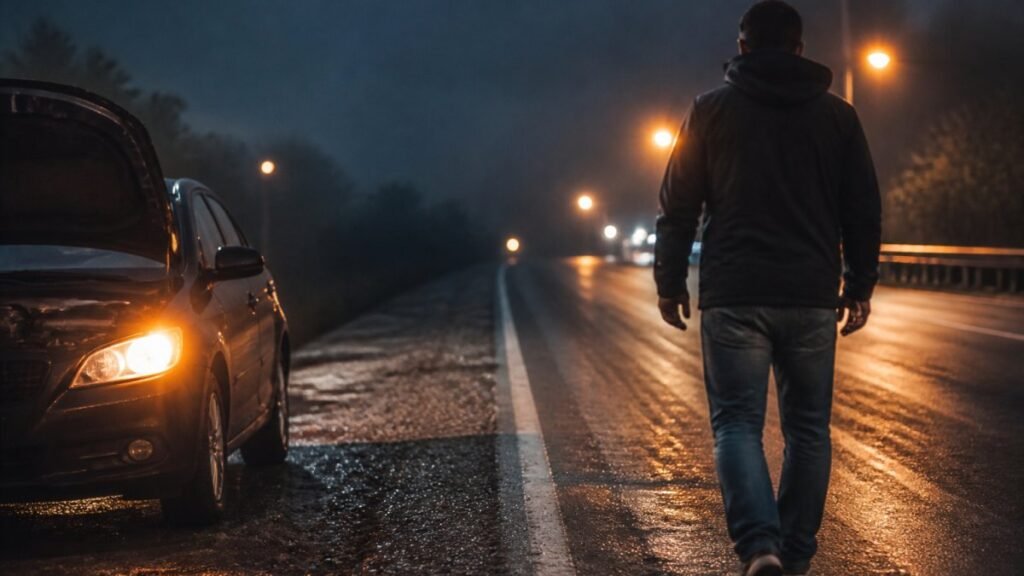
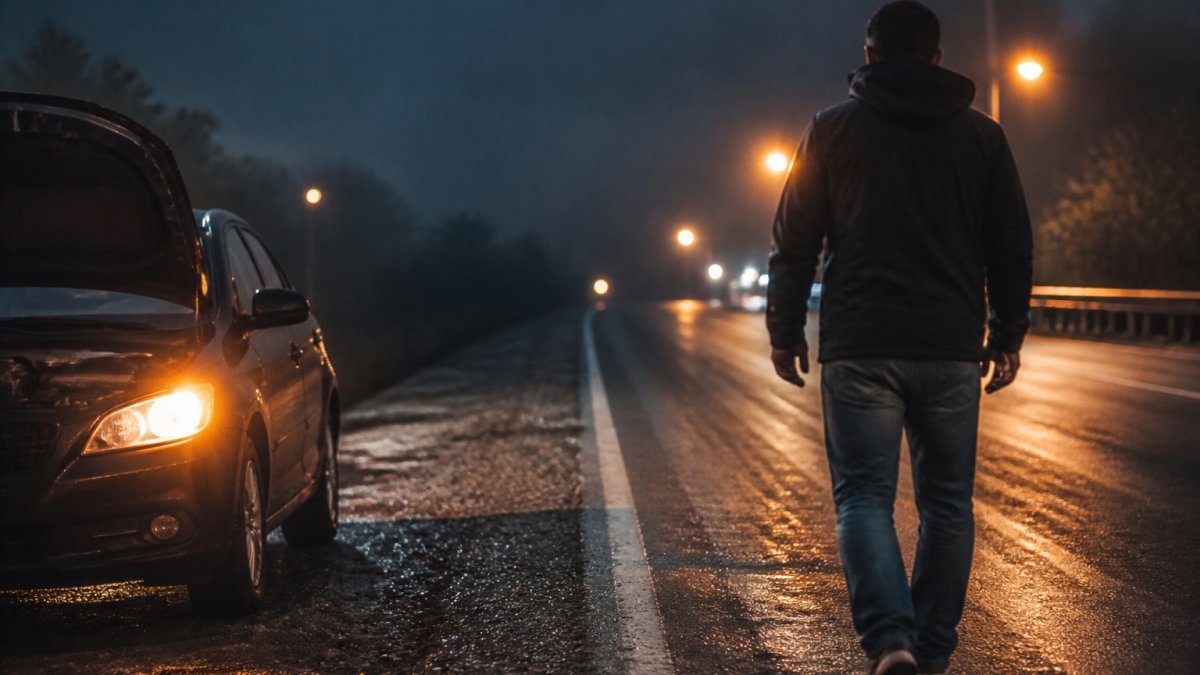
The short answer most drivers need: no, not usually. Choosing to walk to nearest exit after a breakdown sounds like the responsible move, but on a highway it often puts you in more danger than staying put. Good Sam’s breakdown safety guide warns that walking along highways is extremely dangerous and advises staying with your vehicle and calling for help instead.
So when is it safe to walk to the nearest exit after a breakdown? Only in narrow situations: low-traffic roads, a clear path well away from live lanes, and good visibility.
Below, we break down what to do in the first five minutes, when to stay in your car, which door to use, and when to call for a tow.
On a highway, your car is your best protection. It is large, visible, and built to absorb impact. You are not.
What to Do When Your Car Breaks Down on the Highway
What you do in the first five minutes decides how the rest of this goes. Get the car off the travel lanes if you can, get visible, and get help moving. Do not start walking.
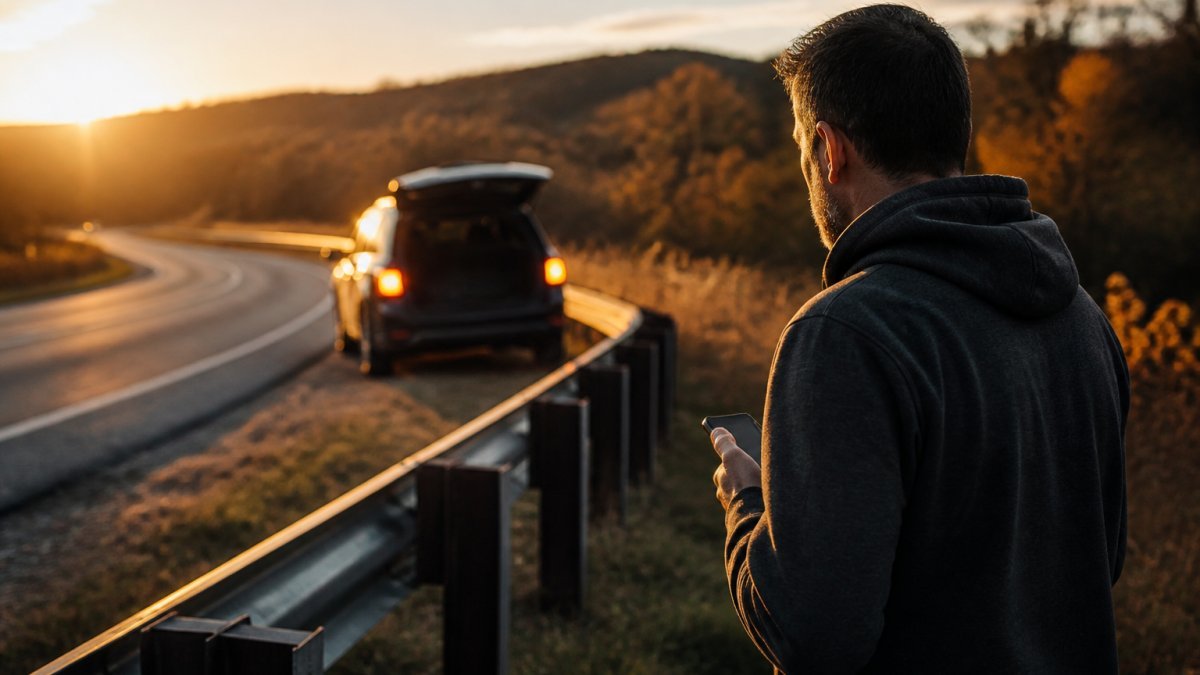
(/blog/professional-towing-highway-169-tulsa/) Expressway, traffic runs at highway speed and sight lines are short. On a 35 mph street in Brookside or downtown Jenks, drivers have time to react.
- Are you in a tunnel, on a bridge, or on a road with no shoulder? These are the three environments where the standard advice flips.
Step-by-Step: Your First Five Minutes
- Steer to the shoulder or an exit ramp. Get as far right as you safely can.
- Turn on your hazard lights immediately, before you stop rolling if you can.
- Set the parking brake and keep your seat belt on until you decide whether to exit.
- Call for help. Call 911 if you are in a live lane or a blind curve. Call a tow for everything else.
- Stay buckled and face forward if you remain inside. Keep your foot off the brake once stopped so your brake lights do not confuse drivers behind you.
If you have a warning triangle or flares, place them only when traffic is light and you can stay well off the roadway. If not, skip it, no triangle is worth stepping into traffic.
How the Answer Changes by Road Environment
Most breakdown advice treats every road the same. They are not, and the difference matters.
- Wide shoulder on a highway. Stay inside, hazards on, call a tow. This is the default on I-44, US-169, and the Creek Turnpike.
- Narrow shoulder or no shoulder. Stay inside. There is no safe place to stand.
- Exit ramp. One of the better places to break down, you are outside live lanes with room to get behind a barrier or onto the grass.
Should You Stay in Your Car During a Breakdown?
Staying in your car is the safer default on freeways and busy highways. Teletrac Navman’s highway breakdown guidance recommends staying inside on freeways or busy highways, while noting that exiting may be appropriate in a low-traffic area.
Stay buckled and face forward. If a car is about to hit you from behind, the seat belt keeps you in the safest part of the cabin.
When should you get out instead?
- Your car is on fire or smoking
- You smell fuel
- You are in a live lane and cannot move
The one thing you should never do is stand behind your car, between your bumper and oncoming traffic. That is where people get hit.
Standing behind your vehicle to wave traffic around is one of the most dangerous things you can do on a highway. Drivers cannot see you until they are almost on top of you, and you have nowhere to go.
How to Safely Exit a Vehicle on the Roadside
If you have decided to exit, which door you use matters as much as when you get out. Use the passenger-side door, the one facing away from traffic, it keeps a metal shell between you and the live lanes.
Which Door to Use and Which to Avoid
- Use the passenger-side door. It faces away from traffic.
- Avoid the traffic-side door. It opens directly into the path of oncoming vehicles.
- Check your mirror and blind spot before you open anything.
The Safe Walking Route After You Exit
This is the part most breakdown guides skip, and it is where people get hurt. Once you are out of the car, you are a pedestrian on a road built for vehicles. Treat every step like it.
- Step out and immediately move perpendicular to traffic, away from the pavement, not along it.
- Walk to the far side of the barrier, the side facing away from traffic. If there is a guardrail or concrete median, get behind it. If there is only grass, walk to the far edge of the shoulder and stop there.
- Do not walk down the shoulder toward the next exit. This is the most common mistake we see. The next exit is usually farther than it looks, the shoulder narrows, and you end up in the traffic lane before you realize it. Unless you can walk to nearest exit on a path that is clearly visible, wide, and flat, stay put.
- Do not cross live lanes for any reason. If you cannot get to safety without crossing traffic, you are safer in the car.
- Walk, do not run. Running draws attention away from traffic and makes you more likely to trip on debris, a curb, or a guardrail post.
- Keep clear of escape routes and obstructions. Do not stand where a driver would swerve to avoid your car, or behind a barrier post where a car could push the barrier into you.
- Follow emergency signs and directions if you are on a bridge, in a tunnel, or near a marked emergency call box. Those signs are placed by engineers who know where the safe refuge is.
How Far to Move and Where to Stop
The right distance is far enough to be out of the debris path if your car is hit, but close enough that a tow operator can find you. In practice, that is usually 10 to 20 feet behind the barrier, on the far side from traffic. Do not go so far that you cannot see your vehicle, the tow driver is looking for the car, not for you.
Passengers, Children, Pets, and Mobility Needs
If you are not alone, the exit is a group operation and needs a plan before the first door opens.
- Passengers and children. Keep everyone buckled and inside if you are staying in the car. If you must exit, move everyone together to the passenger side, away from traffic, and keep them behind a barrier. Hold hands with younger children before you open the door, not after.
- Pets. Keep pets in the car if you are staying inside. If you exit, leash them before you open the door. A loose dog on a highway is a second emergency and will pull toward traffic, not away from it.
- Mobility needs. If a passenger cannot exit quickly or safely, staying in the vehicle is the right call. Tell the dispatcher so the responding crew can bring the right equipment. Do not try to carry someone across a shoulder.
After You Reach Safety
Once you are behind the barrier or well off the pavement, stay there. Do not go back to the car for a phone charger, a jacket, or a purse. Call for help and give the dispatcher four things:
- Your exact location, including the nearest mile marker, exit number, or cross street.
- Which direction you were traveling.
- Your vehicle type, color, and whether it is in a travel lane.
- How many people are with you and whether anyone has mobility needs.
Then wait. Keep your hazard lights on so the tow operator can spot the car, and keep your phone on so dispatch can reach you if the location is unclear. If you are on I-44 near the Arkansas River bridges or on the IDL through downtown Tulsa, mention the landmark, it speeds up the response.
When to Call Roadside Assistance After a Breakdown
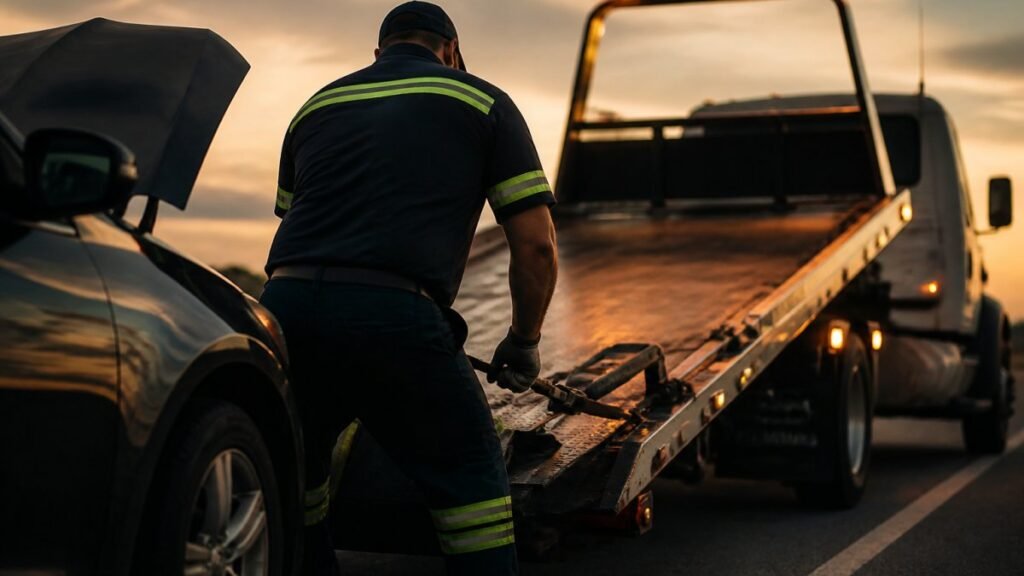
Call for roadside assistance as soon as you are stopped and safe, not after you have tried to fix things yourself. A tow is the answer for a dead battery you cannot jump, a flat you cannot change, a mechanical failure, or any breakdown on a highway where you cannot safely wait.
Call 911 first if:
- You are in a live lane
- You are on a blind curve or over a hill
- There is a fire, smoke, or fuel smell
Call a tow for everything else. Give the dispatcher your exact location, the nearest mile marker or exit, your vehicle type, and whether you are in a travel lane. That last detail changes how fast help gets to you.
Special Situations: Passengers, Children, Pets, and EVs
Some breakdowns need a different plan. If you have passengers, children, pets, or you drive an EV, the standard advice shifts a little.
EVs and Teslas. Electric vehicles should not be towed on their drive wheels. They need a flatbed with proper loading and securement to protect the drivetrain. This is one of the most common questions we get, and damage-free towing matters here more than anywhere else.
| Situation | Best Move | Why |
|---|---|---|
| Highway, live lane | Stay buckled, call 911 | You are the most protected inside the car |
| Highway, wide shoulder | Stay inside, call a tow | Traffic is fast and sight lines are short |
| Low-traffic road | Exit passenger side if safe | You can move away from the roadway |
| Car on fire or smoking | Exit immediately, move upwind | Fire spreads faster than you can react |
| EV or Tesla | Request a flatbed | Drive wheels and battery need proper handling |
| Kids or pets aboard | Keep them inside, leashed if exiting | Loose movement near traffic is the biggest risk |
Conclusion: Stay Put, Stay Safe, Call for Help
The honest answer to whether it is safe to walk to the nearest exit after a breakdown is that most of the time, it is not worth the risk.
If you are stranded anywhere in the Tulsa area, Neptune Towing is ready. We are owner-operated, we provide damage-free towing with proper loading and securement, and we do not impound vehicles.
Frequently Asked Questions
Is it safe to walk to the nearest exit after your vehicle breaks down?
In most cases, no. Walking along a highway shoulder puts you close to traffic moving at 70 mph or faster, and drivers rarely expect a pedestrian there. National safety guidance from organizations like Good Sam and state highway safety offices advises staying with your vehicle, keeping your seat belt on, and calling for help. Only consider walking if you can see a safe, close-by location completely away from live lanes and you are not on a high-speed road.
Should you stay in your car or get out after a highway breakdown?
Stay in your car with your seat belt fastened if you are on a freeway or busy highway. Turn on your hazard lights and call 911 or a towing service. Getting out exposes you to passing traffic. The only time exiting makes sense is if your vehicle is in a live lane, smoking, or on fire. In those cases, exit through the passenger side and move well away from the roadway.
How do you safely exit a vehicle on the side of the road?
If you must exit, use the door facing away from traffic, usually the passenger side. Check mirrors and look over your shoulder before opening the door. Exit quickly and move immediately to a place of safety beyond the guardrail or barrier if one exists. Never stand between your vehicle and oncoming traffic. Keep children and pets close and controlled during the exit.
When should you call roadside assistance after a breakdown?
Call for roadside assistance as soon as you are safely stopped and hazard lights are on. If you are on I-44, US-169, or the IDL in Tulsa, call immediately rather than attempting a repair yourself. Neptune Towing provides 24/7 emergency towing and roadside assistance in Tulsa and surrounding areas. Calling early means help is on the way while you stay safely inside your vehicle.
What should you do if your car breaks down in a traffic lane?
If your vehicle cannot move out of a live lane, your priority is getting everyone out safely. Turn on hazard lights, exit through the side away from traffic, and move beyond any barrier to a safe location. Call 911 immediately. Do not try to push the vehicle unless it is completely safe and traffic is clear. Once everyone is safe, call a towing service for vehicle recovery.