

Table of Contents
- How Long Does It Take for a Tow Truck to Arrive?
- The 30 to 60 Minute Baseline
- Why Some Drivers Wait Hours
- What Actually Affects Your Tow Truck Arrival Time
- Tow Truck Tulsa: What Local Response Times Look Like
- Roadside Assistance Tulsa: Times for Jumps, Lockouts, and Fuel
- Emergency Towing Tulsa: When Every Minute Counts
- Flatbed Towing Tulsa and Why It Sometimes Takes Longer
- How to Speed Up Your Tow and Stay Safe While You Wait
- Frequently Asked Questions
Last Updated: September 10, 2026
How Long Does It Take for a Tow Truck to Arrive?
The average wait for a tow truck in an urban area runs about 45 minutes, and typical response windows fall between 30 and 60 minutes under normal conditions, according to Five Star Towing’s industry response time standards. That is the honest answer to how long does it take for a tow truck to arrive, and it is the number most drivers never hear before they call. At Neptune Towing, we quote that range up front because a stranded driver on I-44 or the Broken Arrow Expressway deserves a real estimate, not a promise nobody can keep. Below, we break down what actually moves that number, why some drivers sit for hours, and how to cut your own wait time.
The towing industry pulled in roughly $12.0 billion in revenue in 2026, per IBISWorld’s automobile towing industry analysis, yet only 25% of operators reported more call volume in 2025. Fewer calls spread across more trucks is one reason dispatch decisions matter so much to your ETA.
The 30 to 60 Minute Baseline
Tow truck arrival time is the interval between your call connecting with a dispatcher and the truck physically reaching your location. The 30 to 60 minute figure assumes normal weather, normal traffic, and a truck already in your service area.
That baseline holds in most metro markets, and Tulsa fits the pattern. What most guides skip is that the clock does not start when you dial. It starts when a driver accepts the job and turns toward you.
Why Some Drivers Wait Hours
Wait times stretching past three hours usually trace back to one of four problems: no truck available in your zone, a dispatch center routing your call to a contractor who is already committed, weather shutting down normal routes, or a mismatch between the equipment you need and what is nearby.
Some consumers report waits exceeding three to six hours for roadside assistance, a gap between advertised response times and actual delivery that shows up in driver community discussions. When you call a local towing company directly instead of a national dispatch line, you skip the routing layer entirely.
What Actually Affects Your Tow Truck Arrival Time
Four variables decide your ETA more than anything else: traffic, weather, time of day, and how dispatch assigns your call. None of them are fully in your control, but understanding them helps you set realistic expectations.
Traffic, Weather, and Time of Day
Peak hours on the IDL, Highway 169, and the BA Expressway can add 15 to 20 minutes to any run. Ice, heavy rain, and high winds slow every truck on the road, and they also increase service demand because more drivers slide off the roadway in the same window.
Time of day cuts both ways. Early morning commutes and the 5 p.m. rush are the worst windows. Late nights are quieter on traffic but harder on visibility, which slows hookup and loading.
How Dispatch Decisions Slow You Down
Dispatch centers triage by urgency, location, and equipment. A collision blocking a lane jumps ahead of a flat tire in a parking lot, and that is the correct call.
Calling a national motor club line adds a routing step before a local truck is ever assigned. If you are on the shoulder of a highway, call a local towing company directly and describe your exact location first.
Tow Truck Tulsa: What Local Response Times Look Like
Response times across the Tulsa metro land close to the 45-minute urban average, with meaningful differences by distance and density. A truck staged near downtown can reach midtown in 20 minutes. The same truck heading to rural stretches outside Sapulpa or Owasso faces longer runs on two-lane roads.
Our service area covers Tulsa, Jenks, Bixby, Broken Arrow, Glenpool, Owasso, Sapulpa, and the communities between them. That footprint is small enough that we know which routes clog at 5 p.m. and which back roads stay open.
| Situation | Typical Wait | Why |
|---|---|---|
| Breakdown in midtown Tulsa | 25-40 min | Short drive, dense truck coverage |
| Flat tire in Broken Arrow | 30-50 min | Suburban distance, moderate traffic |
| Collision on I-44 at rush hour | 45-75 min | Congestion plus scene access limits |
| Rural call near Sapulpa | 40-70 min | Longer drive, fewer trucks nearby |
| Ice or storm conditions | 60-120 min | Volume spike plus slower driving |
Roadside Assistance Tulsa: Times for Jumps, Lockouts, and Fuel
Roadside assistance calls usually arrive faster than full tows because they need less equipment and less time on scene. A jump start, lockout service, or fuel delivery typically takes 20 to 40 minutes in the metro, and the service itself often finishes in under 15 minutes.
Neptune Towing handles all three as standalone calls. You do not need a tow to get help, and a dead battery in a parking lot at 11 p.m. is exactly the kind of call we want.
Emergency Towing Tulsa: When Every Minute Counts
Emergency towing gets priority dispatch, which is why a collision or a vehicle blocking traffic moves to the front of the queue. If you are in a travel lane, on a bridge, or in any position where another driver could hit you, say so when you call. That single detail changes your place in line.
Move-over laws exist for a reason. Tow truck driver fatalities occur on average every six days, according to FOX16 reporting on Move Over laws, and most of those deaths happen during roadside work. Give passing trucks room.
Flatbed Towing Tulsa and Why It Sometimes Takes Longer
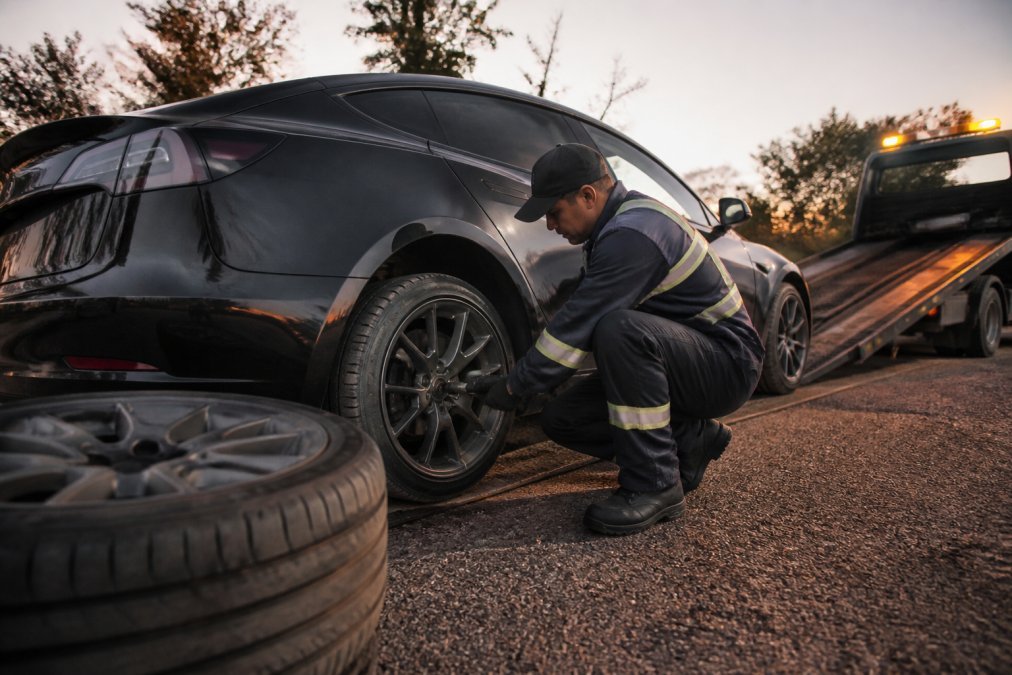
Flatbed towing can add 10 to 20 minutes to a job because loading takes longer and the equipment is more specialized. A flatbed winches your vehicle onto a tilting deck and secures all four wheels, which is the right method for low-clearance cars, classic vehicles, and anything with all-wheel drive.
It is also the only correct way to move a Tesla or another EV. Hooking an electric vehicle by the drive wheels can damage the drivetrain, and that repair bill dwarfs any time saved. We use proper loading and securement on every flatbed call, from a 1987 weekend classic to a daily-driver Model 3.
How to Speed Up Your Tow and Stay Safe While You Wait
The wait is the part you cannot fully control, but what you do during it is entirely up to you, and it matters more than shaving five minutes off your ETA. Most guides stop at “turn on your hazards.” Here is the full protocol we walk drivers through on the phone.
Stay or exit? The decision that comes first
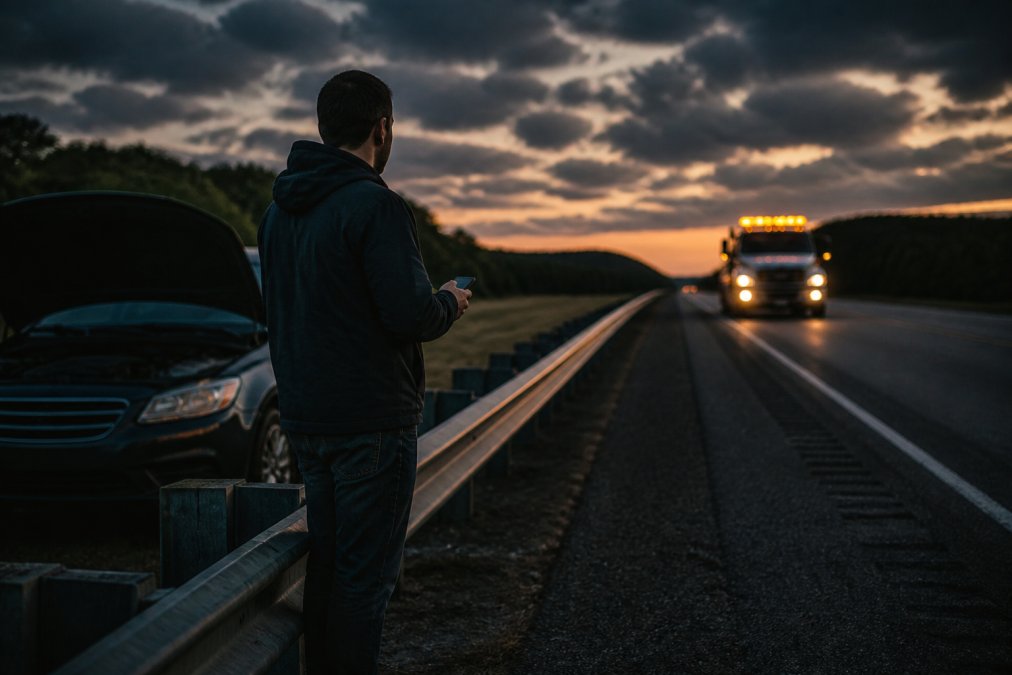
On a highway shoulder, the safest place is usually inside your vehicle with your seatbelt on, especially on the driver’s side away from traffic. Exit only if you can do so on the side away from moving lanes and get behind a barrier. Never stand behind your vehicle or between it and oncoming traffic. If your car is in a live lane, on a bridge, or in a curve where drivers cannot see you in time, get out and move well clear, then call and say exactly that.
Make yourself visible
- Turn on your hazard lights the moment you stop.
- If you have reflective gear, a safety vest, or even a light-colored jacket, put it on before you step out.
- At night, use your phone flashlight to signal, but keep it pointed down and away from traffic so you are not blinding oncoming drivers.
- If you carry roadside flares or reflective triangles, place them well behind your vehicle on the shoulder, never in a travel lane.
Give passing trucks room
Move-over laws exist for a reason. Tow truck driver fatalities occur on average every six days, according to FOX16 reporting on Move Over laws, and most of those deaths happen during roadside work. When you see amber lights, slow down and change lanes if you safely can. That courtesy protects the driver coming to help you and the driver working the next call.
What to have ready before the truck arrives
- Your exact location, including the nearest cross street or mile marker
- Vehicle make, model, year, and color
- Whether the vehicle rolls, steers, or is locked in park
- Keys in hand, not locked inside
- Any special needs: low clearance, EV, classic car, all-wheel drive
- A phone number that will actually ring when the driver calls
Send your location pin through your phone’s map app to whoever is dispatching you. It removes every guess about which side of the highway you are on, and it routinely saves 10 minutes on rural calls.
While you wait, do not
Do not try to change a tire in a live lane, do not stand in the roadway to wave the truck down, and do not leave your vehicle unattended in a travel lane. If you are in a dangerous spot, stay on the line with dispatch and let them know. A local towing company that runs its own trucks can keep a dispatcher on the phone with you until the driver arrives.
Frequently Asked Questions
How fast can a tow truck arrive in the Tulsa area?
Under normal conditions, most tow trucks arrive in 30 to 60 minutes, and urban areas average around 45 minutes. In Tulsa, that means a call from a neighborhood like Brookside or a spot along I-44 usually falls inside that window. During peak hours, ice storms, or heavy rain, expect longer. When you call Neptune Towing, we give you a real estimate based on where you are and how many calls are ahead of you, not a number that sounds good.
Why do some towing companies take longer than others to arrive?
Dispatch method matters more than most drivers realize. Large motor clubs and call centers route requests through a queue, then hand them to whichever contractor accepts, which adds delay and often leaves you without updates. An owner-operated company like Neptune Towing answers locally, knows Tulsa streets, and can tell you exactly where your truck is.
Does flatbed towing take longer than a standard hook and chain tow?
It can, and there is a good reason. A flatbed has to be positioned carefully, the deck tilted, and your vehicle winched on and secured with proper straps before it moves. That loading process adds time, but it is the safest option for low-clearance cars, Teslas, EVs, and classic vehicles. If you need flatbed towing in Tulsa, tell the dispatcher your vehicle type up front so the right truck is sent the first time.
What should I do while waiting for a tow truck?
Get out of traffic lanes and stay behind the guardrail or well off the shoulder. Turn on your hazard lights, and if you have cones or triangles, set them out when it is safe. Stay in your vehicle only if you are on a quiet road with no safe standing area; on I-44 or the IDL, standing away from the car is safer. Keep your phone charged, share your exact location, and watch for the amber lights. Oklahoma’s Move Over law requires drivers to change lanes for stopped tow trucks, but not everyone does.
How can I speed up the dispatch process when I call?
Have four things ready: your exact location including cross streets or a mile marker, your vehicle’s make and model, whether it runs and rolls, and your destination. Mention if it is an EV, a Tesla, or a low-clearance car so a flatbed is dispatched. Text a photo of your location if you are unsure. Calling a local company directly, like Neptune Towing at (539) 292 3074, skips the motor club queue entirely and gets a truck moving faster.
A breakdown never happens at a convenient time, and the wait is the part nobody prepares for. Neptune Towing is owner-operated, licensed and bonded, and answering calls around the clock from Tulsa to Bixby, Broken Arrow, Glenpool, and Owasso. We quote honest ETAs, use damage-free flatbed equipment for EVs, classics, and low-clearance vehicles, and we do not impound cars. Call (539) 292 3074 and get a straight answer on when help will arrive.