
Table of Contents
- Why Loading a Lowered Sports Car Requires Different Techniques
- Preparing Your Lowered Car Before Transport
- Selecting the Right Trailer Type for Low-Profile Vehicle Transport
- Calculating Ramp Length and Load Angle for Safe Loading
- Step-by-Step Loading Process for Lowered Cars
- Damage-Free Towing Techniques for Lowered Vehicles
- Common Mistakes to Avoid When Loading Lowered Cars
- Flatbed Towing in Tulsa for Low-Clearance Vehicles
- Frequently Asked Questions
Last Updated: September 2, 2026
Why Loading a Lowered Sports Car Requires Different Techniques
Loading a lowered sports car safely is fundamentally different from transporting a standard vehicle. A standard car might have 6-8 inches of ground clearance. A lowered sports car might have 4 inches or less. That difference determines whether your car gets loaded without damage or scraped across a trailer ramp.
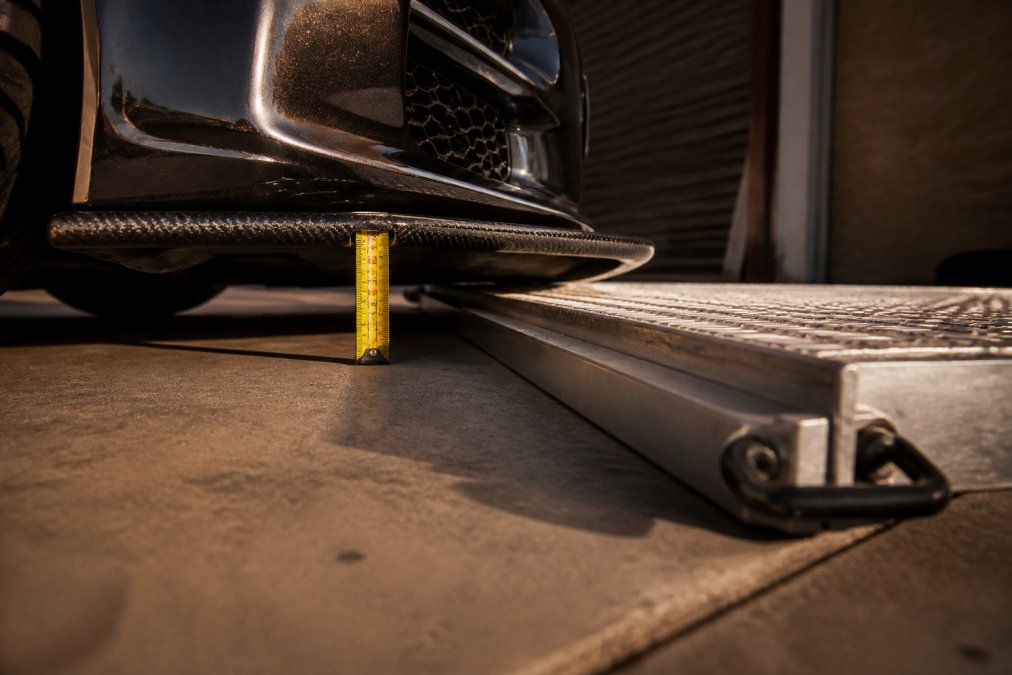
Over 20% of transport-related vehicle damage occurs during loading itself. The risk happens in the first five minutes, when geometry meets physics and there’s no room for error.
At Neptune Towing, we handle lowered vehicles regularly, from air-suspended luxury sedans to track-focused sports cars with custom body kits. The difference between a successful load and costly damage comes down to understanding what makes low-profile vehicle transport different, then executing it properly.
The Geometry Problem: Why Standard Ramps Don’t Work
A standard open car hauler typically has a ramp angle around 16 to 18 degrees (fmcsa.dot.gov). A lowered sports car typically needs something closer to 6 to 10 degrees to avoid contact with the ramp surface itself.
If your car has 4 inches of front splitter clearance and you’re driving up a 16-degree ramp, the splitter will make contact almost immediately. Carbon fiber, fiberglass, or painted plastic, it will scrape. Once it starts, damage compounds. What started as a preventable scrape becomes thousands of dollars in repairs.
This is why enclosed trailers with hydraulic lift gates matter. A hydraulic lift gate raises and lowers the car slowly and evenly, keeping it perfectly level. There’s no ramp angle at all. The car simply sits on a platform that rises and falls vertically. For low-clearance vehicles, this is the difference between damage-free transport and a repair bill.
Common Damage Points During Loading
The front splitter is the most vulnerable point, extending below the bumper and taking the first impact if the approach angle is too steep. Side skirts, rocker panels, and undercarriage components, including aftermarket exhaust systems and underbody bracing, are also at risk. Wheels and tires can blow or bend if they catch on the ramp edge during the initial climb.
Preparing Your Lowered Car Before Transport
Proper preparation means understanding your specific vehicle, its suspension behavior, and what needs to happen before it ever touches a trailer.
Measuring Ground Clearance and Approach Angle
Before you call a tow truck, measure your car’s actual ground clearance from the ground to the lowest point on your car. Measure the front splitter, side skirts, undercarriage, and rear diffuser if you have one. The lowest point is your limiting factor. If anything under 4 inches clears the ground, you need a hydraulic lift gate or extended ramp system.
Approach angle is the angle at which your car can drive up an incline without the front splitter or bumper making contact. For a lowered car, this is typically 6-10 degrees. Know your car’s approach angle before transport day.
Air Suspension and Adjustable Ride Height Management
If your car has air suspension or adjustable ride height, raise your suspension to its highest setting before transport. Some cars do this automatically when you turn off the engine, but others require you to activate a lift mode through the infotainment system. Check your owner’s manual. If your car lowers automatically when turned off, you need a hydraulic lift gate.
Pre-Transport Safety Checklist
Before calling for a tow truck, verify these points:
- Tire pressure is at specification
- Suspension is raised to maximum height if adjustable
- Any removable aero parts have been removed if they hang extremely low
- The parking brake works and holds the car firmly
- The car is parked on level ground
- You have the keys and can demonstrate that the car starts and the parking brake engages
- You know the exact lowest point on your car and its clearance measurement
Selecting the Right Trailer Type for Low-Profile Vehicle Transport
For a lowered sports car, trailer selection is the single most important decision you’ll make.
Enclosed Trailers vs. Open Carriers
Enclosed trailers cost more than open carriers for comparable routes, but for a lowered car, they’re worth it. Open carriers have steep ramp angles and weather exposure. Enclosed trailers usually carry 1 to 6 vehicles per load, giving your car its own protected space. Most importantly, they’re equipped for low-clearance vehicles. If you’re transporting a show car, custom-painted vehicle, or anything with a front splitter under 5 inches, enclosed transport is mandatory.
Hydraulic Lift Gates and Extended Ramps
A hydraulic lift gate is the gold standard for low-clearance vehicles. The gate lowers completely to the ground, eliminating ramp angle entirely. Your car drives straight onto a level platform. The platform rises. The car is secured. There’s no geometry risk at all.
Extended ramps create a shallower angle, typically 8-12 degrees, which is better than a standard ramp for cars with 4-5 inches of clearance. For Neptune Towing customers with lowered vehicles in the Tulsa area, flatbed towing with a hydraulic lift gate is the service that protects your car.
Calculating Ramp Length and Load Angle for Safe Loading
Understanding the math behind ramp angle and ramp length helps you make smarter decisions about transport equipment.
Understanding Ramp Angle Requirements
Ramp angle is measured in degrees from horizontal. For lowered sports cars, a 6-10 degree ramp angle is safe. A 10-15 degree angle is risky. Above 15 degrees, you’re in damage territory. This is why standard 16-18 degree ramps don’t work for low-profile vehicles.
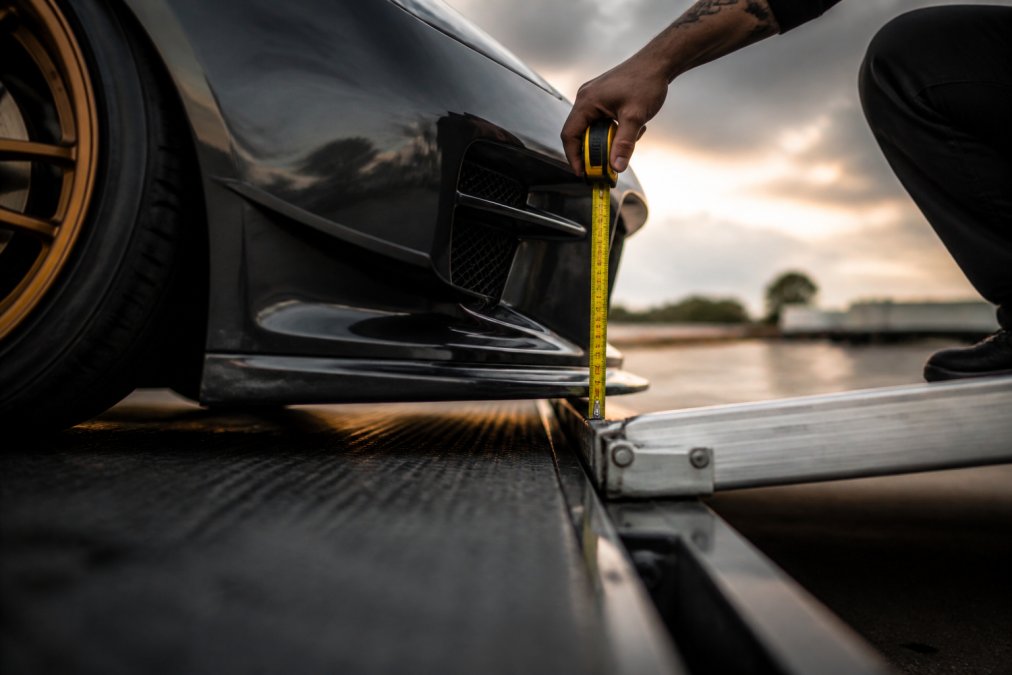
The Math Behind Ramp Length Calculation
If you want a shallower ramp angle, you need a longer ramp. To calculate required ramp length, you need the height of the trailer deck and your desired ramp angle. Most enclosed trailers have a deck height of 48-54 inches.
Ramp Length = Trailer Height ÷ sin(Ramp Angle)
If your trailer deck is 52 inches high and you want a 6-degree angle:
Ramp Length = 52 ÷ sin(6°) = 497 inches (about 41.5 feet)
A standard ramp is typically 20-24 feet long, which creates that 16-18 degree angle. To get a 6-8 degree angle, you need a 30-42 foot ramp. That’s why extended ramps exist. That’s also why hydraulic lift gates are so valuable, they eliminate this equation entirely.
When arranging transport for a lowered car, ask the tow company about their ramp length. If they’re using a standard 20-24 foot ramp, the angle will be too steep. You need extended ramps or a hydraulic lift gate.
Step-by-Step Loading Process for Lowered Cars
Once you have the right equipment, the loading process itself requires precision and care.
Step 1: Prepare the Trailer and Check Level Ground
Before your car arrives, the trailer must be positioned on level ground. Use a level tool to verify. Check the trailer deck for debris, gravel, or anything that could catch a wheel or splitter. Clear it completely. Inspect the ramp or lift gate for damage. Test the hydraulic system if there’s a lift gate. Position wheel chocks at the trailer’s far end to prevent rolling.
Step 2: Position the Vehicle and Engage Parking Brake
Drive the car straight toward the ramp or lift gate. Keep it centered. Even a foot of offset can cause one side of the car to catch on the ramp edge. Engage the parking brake firmly. Keep the engine running.
Step 3: Navigate the Ramp with Controlled Movement
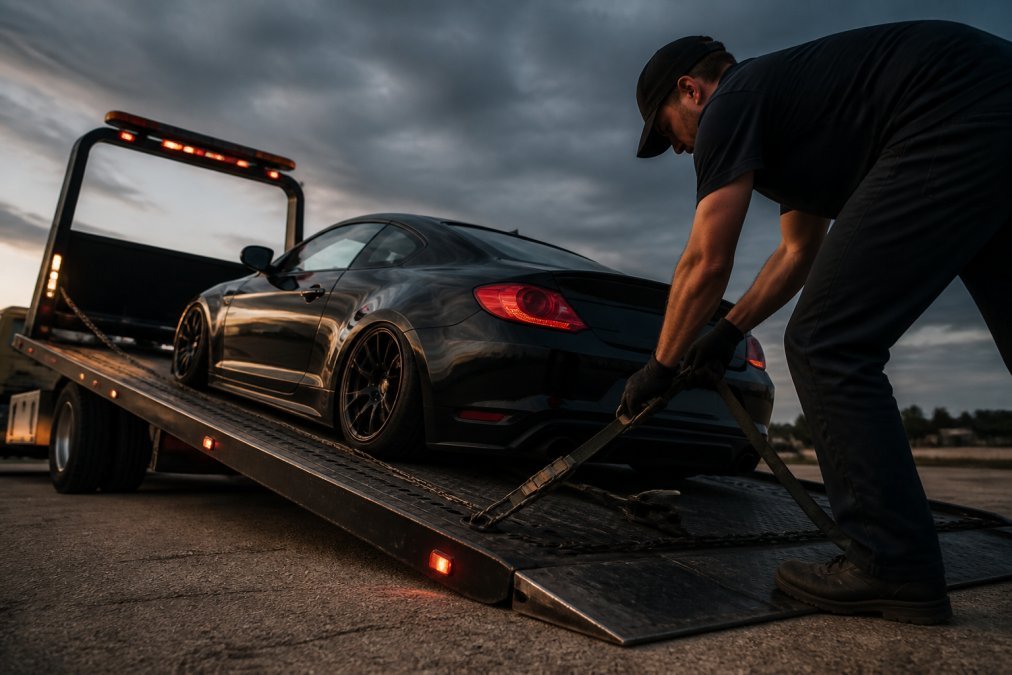
This is the critical moment. Drive slowly. Extremely slowly. If you’re using a hydraulic lift gate, the operator controls the speed. The platform rises gradually, keeping the car level and safe. If you’re using a ramp, drive at a walking pace. Watch the front splitter. Have a spotter outside the car watching for clearance. If anything starts to scrape, stop immediately. Reverse off slowly. Adjust your approach and try again. Once the front wheels are fully on the trailer, keep moving forward slowly until the car is fully on the trailer.
Step 4: Secure the Vehicle with Soft-Tie Straps
Once the car is fully on the trailer, it needs to be secured. Use soft-tie wheel straps, not chains and hooks. Position the straps across all four wheels. Tighten them evenly. The car should not shift side-to-side or front-to-back.
Damage-Free Towing Techniques for Lowered Vehicles
Damage-free towing is a specific set of techniques that protect your car during transport.
Why Soft-Tie Straps Beat Chain and Hook Methods
Chains and hooks are traditional towing equipment. For a lowered car, they’re dangerous. A chain attached to a bumper or suspension point creates a rigid connection that transfers stress directly to the attachment point if the car shifts or bounces.
Soft-tie straps work differently. They secure the car by wrapping around the wheels. The wheel is the strongest part of the car for securement. The strap is soft, so it doesn’t cut into the tire or wheel. The connection is secure but flexible. If the car shifts slightly, the straps absorb the movement instead of transferring stress to the body or suspension.
For lowered vehicles with custom suspension, body kits, or expensive paint, soft-tie straps are non-negotiable.
Protecting Body Kits and Aero Components
If your lowered car has a custom body kit, splitter, side skirts, or diffuser, these components need specific protection during loading and transport. The most vulnerable moment is when the car is being driven onto the trailer.
If removable aero parts are extremely low, remove them before transport. Store them safely. Reinstall them after the car is unloaded. For non-removable components, communicate with the tow operator. Point out exactly where the low points are. The operator can adjust their approach, slow down, or use a shallower ramp.
Wheel Chocks and Load Distribution
Wheel chocks are blocks placed in front of and behind the wheels to prevent rolling. For a lowered car, they help distribute the car’s weight evenly across the trailer. Combined with soft-tie straps, they create a secure, stable platform for transport.
Common Mistakes to Avoid When Loading Lowered Cars
Most damage to lowered cars during transport happens because of preventable mistakes.
Rushing the Loading Process
This is the number one mistake. Someone’s in a hurry. The tow operator wants to finish the job. The car owner wants to get going. So the loading happens fast. And something goes wrong.
Loading a lowered car takes time. Measuring clearance, positioning the car, navigating the ramp slowly, securing it properly, this takes 30-45 minutes for an experienced operator. If someone promises to load your lowered car in 10 minutes, they’re not doing it safely. Slow is safe. Budget extra time.
Ignoring Suspension Travel and Overhang
Suspension travel is how much the suspension compresses under load. When a car is driven onto a trailer, the suspension compresses. The car sits lower. The clearance you measured at home might not be the same clearance on the trailer.
Overhang is how far the front bumper extends beyond the front axle. A long overhang means the front of the car dips lower as the car climbs a ramp. Know your car’s suspension travel and overhang. Factor both into your clearance calculations. If you’re close to the limit, use a hydraulic lift gate.
Skipping the Post-Loading Inspection
After the car is loaded and secured, inspect it before the tow truck leaves. Walk around the entire car. Look for new scratches, dents, or damage. Check that the straps are tight and the car isn’t shifting. If you see damage, document it with photos. Get the tow operator’s information. Report it immediately.
Flatbed Towing in Tulsa for Low-Clearance Vehicles
When you need to move a lowered sports car safely in the Tulsa area, flatbed towing is the gold standard. It’s the only method that truly protects your vehicle from damage.
Why Flatbed Towing Protects Your Lowered Car
Flatbed towing keeps all four wheels off the ground. The car sits on a flat, level platform. There’s no rolling, no suspension stress, no tire wear. The car is transported exactly as it would be on a trailer, completely stationary.
For lowered vehicles, this eliminates almost every risk associated with traditional towing. No ramp angles. No approach angle geometry problems. No suspension compression causing clearance issues. Flatbed towing also protects the suspension and drivetrain. Lowered cars often have custom suspension tuned for a specific ride height. When a car is towed with two wheels off the ground, the suspension and drivetrain experience stress (nhtsa.gov). For a lowered car with custom suspension, this can cause damage.
If your lowered sports car needs to be transported, whether for repairs, storage, or relocation, flatbed towing is the method that protects your investment.
Professional Transport Services Available Locally
Neptune Towing serves the Tulsa, Bixby, Broken Arrow, Jenks, Glenpool, Owasso, Sapulpa, and surrounding Oklahoma communities with flatbed towing specifically designed for low-clearance and specialty vehicles. We understand lowered cars. We know the clearance challenges. We have the equipment, hydraulic lift gates, extended ramps, soft-tie straps, and wheel chocks, to load your car safely.
When you call Neptune Towing for a lowered sports car, you’re talking to a local towing company that specializes in damage-free transport. We measure your clearance. We plan the approach. We load slowly. We secure properly. Your car arrives at its destination without new damage.
We’re owner-operated and available 24/7. We dispatch fast. We load carefully. We protect your vehicle like it’s our own. If you need flatbed towing for a lowered car, Tesla, classic vehicle, or any specialty vehicle in the Tulsa area, call Neptune Towing.
Frequently Asked Questions
Q: What is the safest way to load a lowered car on a trailer?
A: The safest method uses a hydraulic lift gate or extended ramp at a shallow angle (6-10 degrees) to lower the vehicle slowly onto the trailer deck. Soft-tie wheel straps secure the car by the tires, allowing suspension to move naturally. Ensure level ground, engage the parking brake, and use wheel chocks for additional stability.
Q: How do I know if my car is too low for a standard ramp?
A: If your front splitter or undercarriage has less than 5 inches of clearance, a standard ramp (16-18 degrees) will cause scraping. Measure your ground clearance from the lowest point of your front bumper or splitter to the ground. Lowered sports cars typically need ramps closer to 6-10 degrees to avoid contact. When in doubt, use a flatbed with a hydraulic lift gate instead.
Q: Why is soft-tie securement better than chains for lowered cars?
A: Chains and hooks can damage body panels, suspension components, and custom aero parts on lowered vehicles. Soft-tie wheel straps secure the car by the tires, distributing load evenly and allowing the suspension to move naturally during transit. This method reduces stress on the chassis and protects low-sitting components like splitters and diffusers from damage.
Q: What should I do with air suspension before loading?
A: Raise your air suspension to its highest setting before transport to maximize ground clearance. If your vehicle has a factory lift mode, activate it. Some cars lower automatically when turned off, so keep the engine running until the suspension reaches full height. This simple step can increase clearance by 2-4 inches, making the difference between safe loading and potential scraping.
Loading a lowered sports car safely requires the right knowledge, the right equipment, and the right operator. It’s not something to gamble on. When you need flatbed towing for a low-profile vehicle in Tulsa, Neptune Towing has the experience and equipment to protect your car. Call (539) 292-3074 for damage-free towing and professional roadside assistance available around the clock.