

Table of Contents
- How Cold Weather Affects Car Battery Chemistry
- The Double Impact: Reduced Capacity and Increased Power Demand
- Cold Cranking Amps and Winter Engine Turnover
- Signs of a Bad Car Battery Before Winter Hits
- How to Jump Start a Dead Battery Safely
- Battery Age, Modern Electrical Demands, and EV Winter Performance
- Preventative Maintenance to Avoid Winter Battery Failure
- When to Replace Your Battery and When to Call for Help
Last Updated: August 23, 2026
How Cold Weather Affects Car Battery Chemistry
Winter battery failure isn’t random. It’s chemistry working against you. When temperatures drop, chemical reactions inside your battery slow dramatically. At 32°F (0°C), a car battery performs at only 65% of its rated capacity. Drop it to 0°F (-18°C), and you’re looking at losing up to half your battery’s power entirely.
Here’s what’s happening inside: a car battery stores energy through a chemical reaction between lead plates and an electrolyte solution. Cold thickens that electrolyte, slowing the reaction. The ions move slower. The voltage drops. Your battery has less power available exactly when your engine needs more.
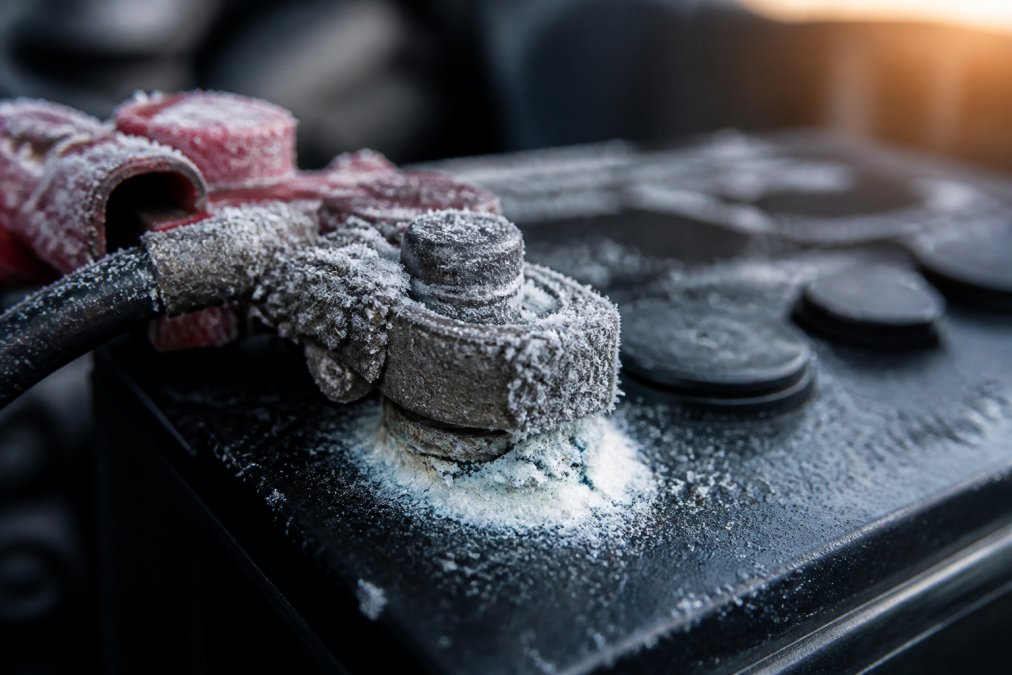
The real threat comes when temperatures push the electrolyte toward its freezing point. A fully charged lead-acid battery won’t freeze until roughly -76°F (-60°C), but a partially discharged battery in 0°F weather faces real danger. When electrolyte freezes, it expands about 9%, potentially cracking the battery case and destroying internal plates permanently. That’s not a jump-start situation anymore, that’s a replacement.
This is why winter battery failures spike sharply. Neptune Towing has responded to countless winter battery calls throughout the Tulsa area, and the pattern is always the same: drivers who had no trouble in fall suddenly find their cars won’t turn over when the temperature drops below freezing overnight.
The Double Impact: Reduced Capacity and Increased Power Demand
Cold weather creates a trap. Your battery is weaker at the exact moment your engine demands more power.
Engines need more cranking power in winter. Cold thickens engine oil, making it harder to turn over. In cold weather, engines require 20% to 30% more power to start compared to mild conditions. Your battery capacity is down 50%, but your engine’s power demand is up 25%. That’s the double impact.
Modern cars make this worse. Your battery has to power security systems, memory settings, touchscreens, heated seats, and sensors, even when parked. Modern batteries typically last three to five years instead of five to seven. Stop-Start technology multiplies the problem, each restart draws significant power. An aging battery that handles normal driving fine can fail completely when Stop-Start technology keeps cycling it. In winter, when capacity is already halved and power demand is already doubled, Stop-Start systems often fail first.
The math is simple: reduced capacity plus increased demand equals failure. A battery that would start your car in October might not start it in January.
Cold Cranking Amps and Winter Engine Turnover
Cold Cranking Amps (CCA) is a battery rating that matters most in winter. It measures how much current a battery can deliver for 30 seconds at 0°F while maintaining at least 7.2 volts. That’s the power your starter needs to turn over a cold engine.
Your battery’s CCA rating tells you its winter performance potential. A battery rated for 600 CCA is stronger in cold than one rated for 400 CCA. But here’s the catch: as a battery ages, its actual CCA output drops even if the battery still works fine in summer. A four-year-old battery might be rated for 600 CCA when new but only deliver 450 CCA in reality. In winter, that gap matters.
This is why battery age becomes critical in cold weather. Most car batteries last between three and five years. A three-year-old battery might still start your car reliably in warm months. In winter, that same battery might fail because its actual CCA output has degraded below what your engine needs. If your alternator is weak or failing, your battery won’t recharge properly during winter driving either.
Signs of a Bad Car Battery Before Winter Hits
Catching a failing battery before winter is the difference between a preventative jump start and a breakdown on I-44 in freezing weather.
Listen for slow cranking. When you turn the key, does the engine turn over slowly before catching? A healthy battery should spin the starter quickly and decisively. Slow cranking means your battery isn’t delivering full power. In summer, you might still get the car started. In winter, you won’t.
Watch for electrical dimming. When you start the engine, do your headlights dim noticeably? That’s your battery struggling to deliver power to both the starter and lights simultaneously. Check for corrosion on terminals too, white, blue, or green crusty buildup creates resistance and makes current flow harder. Clean terminals with a wire brush and baking soda solution.
Pay attention to warning lights. Your dashboard battery light often signals charging system problems. If it comes on, have it diagnosed before winter. Around 25% of vehicles are operating with 12-volt batteries in substandard condition (drive.com.au). In winter, that problem becomes a crisis.
How to Jump Start a Dead Battery Safely
A jump start gets you moving, but only if you do it correctly. Wrong technique can damage your vehicle’s electrical system or create a safety hazard.
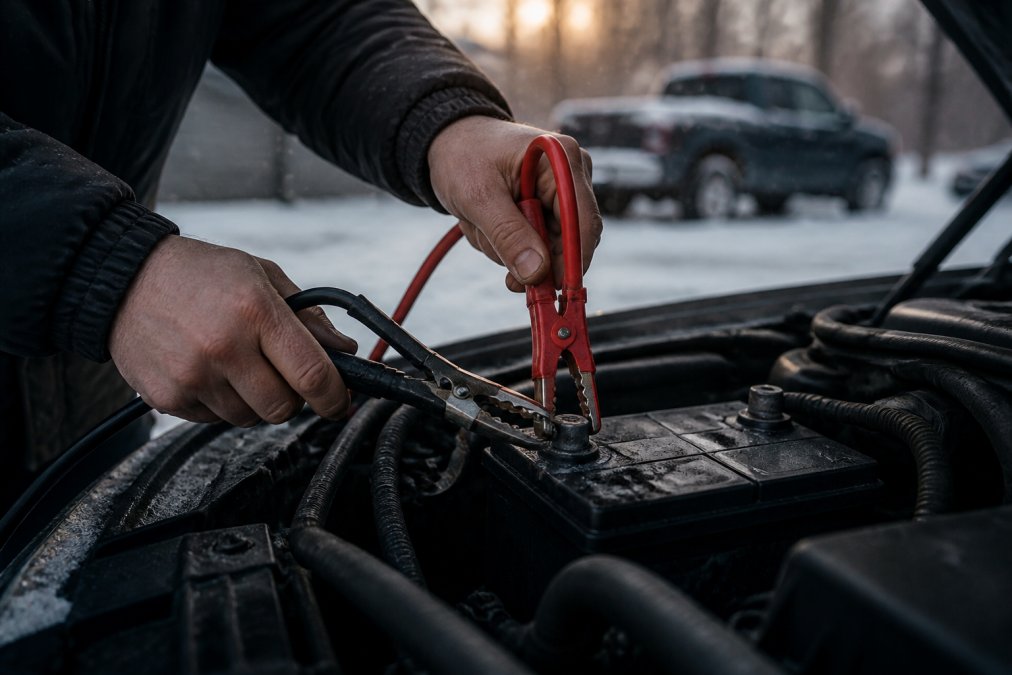
Step 1: Position both vehicles safely. Park the working vehicle close to your dead battery, but not touching. Turn off both engines.
Step 2: Identify the terminals correctly. Your battery has two terminals: positive (marked with a plus sign or red cover) and negative (marked with a minus sign or black cover).
Step 3: Connect the red cable first. Attach one end to the positive terminal of your dead battery. Attach the other end to the positive terminal of the working vehicle’s battery.
Step 4: Connect the black cable. Attach one end to the negative terminal of the working vehicle’s battery. Attach the other end to an unpainted metal surface on your engine block, not the negative terminal of your dead battery. This prevents sparks near the battery.
Step 5: Start the working vehicle. Let it run for 2-3 minutes to charge your dead battery partially.
Step 6: Start your vehicle. Try starting your car. If it doesn’t start after 30 seconds, wait another minute and try again.
Step 7: Disconnect in reverse order. Remove the black cable from your engine first, then from the working vehicle. Remove the red cable from the working vehicle, then from your battery.
Step 8: Keep running. Drive for at least 20 minutes to let your alternator recharge the battery.
If your battery won’t hold a charge even after a jump start, or if it fails repeatedly, replacement is your next step. Neptune Towing can transport your vehicle to a repair facility when you need professional help, and we handle the tow safely without damage to your car.
Battery Age, Modern Electrical Demands, and EV Winter Performance
Your battery’s age is the single strongest predictor of winter failure. Most car batteries last between three and five years. After three years, internal degradation accelerates. After five years, failure is common even in mild conditions. lead acid battery limitations.
Modern vehicles stress batteries harder than older cars did. Security systems, always-on sensors, memory modules, and touchscreens draw power constantly, even when parked. Your battery is working 24/7, not just when you’re driving.
Electric vehicles use a standard 12-volt battery to power locks, electronics, and the high-voltage system controller. If that 12-volt battery dies in cold weather, the high-voltage system cannot activate. You’re stranded. The 12-volt is the gateway, and when it fails, the entire vehicle fails.
EV batteries themselves are affected by cold too. Electric vehicles experience 14% to 39% range reduction in cold conditions, averaging around 25%. This isn’t battery failure, it’s normal cold weather behavior. Lithium-ion chemistry slows in cold, reducing power output temporarily. When the battery warms up, range returns.
The real EV winter threat is different: coolant leaks. A January 2026 analysis showed that 40% of roadside assistance calls for EVs were due to coolant leaks, often caused by small O-ring seals shrinking in cold and allowing battery-cooling fluid to spray out. That’s not the battery failing, it’s the thermal management system failing. But the result is the same: a stranded vehicle needing professional recovery.
For EV owners in the Tulsa area, Neptune Towing provides specialized, damage-free flatbed towing for Teslas and other electric vehicles. We understand that EVs require different handling than traditional cars, and we have the equipment and experience to transport them safely without damage to the drivetrain or charging system.
Preventative Maintenance to Avoid Winter Battery Failure
Prevention is cheaper than replacement, and replacement is cheaper than a breakdown in freezing weather.
1. Test your battery before winter. Most auto parts stores offer free battery testing. They measure your battery’s actual voltage and CCA output. If your battery is more than three years old, get it tested in September or October.
2. Clean corrosion from terminals. Disconnect the negative terminal first, then the positive. Mix baking soda and water into a paste. Scrub the terminals with an old toothbrush until corrosion is gone. Rinse with distilled water and dry completely. Reconnect positive first, then negative.
3. Check your alternator. Your alternator charges the battery while the engine runs. If it’s failing, your battery won’t recharge properly. Listen for a whining sound when the engine starts. Watch for dimming lights while driving.
4. Reduce parasitic drain. Avoid leaving lights, radio, or heated seats running when the engine is off. If you park for extended periods in winter, consider a battery tender, a trickle charger that maintains charge without overcharging.
5. Keep your battery warm. A battery blanket or insulation wrap helps maintain temperature in extreme cold. Even a few degrees of warmth helps the chemical reactions inside the battery work more efficiently.
6. Drive regularly. Short trips in winter are particularly hard on batteries because the engine doesn’t run long enough for the alternator to fully recharge. Combine short errands into one longer drive when possible.
7. Monitor your battery light. Your dashboard battery warning light often signals charging system problems. If it comes on, have it diagnosed before winter.
Battery-related failures account for approximately 23% of serious vehicle breakdowns (aaa.com). That’s the most common reason drivers need roadside assistance. Winter makes it worse. Prevention now means you won’t be one of those statistics.
When to Replace Your Battery and When to Call for Help
Knowing when to replace your battery saves you from a winter breakdown. Knowing when to call for professional help keeps you safe.
Replace your battery if:
- It’s more than four years old and winter is approaching
- Testing shows it delivers less than 70% of its rated CCA
- It fails to hold a charge even after a full recharge cycle
- Corrosion returns quickly after cleaning
- Your engine cranks slowly even in mild weather
- You see cracks in the battery case
Call for professional help if:
- Your car won’t start and you don’t have jumper cables or another vehicle
- You’re stranded on a highway or in unsafe conditions
- Your battery is damaged or leaking
- You’re uncomfortable working with electrical connections
- You need your vehicle transported to a repair facility
Neptune Towing is available 24/7 for emergency towing and roadside assistance throughout the Tulsa area. If you’re stranded with a dead battery on I-44, Highway 169, or any road in Tulsa, Bixby, Broken Arrow, Jenks, or surrounding communities, call us immediately. We’ll dispatch a tow truck to your location and transport you safely to a repair facility or your destination. We handle every vehicle, sedans, trucks, SUVs, Teslas, and specialty vehicles, with damage-free towing procedures.
Winter battery failure doesn’t have to catch you off guard. Understanding how cold affects your battery chemistry, recognizing the warning signs, and taking preventative steps now means you’ll start reliably all season long. When you do need help, whether it’s a jump start on a cold morning or a tow to your mechanic, Neptune Towing provides immediate, professional roadside assistance and damage-free towing throughout Tulsa and surrounding communities. Call us anytime at (539) 292-3074 for fast, honest service when you need it most.
Frequently Asked Questions
Why does my car battery keep dying when it gets cold?
Cold reduces your battery's chemical reaction speed, cutting capacity by 20-60% at 0°F. Meanwhile, your engine needs 20-30% more power to start because oil thickens and components stiffen. This double impact, less power available, more power needed, causes winter battery failure. At 32°F, a battery operates at only 65% capacity. If your battery is already three to five years old, cold weather often triggers the first failure.
What are the signs of a bad car battery before winter arrives?
Watch for slow engine cranking, dim headlights, clicking sounds when turning the key, or a battery warning light on your dashboard. If your car struggles to start on mild days, winter will expose that weakness. A load test at a repair shop can measure your battery's actual health. If you're hearing a single loud click instead of the engine turning over, your battery is likely dead or severely discharged and needs immediate jump-start service.
How do I jump start a dead battery safely?
Turn off both vehicles. Connect the red jumper cable to the dead battery's positive terminal, then to the good battery's positive terminal. Connect the black cable to the good battery's negative terminal, then to an unpainted metal surface on the dead car's engine (not the negative terminal). Start the working vehicle, wait 2-3 minutes, then start your car. Keep both running for a few minutes. Disconnect cables in reverse order. If your battery won't hold a charge after jumping, call for roadside assistance, you may need a battery replacement or a tow to a repair facility.
Can cold weather permanently damage my car battery?
Yes. When electrolyte inside a battery freezes, it expands about 9%, potentially cracking the battery case and damaging internal plates. A fully charged battery won't freeze until around -76°F, but a partially discharged battery in 0°F weather risks freezing damage. This is why keeping your battery in good condition and fully charged is critical. Once frozen damage occurs, the battery cannot be repaired and must be replaced.
This article was written using GrandRanker