
Table of Contents
- Understanding Approach Angle and Ground Clearance
- What You’ll Need Before Loading a Lowered Car
- Tow Truck Ramps for Low Clearance Cars: Choosing the Right Option
- Step-by-Step Process: How to Load a Lowered Car onto a Flatbed
- Damage-Free Towing Lowered Vehicles: Prevention Checklist
- Winching a Lowered Car onto a Flatbed: Safety and Technique
- How to Secure a Lowered Car on a Flatbed: Tie-Downs and Chocks
- Common Mistakes to Avoid When Loading Lowered Cars
How to Load a Lowered Car onto a Flatbed: A Step-by-Step Guide
Last Updated: July 26, 2026
When you own a lowered car, getting it transported safely becomes a real challenge. At Neptune Towing, we’ve handled hundreds of lowered vehicles across Tulsa and the surrounding communities, and we understand that loading a lowered car onto a flatbed requires specific knowledge and the right approach. A standard tow truck ramp won’t work, the approach angle is too steep, and your bumper, valance, and front end will scrape. We’re breaking down exactly what you need to know to load a lowered car safely onto a flatbed without causing damage.
Understanding Approach Angle and Ground Clearance
Your approach angle is the maximum slope a vehicle can drive up without scraping its front bumper or undercarriage. Lowered cars have significantly reduced clearance compared to stock vehicles, making standard ramps dangerous.
Most standard loading ramps are designed with an approach angle between 15-18 degrees. For a lowered car with 3-4 inches of ground clearance lost to suspension modifications, this angle is too aggressive. The front bumper, splitter, or valance will make contact with the ramp surface before the wheels do, causing expensive damage in seconds.
A lowered vehicle needs an approach angle closer to 8-12 degrees to avoid contact. This is where low-profile ramps become essential.
Measure your vehicle’s actual ground clearance before attempting any loading. Place a straightedge across the lowest front point and measure down to the ground. This tells you exactly what ramp angle you can safely use.
What You’ll Need Before Loading a Lowered Car
Essential Equipment and Safety Gear
You’ll need low-profile loading ramps or ramp extensions to reduce the approach angle. Standard ramps won’t work. You’ll also need wheel chocks to prevent the vehicle from rolling once it’s on the deck. A spotter is essential, someone to stand outside the vehicle and guide the driver, watching for clearance issues as the car climbs the ramp.
Tie-down straps rated for your vehicle’s weight are mandatory. Use at least four tie-down points, and for vehicles with air suspension or extreme lowering, six tie-downs is safer. Safety equipment includes work gloves, eye protection, and a high-visibility vest for the spotter.
Preparing Your Tow Vehicle and Flatbed Trailer
Your tow vehicle must be powerful enough to handle the loaded trailer. The flatbed trailer itself should be level or slightly tilted backward. A trailer that tilts forward makes the approach angle even steeper and increases the risk of front-end contact.
Inspect the flatbed surface for debris, rust, or damage that could harm your vehicle during loading or transport. Check that the trailer lights work, the hitch is secure, and all safety chains are attached.
Never attempt to load a lowered car onto a trailer with a damaged hitch, worn brake pads, or faulty lighting. Verify that your entire towing setup is mechanically sound before you load anything.
Tow Truck Ramps for Low Clearance Cars: Choosing the Right Option
Low-Profile Ramps vs. Standard Ramps
Low-profile ramps are the only safe option for lowered vehicles. Standard ramps, which are typically 8-10 feet long with a 15-18 degree angle, were designed for vehicles with normal ground clearance and will damage your lowered car.
Low-profile ramps are longer (often 12-15 feet), which spreads the height change over a greater distance and reduces the angle to 8-12 degrees. This gentler slope allows your lowered car to climb without the front end scraping. Professional towing companies, including Neptune Towing, use adjustable low-profile ramps that can be configured for different vehicle heights and weights.
DIY Ramp Extensions and 2×4 Plank Solutions
If you don’t have access to low-profile ramps, you can extend standard ramps using 2×4 planks. Place 2×4 planks on the ground in front of the standard ramp, creating a gentle slope that leads into the ramp itself. Secure the planks so they don’t shift as the vehicle drives over them.
This method works best for vehicles that are moderately lowered (2-3 inches). For extremely lowered vehicles (4+ inches), you really do need professional low-profile ramps or a winch-assisted loading approach.
The longer your ramp system, the shallower the approach angle. Adding just 4-6 feet of extension can reduce your approach angle by 3-5 degrees, which makes a significant difference for lowered vehicles.
Step-by-Step Process: How to Load a Lowered Car onto a Flatbed
Step 1: Position and Secure the Tow Vehicle
Position your tow vehicle and flatbed trailer on level ground. The trailer should be straight, not at an angle. Engage the parking brake on the tow vehicle and any trailer brakes. Verify that the hitch is secure by walking around the trailer and checking that all connections are tight. Remove any obstacles from the loading path.
Step 2: Reduce Ramp Angle and Set Up Loading Path
Place your low-profile ramps at the rear of the flatbed, positioned symmetrically so the vehicle’s wheels will roll straight up the center of each ramp. If you’re using 2×4 plank extensions, position them on the ground first, then place the ramps on top.
Measure the approach angle if possible. For a lowered car, aim for 10-12 degrees or less. Have your spotter stand to the side of the loading area where they can see both the front of the lowered car and the ramps.
Step 3: Guide the Vehicle Onto the Flatbed Trailer
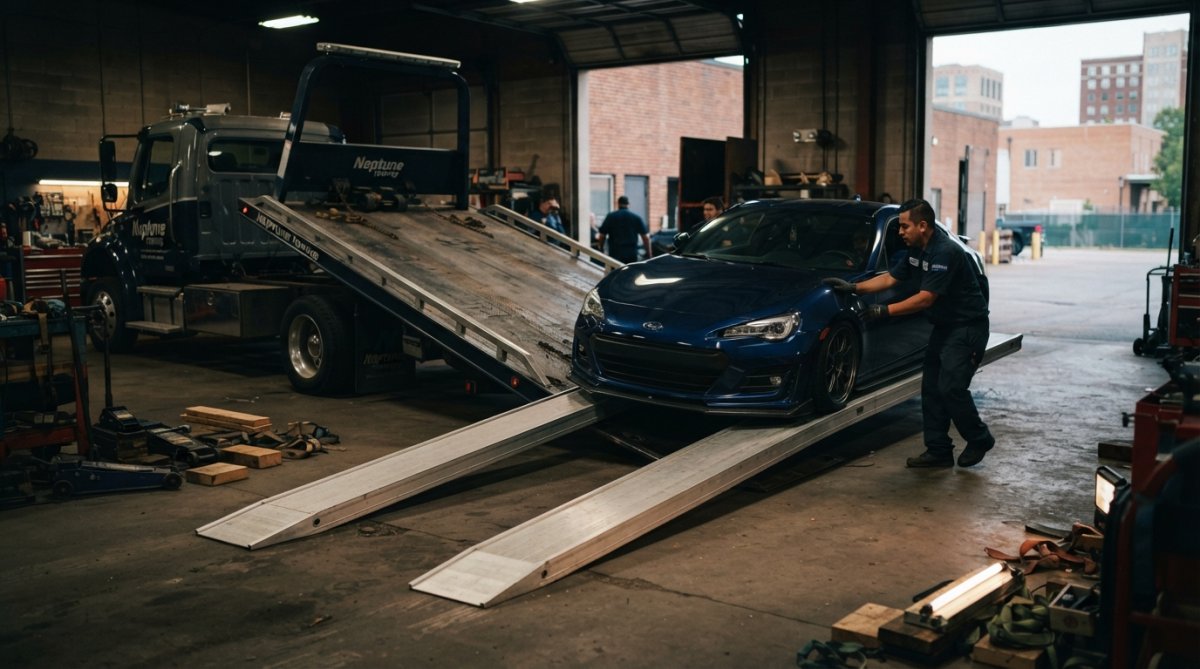
The driver of the lowered car should approach the ramps slowly, at walking speed or slower. As the car approaches the ramps, the spotter should watch the front bumper and valance. If there’s any scraping sound or if the spotter sees contact, the driver should stop immediately and reassess.
Once the front wheels are on the ramps, the driver should continue at the same slow speed, keeping the steering wheel straight. Turning the wheel while on the ramps changes the vehicle’s geometry and can cause the side of the car to contact the ramp edge. Once the entire vehicle is on the deck, the driver should stop and turn off the engine.
Damage-Free Towing Lowered Vehicles: Prevention Checklist
Protecting Bumpers, Valances, and Undercarriage
Damage-free towing starts with understanding what parts of your lowered car are at risk. The front bumper is the most vulnerable. Air dams, splitters, and custom valances extend even lower than the bumper itself. The undercarriage of a lowered car is also exposed, with coilovers, air suspension components, and custom exhaust systems hanging lower than on stock vehicles.
Before loading, inspect your vehicle’s lowest points. The ramp angle must be shallow enough that all of these points clear the ramp surface. Use protective padding on the ramps if possible. After loading, inspect the front end and undercarriage one more time before transport.
Monitoring for Scraping and Contact Points
Listen carefully during the loading process. A scraping sound means contact is happening. If you hear scraping, stop immediately and reassess. The spotter’s role is critical, they need to watch for visual signs of contact, the car tilting, or the front end dipping.
For air suspension vehicles, keep the suspension at its highest setting during loading to maximize clearance. For vehicles with extreme lowering (4+ inches), consider using a winch-assisted loading approach instead of driving up the ramps.
Never load a lowered car alone. You need a spotter to watch for clearance issues. A moment of inattention can result in thousands of dollars in damage.
Winching a Lowered Car onto a Flatbed: Safety and Technique
When Winch-Assisted Loading Is Necessary
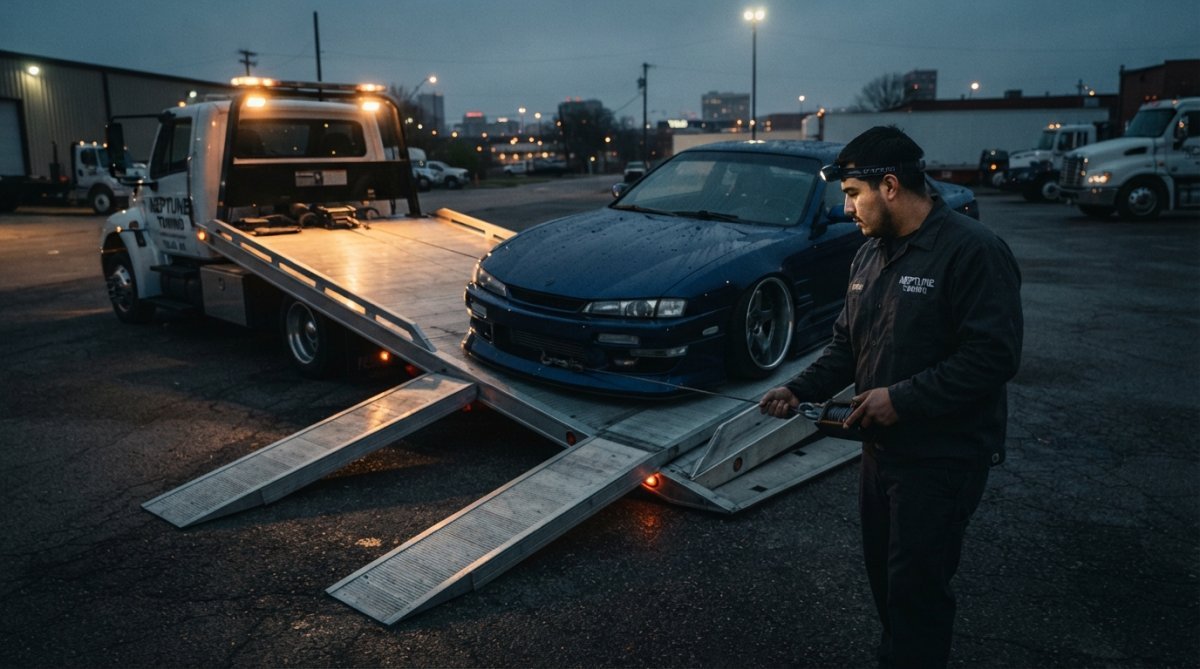
Winch-assisted loading is the safest method for extremely lowered vehicles, vehicles with custom body kits, or vehicles with very low splitters or air dams. Instead of driving the car up the ramps, you use a winch to pull the vehicle onto the flatbed slowly and controlled.
This method is necessary when the approach angle required for the vehicle to drive up is impractical. Professional towing companies have winches rated for the weight of the vehicles they tow. A typical lowered car weighs 3,000-4,000 pounds, so a winch rated for at least 5,000 pounds is necessary.
Proper Tie-Down Points and Winch Safety
The winch cable needs to attach to a strong point on the vehicle. The frame is ideal. Never attach the winch cable to the bumper, which will pull off under load. Locate the frame rails on your vehicle and attach a heavy-duty tow strap or cable to the frame, then attach the winch cable to the tow strap.
Use a snatch block or pulley if possible to increase the mechanical advantage of the winch. Before winching, position the vehicle so it’s aligned with the flatbed. Pull slowly at a steady, controlled speed. As the vehicle climbs the ramp, watch for any signs of the bumper or undercarriage making contact. If contact occurs, stop the winch immediately and reassess.
How to Secure a Lowered Car on a Flatbed: Tie-Downs and Chocks
Proper Tie-Down Placement and Tension
Once the lowered car is on the flatbed, it needs to be secured so it doesn’t shift during transport. Use at least four tie-down straps, one at each corner of the vehicle. For a lowered car with a stiff suspension and low center of gravity, six tie-downs is safer.
Attach the tie-downs to the frame or to designated tie-down points on the vehicle. Never attach to the bumper, hood, or trunk. Tighten the straps firmly but not excessively. The vehicle should not move at all when you push on it, but you shouldn’t be deforming the frame or bending suspension components. Check the tie-downs after the vehicle has been on the trailer for a few minutes.
Wheel Chocks and Trailer Bed Blocking
Wheel chocks prevent the vehicle from rolling forward or backward on the flatbed. Place chocks in front of the front wheels and behind the rear wheels. Use heavy-duty chocks rated for the weight of the vehicle. For a lowered car, make sure the chocks fit under the wheels without contacting the bumper or undercarriage.
Verify that the vehicle is sitting level on the trailer. A vehicle that’s tilted forward or backward puts uneven stress on the suspension and can shift during transport.
Common Mistakes to Avoid When Loading Lowered Cars
The most common mistake is using standard ramps without accounting for reduced ground clearance. Another mistake is loading too fast. Speed causes impact and increases the risk of bumper contact. A lowered car should be loaded at walking speed or slower.
Failing to use a spotter is a major mistake. You can’t see the front of your own vehicle while driving. Using improper tie-down attachment points is dangerous and may not hold the vehicle securely during transport. Attempting to load in poor lighting is risky. Finally, skipping the post-load inspection is a mistake. Check the vehicle for damage before transport.
Loading a lowered car onto a flatbed requires planning, the right equipment, and careful execution. When you’re dealing with a vehicle that’s been customized with air suspension, carbon fiber parts, or extreme lowering, the stakes are high. If you’re in the Tulsa area and you need help transporting a lowered vehicle safely, Neptune Towing specializes in damage-free towing for custom and lowered cars. We use proper low-profile ramps, experienced spotters, and secure tie-down procedures to protect your vehicle during loading and transport. Call Neptune Towing at (539) 292-3074 for professional flatbed towing you can trust.
Frequently Asked Questions
What's the best way to prevent scraping when you load a lowered car onto a flatbed?
The key is reducing your approach angle and using low-profile ramps specifically designed for ground-hugging vehicles. Position ramps as far back from the trailer's front edge as possible, and use 2×4 planks or ramp extensions to increase clearance under the front bumper and valance. Go slowly, and have a spotter watching the undercarriage for any contact points. Air suspension vehicles can be aired down slightly before loading to gain extra clearance.
Can you use a winch to load a lowered car onto a flatbed safely?
Yes, winch-assisted loading is safe when done correctly. Attach the winch cable only to factory tie-down points or reinforced frame locations, never to bumpers or suspension components. Use a spotter to monitor the vehicle's angle and clearance as it's winched up. Winching is especially useful for vehicles that can't self-load or when approach angles are extremely tight. Always ensure the tow vehicle and trailer are secure before engaging the winch.
What equipment do I need to safely load a lowered car onto a flatbed?
You'll need low-profile or adjustable ramps, wheel chocks or blocks to secure the tow vehicle, tie-down straps rated for your vehicle's weight, a properly maintained flatbed trailer, and safety equipment like work gloves and a high-visibility vest. If using a winch, ensure it's rated for your vehicle's weight and that you have proper anchor points. For air suspension vehicles, you may also need an air suspension controller to lower the vehicle before loading.
When should I call a professional towing service instead of attempting to load a lowered car myself?
Call a professional if your vehicle has extreme ground clearance issues, air suspension that won't lower, or if you lack proper ramps and tie-down equipment. Professional tow services like Neptune Towing have specialized flatbed equipment, experience with damage-free loading, and insurance coverage. If you're uncertain about approach angles or your vehicle's tie-down points, professional help protects both your car and your liability.
This article was written using GrandRanker