
Last Updated: November 5, 2026
Quick Summary
You can check tire pressure without a gauge by looking for a low tire that bulges or squats, feeling for a soft sidewall, and watching for a dashboard TPMS light. These methods only flag a problem; they can’t give an exact PSI, so get a real reading as soon as you can.
- A steady TPMS light often means one or more tires are low.
- A flashing TPMS light can point to a system fault, not just low air.
- Check tires when cold, since pressure rises after driving.
- The sidewall number is the maximum pressure, not your target.
- Find the recommended PSI on the driver-side door placard.
Table of Contents
- Why Checking Tire Pressure Without a Gauge Only Goes So Far
- How to Check Tire Pressure on Dashboard Warning Systems
- Signs of Low Tire Pressure You Can See and Feel
- How to Know Which Tire Needs Air Without a Gauge
- How to Check Tire Pressure at a Gas Station
- Finding Your Vehicle’s Recommended Tire Pressure
- When a Low Tire Means Call for Roadside Help in Tulsa
- Frequently Asked Questions
Why Checking Tire Pressure Without a Gauge Only Goes So Far
Most drivers in Tulsa never think about tire pressure until a tire looks low or the car feels wrong on the road. Checking without a gauge is possible, but it has limits. A tire can look fine and still be underinflated.
Here’s the honest part: touch and sight checks can flag a problem. They cannot tell you the exact PSI. Mavis makes the same point, noting that checking without a gauge is possible but not reliable. Mavis, How to Check Tire Pressure Safely & Accurately
So think of these methods as a first alert. If something feels off, get a real reading as soon as you can.
How to Check Tire Pressure on Dashboard Warning Systems
Many newer vehicles have a tire pressure monitoring system, or TPMS. When a tire drops well below the set level, a light on the dashboard usually comes on.
- A steady TPMS light often means one or more tires are low
- A flashing light can point to a system fault, not just low air
- Some cars show exact pressures on the driver information screen
TPMS is a warning, not a measurement tool. It typically triggers only when pressure drops significantly, so a tire can be low enough to hurt handling or fuel economy before the light appears. If the light comes on, stop when safe and check the tires with a gauge.
Signs of Low Tire Pressure You Can See and Feel
Before you drive, walk around the car and look at how each tire sits on the pavement. A tire that is low on air squats flatter at the bottom, so the sidewall bulges outward and the contact patch spreads wider than the tire next to it. That bulge is the tire flexing more than it should, and it is the most reliable visual clue you have without a gauge.
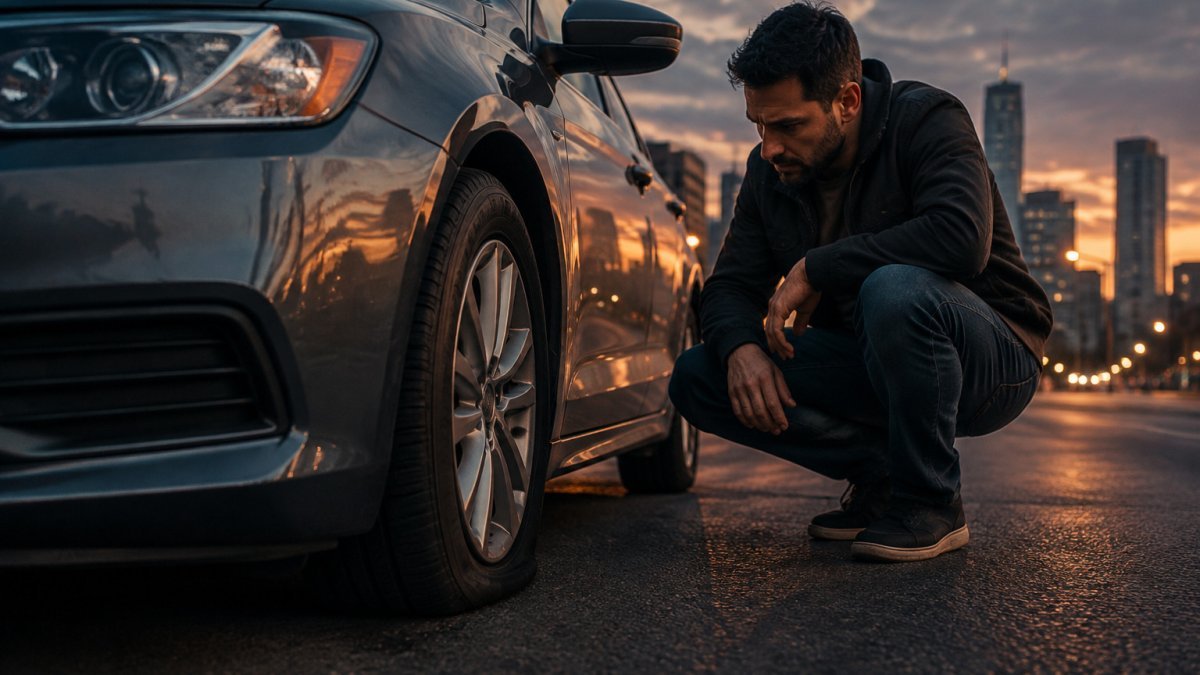
AAA describes this visual check as a way to spot possible underinflation, not to find an exact pressure. AAA, How To Check Tire Pressure: Everything You Need To Know That distinction matters. A tire can be several PSI low and still look normal from ten feet away, especially a stiff sidewall tire on a newer car or an EV.
Other warning signs include:
- The tire bulges or looks soft along the sidewall
- The car pulls to one side on a straight, flat road
- The steering feels heavy or slow to respond
- The tire wears faster on its outer or inner edges
- You hear more road noise or feel a vibration through the seat
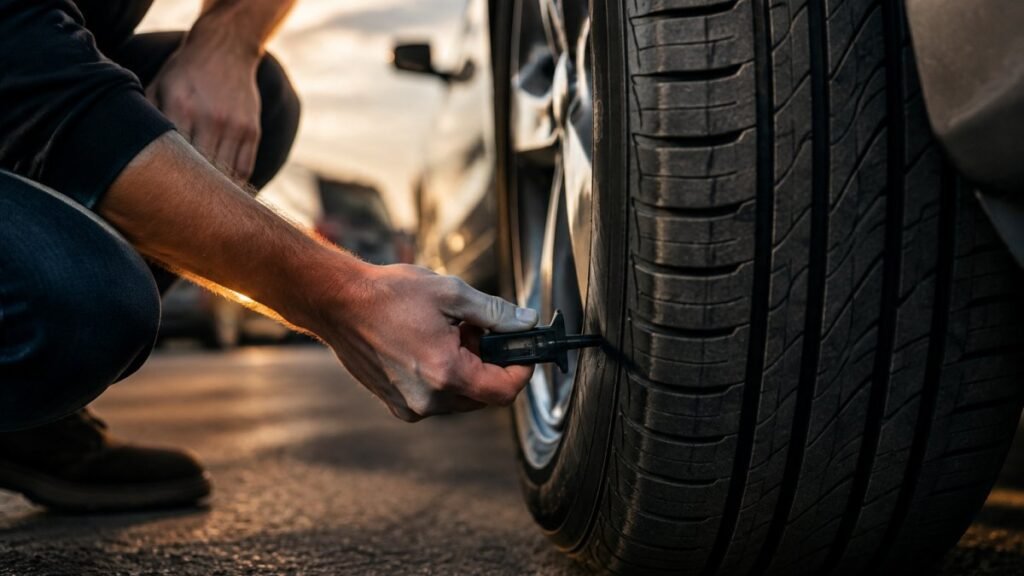
Press on the tire with your hand or thumb. A properly inflated tire feels firm and gives very little. A soft tire gives more than the others, and you can often feel the difference at the sidewall before you see it. Compare the suspect tire to its partner on the same axle, then to the front and rear tires. This is useful for spotting a problem, but it cannot tell you the number. Hand pressure varies from person to person, and a tire that feels firm to you may still be below the vehicle’s recommended cold PSI.
Watch out: driving on a badly underinflated tire makes the sidewall flex far more than it was designed to. That flex builds heat, and sustained heat is what damages the tire carcass or the wheel. If a tire looks very flat or you can see a bulge or cut in the sidewall, don’t keep driving on it.
One more thing worth knowing: the tire sidewall number is the tire’s maximum pressure, not your target. The pressure your car actually needs is on the driver-side door placard, and that is the number a gauge should be checked against once you have one.
How to Know Which Tire Needs Air Without a Gauge
Walk around the car and compare each tire to the one next to it. Look at the tread, the sidewall, and how much the tire sits on the pavement.
A simple sequence helps:
- Start with the front left tire and work clockwise around the car
- Note any tire that looks lower or softer than its partner on the same axle
- Compare left and right tires first, then front and rear
- Mark the suspect tire, then check it with a gauge
If two tires on the same side look low, check the spare too. A slow leak can be hard to spot by eye.
How to Check Tire Pressure at a Gas Station
Many gas stations have an air pump, and some have a built-in gauge. Treat that gauge as a rough reference, not a final answer. Station gauges get dropped, left in the weather, and knocked around, so they drift. If the reading looks suspicious, cross-check it against your dashboard TPMS display or a gauge you keep in the glovebox.
Here is the sequence that works:
- Check the tires when they are cold, before a long drive or after the car has sat for a few hours
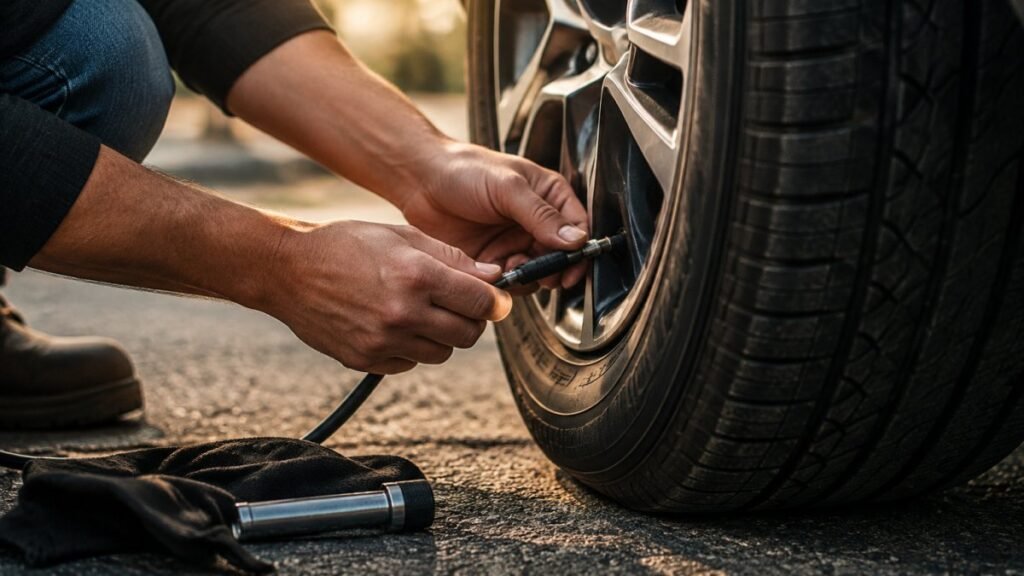
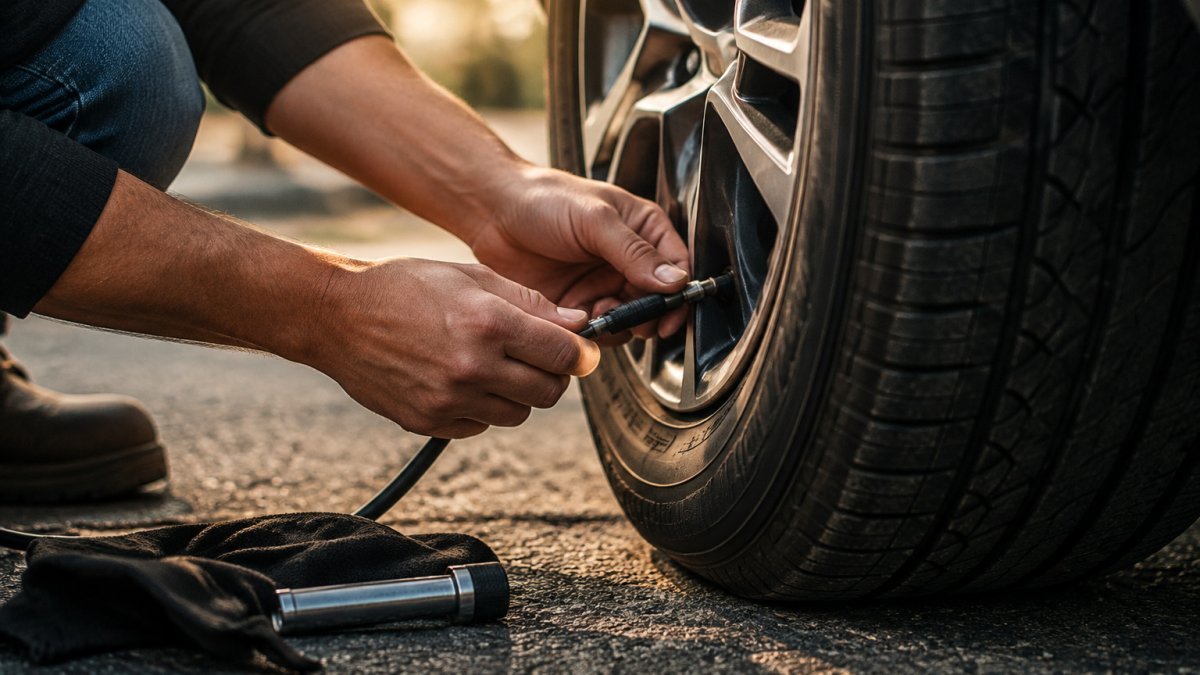
- Remove the valve cap and press the gauge firmly onto the valve stem until the hiss stops
- Read the number and compare it to the recommended pressure on the driver-side door placard
- Add air in short bursts, then check again rather than holding the chuck on and guessing
- Put the valve cap back on when you’re done
Pressure changes with temperature, so a tire checked after driving will read higher than when cold. Plan your checks for the morning, before the car has been driven far, and use the cold number as your baseline. If you have to check a warm tire, note that the reading will run higher and recheck cold when you can.
Your TPMS can help here. Many newer vehicles show exact pressures per tire on the driver information screen, which lets you confirm what the station gauge is telling you. Keep in mind that TPMS is a warning system, not a measurement tool. It typically triggers only when a tire drops well below the set level, so a tire can be low enough to hurt handling or fuel economy before the light ever comes on. A steady light usually means one or more tires are low; a flashing light can point to a system fault rather than low air. Because a warning light can miss gradual pressure loss, checking tires regularly matters for every vehicle, and the same habit helps maintain trailer tires.
If a tire reads low, don’t just top it off and forget it. Inflate to the placard value, then watch that tire over the next few days. A tire that keeps losing air has a slow leak, and a slow leak is a repair question, not an air question. If the tire is losing air quickly, shows a bulge or sidewall cut, or you are parked on a busy stretch like I-44 or the Broken Arrow Expressway and don’t feel safe working next to traffic, stop and call for help instead of adding air.
Neptune Towing is an owner-operated local towing company, and we handle tire changes and roadside assistance across Tulsa, Jenks, Bixby, Broken Arrow, and Glenpool. If you’re stuck with a low or flat tire, call (539) 292 3074 and we’ll get you to a safe spot.
Finding Your Vehicle’s Recommended Tire Pressure
The recommended tire pressure is not the number printed on the tire sidewall. That number is the tire’s maximum pressure. The right number for your car is listed on the driver-side door placard, which is the sticker on the door jamb. You can also find it in the owner’s manual.
Use the recommended PSI for your vehicle, not a number you find online for a different model. Pressure needs can change with the vehicle’s load, so check the placard again if you carry heavy cargo or tow.
The number on the tire sidewall and the number your car needs are different, so check the right one.
| Number | Where to find it | What it means |
|---|---|---|
| Tire sidewall | Printed on the tire | Maximum pressure, not your target |
| Driver-side door placard | Sticker on the door jamb | Recommended pressure for your vehicle |
| Owner’s manual | Vehicle manual | Also lists the recommended pressure |
| Heavy load or towing | Check the placard again | Pressure needs can change with load |
When a Low Tire Means Call for Roadside Help in Tulsa
Some low tires are safe to fix yourself. Others mean you should stop driving and call for help. Call for roadside assistance if:
- The tire is flat or very soft and you can’t add air safely
- The tire is losing air quickly, even after inflating
- You see damage, a bulge, or a sidewall cut
- You’re on I-44 or another busy road and don’t feel safe changing it
Neptune Towing provides roadside assistance across Tulsa, Bixby, Jenks, Broken Arrow, and nearby communities, including tire changes and jump starts. If you’re stuck, call (539) 292 3074 and we’ll get you to a safe spot.
Frequently Asked Questions
How can I tell my tire pressure without a gauge?
You can spot a seriously underinflated tire by looking at it and pressing on it. A tire that looks flattened where it meets the road, or that feels soft when you press the sidewall with your hand, may be low. The catch is that these checks only tell you something is wrong, not what the exact PSI is. Neither method can confirm the number, so a gauge is still the only way to know. If a tire looks low, treat it as a reason to check properly rather than a reading you can trust.
Can I safely drive with a tire that looks low?
Driving on a visibly low tire is risky. Underinflation can cause overheating, poor handling, longer stopping distances, and in severe cases a blowout. If a tire looks flat, feels soft, or your dashboard warning light is on, avoid highway speeds and get it checked as soon as you can. If the tire is badly flat or you are unsure whether it is safe to continue, call for help rather than pushing on. Neptune Towing can get you and the vehicle to a repair shop.
How do I know how much air to put in my tires?
The right pressure is the manufacturer-recommended figure for your specific vehicle, not the maximum printed on the tire sidewall. Look for it on the sticker inside the driver-side door jamb, or in your owner’s manual. Check tires when they are cold, meaning the car has sat for a few hours or driven only a short distance. Adding air at a gas station still requires a gauge to hit the target number accurately.