
Table of Contents
- What to Do During a Car Breakdown: Immediate Safety Steps
- Calling for Roadside Assistance: How to Get Help Fast
- Signaling for Help and Staying Visible
- Car Won’t Start Troubleshooting: Common Causes and Quick Fixes
- Flat Tire on Highway: What to Do and When to Call a Tow Truck
- Building a Car Emergency Kit for Breakdowns
- Managing Panic and Staying Calm During a Breakdown
- EV and Tesla Breakdowns: Special Considerations
Last Updated: July 18, 2026
What to Do During a Car Breakdown: Immediate Safety Steps
Your car dies on I-44 during rush hour. The first 60 seconds matter more than you think. At Neptune Towing, we’ve responded to thousands of breakdowns across Tulsa, Bixby, Broken Arrow, and surrounding communities. Drivers who stay safe and get help fastest know exactly what to do before it happens.
Activate Your Hazard Lights and Emergency Brake
The moment you realize something’s wrong, engine dies, steering feels wrong, losing power, activate your hazard lights instantly. These flashing lights tell every driver behind you that something’s wrong and buy you critical time. Engage your emergency brake gently. If you’re moving, use regular brakes first to slow down gradually, then apply the emergency brake once you’re moving slowly.
If your power steering fails, your steering wheel will feel extremely heavy but you can still steer, it just takes more effort. Keep both hands on the wheel and aim for the shoulder. Power brakes may also fail, so press the brake pedal firmly and steadily.
Pull to the Highway Shoulder Safely
Once your vehicle is slowing, get completely off the roadway onto the shoulder. On I-44 or I-244, aim for the gravel or paved shoulder. If you’re on a busy road in Tulsa with no shoulder, look for a parking lot or side street. Keep steering smoothly and avoid sudden jerks. Once stopped, put your vehicle in Park, engage the parking brake fully, and turn off the engine if it’s still running.
Stay Inside or Exit: Making the Right Call
Stay inside your vehicle if:
- You’re on a busy highway like I-44 or US-75 with heavy traffic
- The shoulder is narrow or non-existent
- You’re in an unfamiliar area or at night
- Weather is severe
Your vehicle is a protective shell and more visible than you standing on the roadside.
Exit to a safe distance if:
- You’re on a quiet road with light traffic
- Your vehicle is leaking fuel, smoke, or steam
- You smell burning rubber or electrical burning
If you do exit, stay well away from traffic on the passenger side of your vehicle, at least 100 feet away and behind any guardrail.
If your engine is smoking or you smell burning, exit immediately and move at least 100 feet away. Do not attempt to open the hood. Call 911 and a tow truck immediately.
Calling for Roadside Assistance: How to Get Help Fast
You’re safe. Your hazard lights are on. Now call for help. Contact a local towing service or roadside assistance provider. If you have auto insurance with roadside assistance coverage, check your policy, many plans include free towing. Otherwise, call a local tow truck company directly. Neptune Towing serves Tulsa, Jenks, Bixby, Broken Arrow, Glenpool, Owasso, Sapulpa, and surrounding areas. When you call, you reach a local, owner-operated business, not a distant call center.
Have your location information ready before you dial.
Communicating Your Location Using GPS and Mile Markers
The most critical information is your exact location. Vague directions like "I’m on I-44 near Tulsa" aren’t helpful.
Use mile markers if you’re on a highway. Mile markers are small green signs numbered sequentially. Tell the dispatcher: "I-44 eastbound, mile marker 234, broken down in the right lane."
Use your phone’s GPS if you’re not on a highway. Open Google Maps or your phone’s GPS app and read the exact coordinates or address to the dispatcher: "I’m at 123 Main Street, Broken Arrow" or "My GPS shows coordinates 36.0726, -95.8437."
Describe landmarks if GPS isn’t working. "I’m on US-75 heading north, just past the Bixby exit" or "I’m on the Broken Arrow Expressway, right before the 91st Street overpass."
What Information to Have Ready
Before you call, gather:
- Your exact location (mile marker, GPS coordinates, or landmark)
- The direction you’re traveling
- Your vehicle’s year, make, model, and color
- A brief description of what happened ("Engine died," "Flat tire," "Won’t start")
- Whether you’re safely pulled over
- Your phone number
If you have a roadside assistance membership or auto insurance policy, have your membership or policy number ready.
The faster you get help on the way, the shorter you’re stranded. Have your location locked in before you call.
Signaling for Help and Staying Visible
While waiting for the tow truck, visibility is your safety insurance. Your hazard lights are your first line of defense. On busy roads during heavy traffic or in low-light conditions, reflective triangles or flares create a visible warning zone around your vehicle.
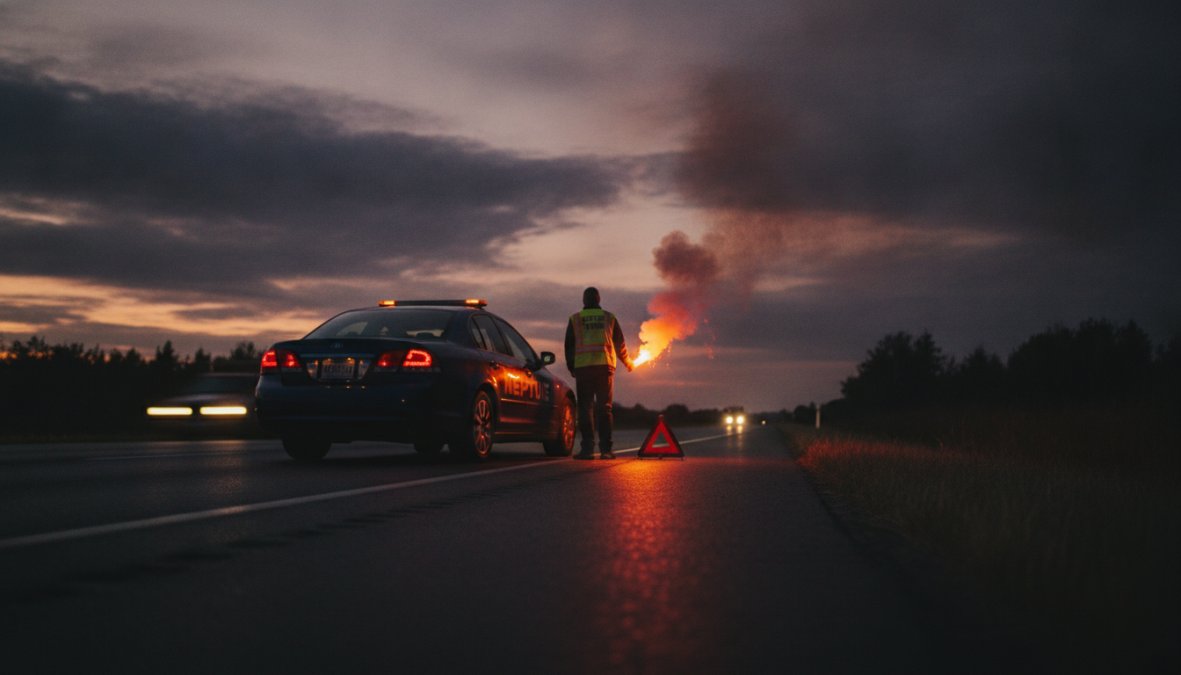
If you have reflective triangles or flares, place them on the road behind your vehicle, starting about 10 feet back and spacing them 10 feet apart. On I-44, this alerts drivers to slow down and move over. Flares burn brightly and are especially useful at night. Triangles reflect headlights back to approaching drivers. Both are legal in Oklahoma and inexpensive to carry.
If you don’t have triangles or flares, stay in your vehicle with hazard lights on. Don’t stand on the roadway waving at traffic. On quieter roads, keep your hazard lights on and turn on your interior dome light so people can see someone is in the vehicle.
Car Won’t Start Troubleshooting: Common Causes and Quick Fixes
Not all breakdowns require a tow truck. Some are quick fixes you can handle yourself.
Dead Battery Signs and Jump Start Solutions
A dead battery is the most common cause of a no-start condition. You turn the key and hear rapid clicking sounds, or nothing at all. Your dashboard lights might be dim or completely dark.
If you have jumper cables and another vehicle nearby, you can attempt a jump start. Position the working vehicle close to yours (but not touching). Turn both vehicles off. Locate the battery terminals, positive is usually red, negative is black. Attach the red jumper cable to the positive terminal of your dead battery, then to the positive terminal of the working battery. Attach the black cable to the negative terminal of the working battery, then to an unpainted metal surface on your engine block.
Start the working vehicle and let it run for 2-3 minutes. Then try starting your vehicle. If it starts, let both vehicles run for a few minutes before disconnecting the cables in reverse order. Drive your vehicle for at least 20 minutes to recharge the battery.
If you don’t have jumper cables, another vehicle nearby, or the jump start doesn’t work, call for roadside assistance. Neptune Towing provides jump start service across Tulsa and surrounding areas.
A dead battery in cold weather is more common than you’d think. If your battery is more than 3-4 years old and you’re in Oklahoma during winter, consider having it tested.
Fuel and Ignition Issues
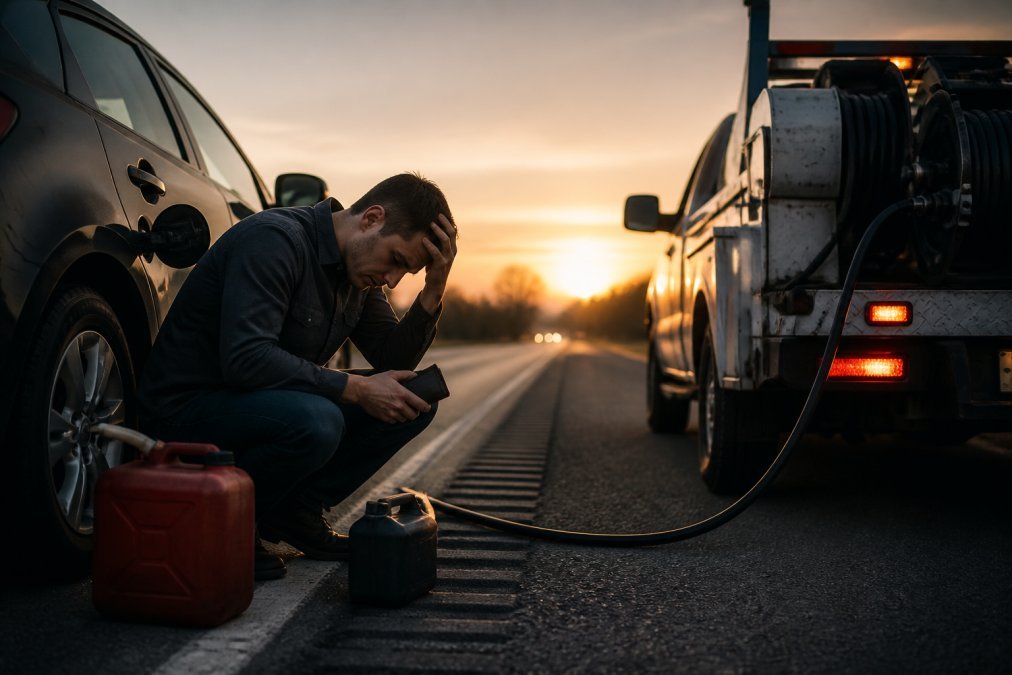
If your battery seems fine but the engine won’t turn over, the problem might be fuel or ignition related. If you’re out of gas, you need fuel delivery. Neptune Towing provides fuel delivery service. If you have fuel but the engine won’t start, the fuel pump might have failed or fuel injectors might be clogged. If you turn the key and nothing happens, no cranking, no clicking, no lights, the ignition switch might be faulty or there’s an electrical problem. These require professional diagnosis. If you can’t diagnose the problem in 5-10 minutes, call for help.
Flat Tire on Highway: What to Do and When to Call a Tow Truck
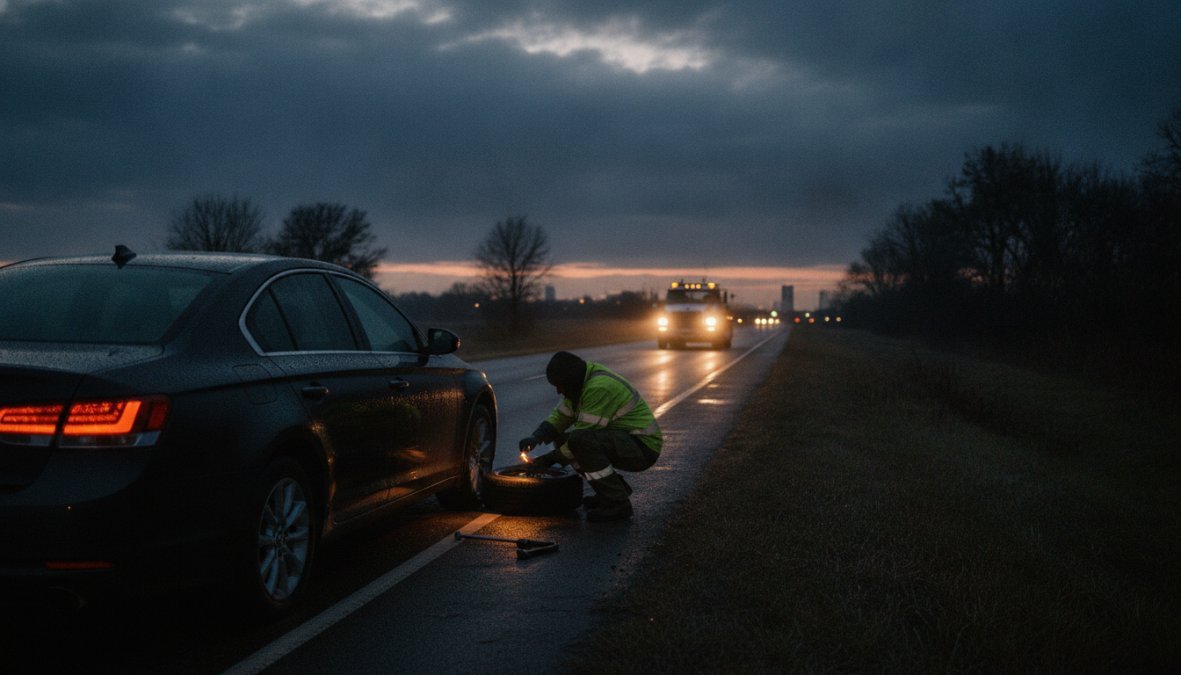
A flat tire is one of the few breakdowns where you might handle the repair yourself. Recognize the signs: sudden vibration, flapping sound, or your vehicle pulling to one side. Get to the shoulder immediately using the same safety process: hazard lights, gentle braking, steer to the shoulder.
Safe Tire Change Procedures
If you decide to change the tire yourself: loosen the lug nuts before jacking up the vehicle. Position the jack at the correct jacking point (consult your owner’s manual). Raise the vehicle until the flat tire is about 6 inches off the ground. Remove the lug nuts and tire. Mount the spare on the lug bolts and hand-tighten the lug nuts. Lower the vehicle back to the ground. Tighten the lug nuts in a star pattern for even pressure. Drive to the nearest gas station or repair shop to check the spare tire pressure. The entire process takes 15-30 minutes if you’re comfortable with it.
When to Skip the Tire Change and Call for Help
Don’t attempt a tire change if you’re on a busy highway during rush hour, uncomfortable with the process, don’t have proper tools, your vehicle is low to the ground and difficult to jack safely, weather is severe, you’re alone and feel unsafe, or the tire is damaged beyond a simple plug or patch. Call for roadside assistance. Neptune Towing provides tire change service with proper equipment and expertise.
Building a Car Emergency Kit for Breakdowns
The best time to prepare for a breakdown is before it happens. An emergency kit in your vehicle can turn a stressful situation into a manageable one.
| Item | Purpose |
|---|---|
| Jumper cables | Jump-start a dead battery |
| Flashlight with extra batteries | See in low light |
| Reflective triangles or flares | Signal other drivers |
| First aid kit | Treat minor injuries |
| Multi-tool or knife | Cut, pry, or tighten |
| Duct tape and zip ties | Temporary repairs |
| Work gloves | Protect hands |
| Tire pressure gauge | Check tire pressure |
| Spare fuses and belts | Emergency engine repairs |
| Blanket or emergency blanket | Stay warm |
| Water and non-perishable snacks | Stay hydrated and fed |
| Phone charger | Keep your phone powered |
| Pen and paper | Write down information |
| Auto insurance information | Verify coverage |
Store this kit in your trunk or under a seat. Check it twice a year to replace expired items and ensure everything is still there.
Managing Panic and Staying Calm During a Breakdown
The psychological side of a breakdown is often harder than the mechanical side. Your adrenaline spikes, breathing gets shallow, and your mind races through worst-case scenarios.
Breathe. Take slow, deep breaths. Inhale for four counts, hold for four, exhale for four. This activates your parasympathetic nervous system and calms your body’s stress response. Remind yourself you’re safe. You’re in a vehicle. You’ve pulled over. You’ve called for help. Stay in the present moment. Don’t worry about how long the tow truck will take or what the repair will cost. Focus on what you’re doing right now. Use your time productively. Call a friend or family member. Listen to music or a podcast. Read something on your phone.
A breakdown is inconvenient, not catastrophic. You have a plan. You’ve called for help. You’re going to be okay.
EV and Tesla Breakdowns: Special Considerations
Electric vehicles and Teslas are becoming more common on Tulsa roads. If you drive one, here’s what you need to know.
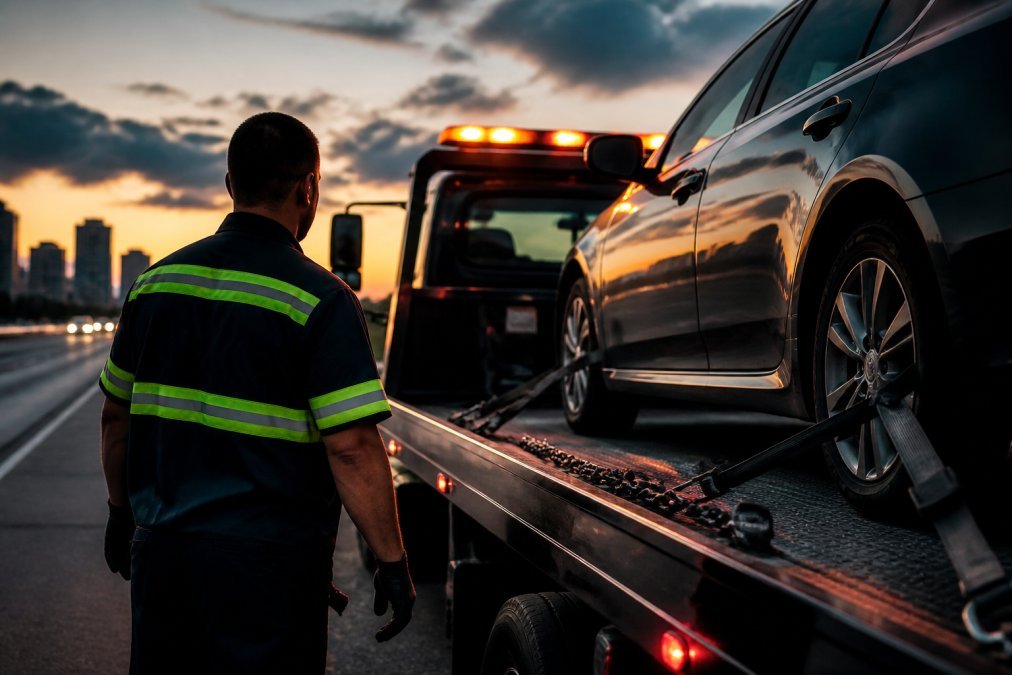
Range anxiety is real. If your EV’s battery dies and you’re out of charge, you can’t simply get fuel delivered. You need a tow truck to transport your vehicle to a charging station or repair facility. Towing an EV is different. Many standard tow trucks use methods that can damage an EV’s drivetrain. Flat-bed towing is the safest method because it keeps all four wheels off the ground. Neptune Towing specializes in EV and Tesla towing and uses flatbed equipment specifically designed to transport electric vehicles safely.
Charging while stranded. Some newer EVs can use a charging network app to find nearby chargers. If you break down near a charging station, you might charge enough to reach a service center. Battery management in extreme weather. EV batteries perform differently in extreme heat and cold. In Oklahoma winters, your EV’s range might drop 20-40%. Plan for reduced range and have a backup plan for roadside assistance.
Last Updated: July 18, 2026
When a breakdown happens, what you do in the first few minutes determines how quickly you get back on the road safely. Activate hazard lights, pull to safety, call for help, stay calm, and wait for professional assistance.
Breakdowns don’t have to be traumatic. They’re a normal part of driving. The difference between a nightmare and a manageable inconvenience is preparation and knowing who to call.
Neptune Towing is here when you need us. We serve Tulsa, Bixby, Broken Arrow, Jenks, Glenpool, Owasso, Sapulpa, and surrounding communities 24/7. We provide damage-free towing, emergency roadside assistance, jump starts, tire changes, fuel delivery, and specialized EV towing. As an owner-operated local business, we treat every customer with respect and provide honest, transparent service, no surprise fees, no impound storage, just help when you need it.
Call Neptune Towing at (539) 292-3074 when you’re stranded. We’ll get you and your vehicle to safety.
Frequently Asked Questions
What should I do first if my car breaks down on the road?
Activate your hazard lights immediately, then safely pull onto the highway shoulder as far from traffic as possible. Turn on your emergency brake and shift into Park. If you're on a busy highway like I-44 near Tulsa, stay inside your vehicle with your seatbelt on unless there's immediate danger. Once you're safely positioned, assess the situation and call for roadside assistance or a towing service if you need help.
What should I include in a car emergency kit for breakdowns?
A proper car emergency kit should contain jumper cables, a flashlight with extra batteries, flares or reflective triangles, a basic tool kit, a first-aid kit, blankets, water, and a phone charger. Keep jumper cables accessible in case you need a jump start, and include reflective triangles to increase visibility to other drivers. Store your kit in an easily accessible location so you can grab it quickly during an emergency.
How do I know my exact location to tell a tow truck dispatcher?
Use your phone's GPS to get your precise coordinates, or look for mile marker signs on highways, these are numbered and appear every mile on most Oklahoma interstates. If you're in Tulsa or nearby areas like Broken Arrow or Bixby, provide the highway name, mile marker number, and nearest cross street or landmark. Share your GPS coordinates with the dispatcher if possible, as this helps Neptune Towing and other roadside assistance services locate you faster.
Is it safer to stay in my car or stand outside during a breakdown?
Stay inside your vehicle with your seatbelt on, especially on busy highways. Standing outside puts you at risk from passing traffic. Only exit if there's immediate danger like smoke or fire, or if you need to retrieve something from your trunk safely. Keep your doors locked and hazard lights on. If you need to stand outside briefly, position yourself away from traffic and keep an eye on approaching vehicles.
What do I do if my car won't start during a breakdown?
First, check if the battery is dead, listen for clicking sounds when you turn the key. If you have jumper cables and another vehicle stops to help, connect the positive cable to your battery's positive terminal first, then to the other vehicle's positive terminal. Connect the negative cable to the negative terminal of the other battery, then to an unpainted metal surface on your engine. Let the other vehicle run for a few minutes before starting yours. If this doesn't work, call for professional roadside assistance or a towing service.
Resources for Tulsa-Area Drivers
[EXTERNAL_LINK: Oklahoma Department of Transportation Highway Safety Guidelines | odot.org]
[EXTERNAL_LINK: National Highway Traffic Safety Administration Emergency Vehicle Procedures | nhtsa.gov]
[EXTERNAL_LINK: AAA Roadside Assistance and Emergency Preparedness Resources | aaa.com]
This article was written using GrandRanker