

Table of Contents
- Why Safe EV Transport Matters: Understanding the Risks
- EV Towing Requirements and Special Considerations
- How to Put an EV in Neutral for Towing: Step-by-Step
- Electric Vehicle Battery Safety During Transport
- Flatbed Towing for Electric Vehicles: The Safest Method
- How to Safely Transport Electric Vehicles: Preparation Checklist
- Choosing a Qualified Auto Transport Carrier for Your EV
- Common Mistakes to Avoid When Transporting EVs
Last Updated: July 12, 2026
Why Safe EV Transport Matters: Understanding the Risks
Electric vehicles operate on fundamentally different principles than traditional combustion engines, creating unique safety challenges during transport. EVs contain lithium-ion battery systems that store enormous amounts of energy in a small space. When disabled or damaged, the battery management system may not function normally, changing how the vehicle must be handled.
The risks are real. Thermal runaway, a chain reaction where the battery overheats uncontrollably, can occur during transport if the battery is damaged or the vehicle improperly secured. Fire suppression equipment, proper ventilation, and understanding state of charge all become critical factors. Not every tow truck driver has been trained on EV transport protocols.
Transporting an EV improperly can trigger battery fires that are extremely difficult to extinguish. Water actually accelerates lithium-ion fires, making them more dangerous than traditional vehicle fires. Professional EV towing with proper knowledge and equipment is non-negotiable.
EV Towing Requirements and Special Considerations
Standard towing procedures don’t apply to electric vehicles. High-voltage systems create shock hazards for untrained personnel. The battery management system may shut down unpredictably when disabled. Battery weight distribution is different, typically mounted low in the chassis, affecting how the vehicle should be loaded and secured.
Most traditional towing companies treat EVs like any other vehicle, risking damage and safety problems. The difference between damage-free EV towing and standard towing is knowledge, equipment, and protocols.
Lithium-Ion Battery and Thermal Runaway Risks
The lithium-ion battery pack is a complex system containing hundreds of cells managed by sophisticated electronics. When operating normally, the battery management system monitors temperature, voltage, and current. When disabled or damaged, that protection may fail.
Thermal runaway occurs when a single cell overheats, triggering a chain reaction through the pack. Once started, it’s nearly impossible to stop, with temperatures exceeding 1,000 degrees Fahrenheit and flammable gases produced. State of charge matters during transport, a battery at 100% has higher thermal runaway risk if damaged than one at 20% SOC.
Damage from impact, puncture, or extreme temperatures can trigger thermal runaway hours after towing. Professional EV transport companies monitor vehicles during and after transport, understanding warning signs of battery distress.
High-Voltage Systems and Shock Hazards
Every EV contains high-voltage systems operating at 300-400 volts or higher. These systems are isolated under normal conditions, but damage can compromise that isolation. A technician touching the wrong component could receive a potentially fatal electrical shock.
Orange high-voltage cables are color-coded as warnings, with connectors designed to prevent accidental contact. However, vehicle damage can expose these systems. During towing, improper handling can make high-voltage components accessible. Professional towing services understand EV electrical architecture and follow proper safety procedures, recognizing that disconnecting the 12-volt battery alone is insufficient to make an EV safe to handle.
How to Put an EV in Neutral for Towing: Step-by-Step
Preparing Your Vehicle Before Transport
If your EV is operational and needs towing, engage the parking brake and shift into Park. Press the brake pedal and move the gear selector to Park. The vehicle’s battery management system will lock the wheels electronically.
Turn off the vehicle completely by pressing the power button until the display goes dark. This ensures drive motors are fully de-energized.
If the vehicle is partially powered but won’t start, you may need to manually shift into Neutral. On Tesla vehicles, press the gear stalk up twice while in Park. On other manufacturers’ vehicles, the process varies. Check your owner’s manual for specific instructions.
Engaging Transport Mode Safely
Many modern EVs have a "Transport Mode" or "Tow Mode" designed for this situation. Tesla vehicles have Tow Mode accessible through the touchscreen if the battery has sufficient charge. Enabling Tow Mode disables regenerative braking and ensures drive motors are fully disengaged.
If your vehicle has Tow Mode, enable it before the tow truck arrives. If the vehicle has no power, the tow operator will use a flatbed with wheel lifts.
Never tow an EV in Neutral by towing from the front wheels while rear wheels are on the ground, this damages the drive motor and transmission. All four wheels must either be off the ground or rolling freely. A flatbed tow truck is the only safe method for most EVs.
Electric Vehicle Battery Safety During Transport
Once your EV is on the flatbed, focus shifts to battery monitoring and environmental control. The battery must remain cool and protected from impact, with state of charge monitored throughout transport.
State of Charge (SOC) and Battery Management System Monitoring
State of charge is the percentage of battery capacity currently available. From a transport safety perspective, lower SOC is better because there’s less stored energy that could be released if the battery is damaged.
Before transport, check your EV’s state of charge. If above 80%, consider charging or discharging it to reduce SOC. If the vehicle is disabled, inform the tow operator of the state of charge.
During transport, the battery management system continues functioning if the vehicle has charge. The BMS monitors temperature, voltage, and current. A professional EV towing service will monitor these indicators and understand their meaning.
If your EV has a battery conditioning system, it will continue to cool or heat the battery during transport if powered. This actively protects the battery. Don’t turn off the vehicle if it’s operational and the battery is being conditioned.
Handling Charging Cables and Accessories
Before transport, disconnect all charging cables and remove accessories that could be damaged. The charging cable should be stored safely inside the vehicle or in the tow truck’s cab.
Roof-mounted accessories like cargo carriers or bike racks should be removed before transport. Interior items should be secured so they don’t shift during transport.
Flatbed Towing for Electric Vehicles: The Safest Method
Flatbed towing is the only safe method for transporting most electric vehicles. This is the method recommended by manufacturers like Tesla, Chevrolet, and Nissan, protecting your vehicle from damage and tow operators from electrical hazards.
Enclosed vs. Open Transport: Which Is Right for Your EV
An open flatbed exposes your vehicle to weather and road debris. An enclosed trailer protects the vehicle from these factors. For most local towing situations, an open flatbed is sufficient and more economical. For longer-distance transport or particularly valuable vehicles, an enclosed trailer is worth considering.
From a safety perspective, an enclosed trailer provides better environmental control. However, for routine local towing, an open flatbed with proper securement is safe and standard.
Proper Loading, Securement, and Ground Clearance
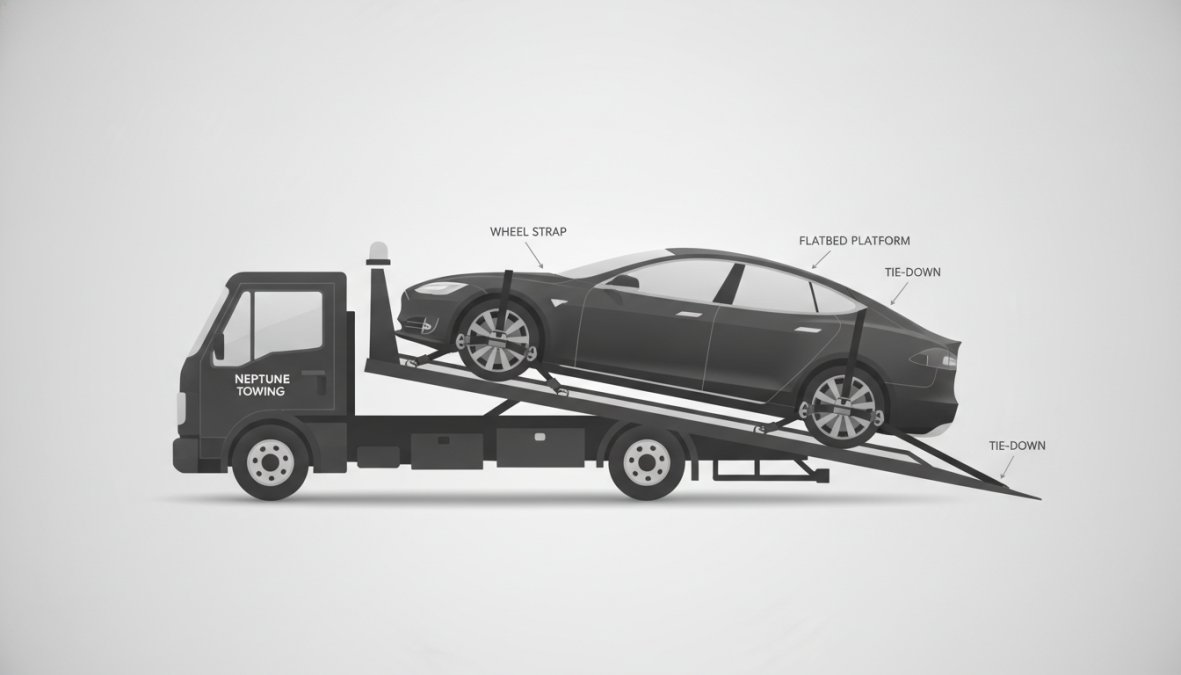
Loading an EV onto a flatbed requires specific techniques. The vehicle should be driven or winched onto the flatbed slowly and carefully, with all four wheels fully supported. Wheels should be positioned near the flatbed’s center to distribute weight evenly.
Once positioned, the vehicle must be secured with wheel straps or frame tie-downs. Professional tow operators use damage-free tie-down systems designed for modern vehicles. Wheel straps secure the vehicle without pressure on the body or undercarriage.
Ground clearance is important because batteries are mounted low in the chassis. The flatbed must be positioned so the battery pack and undercarriage components don’t drag or strike the ground.
How to Safely Transport Electric Vehicles: Preparation Checklist
Pre-Transport Vehicle Inspection
Before the tow truck arrives, visually inspect your vehicle for damage to the battery pack, undercarriage, or high-voltage components. Inform the tow operator of any damage and take photos for insurance purposes.
Check your vehicle’s state of charge and note it. If operational, check for warning lights related to the battery, power system, or cooling system. Verify that all doors lock and unlock properly. Remove personal items from the vehicle.
Documentation and Insurance Considerations
Have your vehicle registration and insurance information ready. If your vehicle has been damaged, document it with photos before transport.
Contact your insurance company if the tow is covered under your policy. Some insurance policies have specific coverage for battery-related issues or EV-specific transport. Check your policy to understand your coverage.
| Preparation Step | What to Do | Why It Matters |
|---|---|---|
| Document vehicle condition | Take photos of exterior, battery area, and any damage | Protects against false damage claims |
| Note state of charge | Check battery percentage and record it | Informs transport safety decisions |
| Remove personal items | Clear interior of valuables and loose items | Prevents loss or damage during transport |
| Verify door locks | Test all doors and locks | Ensures vehicle security during transport |
| Communicate damage | Tell tow operator about any visible issues | Allows proper handling and documentation |
| Contact insurance | Verify coverage and requirements | Ensures claim will be processed correctly |
Choosing a Qualified Auto Transport Carrier for Your EV
Not all towing companies are equipped to handle electric vehicles safely. A qualified EV transport carrier has operators trained on EV-specific procedures and access to flatbed equipment designed for modern vehicles.
Neptune Towing specializes in damage-free towing for all vehicle types, including electric vehicles and Teslas. Our operators are trained on EV transport protocols, use proper securement equipment, and communicate with customers throughout transport. We serve Tulsa, Jenks, Bixby, Broken Arrow, Glenpool, Owasso, Sapulpa, and surrounding communities.
Carrier Certification and Safety Protocols
A qualified EV transport carrier should be licensed and bonded. In Oklahoma, towing companies must be licensed through the Oklahoma Corporation Commission.
Ask about the carrier’s training and certifications. Have their operators completed EV-specific training? Inquire about their safety protocols: How do they secure EVs? What equipment do they use? How do they handle high-voltage systems? A professional carrier will explain their procedures clearly.
Post-Transport Inspection and Damage Documentation
After transport, your vehicle should be inspected for damage. The tow operator should document the vehicle’s condition upon arrival with photos and a written report.
A professional carrier will provide a bill of lading or transport documentation that includes the vehicle’s condition at pickup and delivery, protecting both customer and carrier.
Common Mistakes to Avoid When Transporting EVs
The most common mistake is using a standard tow truck that pulls the vehicle by the front wheels while rear wheels drag on the ground. This damages the drive motor, transmission, and battery connections.
Another mistake is failing to put the vehicle in Neutral or Transport Mode before towing. If drive motors are engaged, they’ll be damaged. Always follow manufacturer procedures.
Towing an EV at highway speeds with a standard tow truck is problematic, the battery and high-voltage systems may overheat without adequate ventilation or cooling. A flatbed at controlled speeds is proper.
Failing to communicate the vehicle’s condition to the tow operator is also problematic. If your EV has damage, warning lights, or battery issues, the operator needs to know.
Finally, choosing based solely on price is a mistake. A cheap tow that damages your EV costs far more in repairs than professional, damage-free transport. When you need a towing service in Tulsa, choose a company with experience, proper equipment, and commitment to protecting your vehicle.
Frequently Asked Questions
Can electric vehicles be towed like regular cars?
No. Electric vehicles require specialized handling during transport. Unlike conventional vehicles, EVs have high-voltage battery systems, heavy lithium-ion batteries, and complex battery management systems (BMS) that demand damage-free flatbed towing rather than wheel-lift or dolly methods. Never tow an EV with two wheels off the ground, as this can damage the drivetrain and pose safety risks. Always use a qualified auto transport carrier experienced in EV handling.
How do you put an electric vehicle in neutral for towing?
First, ensure the vehicle is safely parked with the parking brake engaged. Access the infotainment system or touchscreen and navigate to the transport or towing mode setting, this varies by manufacturer (Tesla, Nissan Leaf, Chevy Bolt, etc.). Some EVs require you to press and hold specific buttons on the dashboard. Consult your owner's manual for exact steps. Once transport mode is engaged, the vehicle shifts into a neutral state that allows safe flatbed towing without damaging the battery management system or drivetrain.
What state of charge should an EV battery be at for transport?
Most manufacturers recommend transporting an EV with a battery state of charge (SOC) between 20% and 80%. This range minimizes thermal runaway risk and prevents stress on the lithium-ion battery during transport. Avoid shipping an EV with a fully charged or completely depleted battery. If your vehicle arrives damaged or with a low charge, document the battery status immediately and contact your insurance provider. For damaged EVs, inform the carrier about any visible battery damage or corrosive leaks.
Is flatbed towing the only safe way to transport an electric vehicle?
Yes, flatbed towing is the safest and most recommended method for transporting electric vehicles. Enclosed flatbed transport provides additional protection from weather and road hazards. Open flatbed is acceptable but offers less protection. Never use wheel-lift, dolly, or tow-behind methods, as these can damage the EV's drivetrain, battery, or high-voltage systems. When choosing an auto transport carrier in the Tulsa area, verify they have experience with EV transport and proper safety protocols, including fire suppression equipment and knowledge of battery management systems.
When your EV breaks down or needs transport in the Tulsa area, you need a towing service that understands electric vehicles. Neptune Towing provides damage-free EV towing with operators trained on high-voltage systems and proper securement procedures. We serve Tulsa, Jenks, Bixby, Broken Arrow, and surrounding communities with honest, professional service. Call (539) 292 3074 for emergency EV towing that protects your vehicle and gets you to safety quickly.
This article was written using GrandRanker