

Table of Contents
Last Updated: June 20, 2026
A dead battery is one of the most common reasons drivers end up stranded, and knowing how to jump start a dead battery correctly can mean the difference between a five-minute fix and a two-hour wait. The connection sequence matters far more than most people realize, getting it backwards can damage your vehicle’s electrical system or cause a dangerous spark near the battery.
Safety Precautions Before Jump Starting Your Car
A car battery contains sulfuric acid and produces hydrogen gas during charging. A spark near a venting battery can ignite that gas, which is why safety protocol exists.
Personal protective equipment and vehicle inspection
Before touching any cables, run through this checklist:
-
Eye protection: Safety goggles protect against acid splatter and sparks.
-
Inspect the battery: Look for cracks, bulging, or leaking fluid. A physically damaged battery should not be jump started.
-
Check for corrosion: White or blue-green buildup on battery posts reduces electrical contact. Wipe terminals dry before connecting cables.
-
Confirm both vehicles are off: Both the dead vehicle and the donor vehicle should be fully off before you connect anything.
-
Ensure the vehicles are not touching: Park close enough for cables to reach, but the two cars must not make metal-to-metal contact.
-
Check your vehicle manual: Some manufacturers specify jump-starting procedures unique to their electrical system. BMW, for example, often has a remote jump point under the hood rather than the battery itself.
Tools and Equipment You’ll Need to Jump Start
The right equipment makes the process safer and faster. Undersized cables create heat buildup and poor conductivity.
Jumper cables vs. portable jump starter packs
|
Feature |
Jumper Cables |
Portable Jump Starter Pack |
|---|---|---|
|
Requires donor vehicle |
Yes |
No |
|
Storage size |
Bulky |
Compact |
|
Works alone |
No |
Yes |
|
Best for cold weather |
Depends on cable gauge |
Yes (lithium models) |
|
Risk of incorrect connection |
Higher |
Lower (smart clamps) |
|
Typical cost range |
Low |
Moderate to higher |
Jumper cables: Choose cables at least 10 to 12 feet long with a gauge of 4 to 6. Thicker cables (lower gauge number) handle more current with less resistance.
Portable jump starter packs: Modern lithium-ion jump starters are compact enough to fit in a glove box and powerful enough to start most passenger vehicles. Many include smart clamps that prevent reverse polarity connections. According to AAA’s vehicle breakdown research, battery-related failures are consistently among the top reasons for roadside service calls.
How to Jump Start a Dead Battery: The Complete Process
The connection sequence protects both vehicles and the person doing the work. Reverse the order, and you risk a short circuit, a damaged alternator, or a spark near the battery.
Total Time: 15-20 minutes Difficulty: Beginner
Step 1: Identify battery terminals and prepare connections
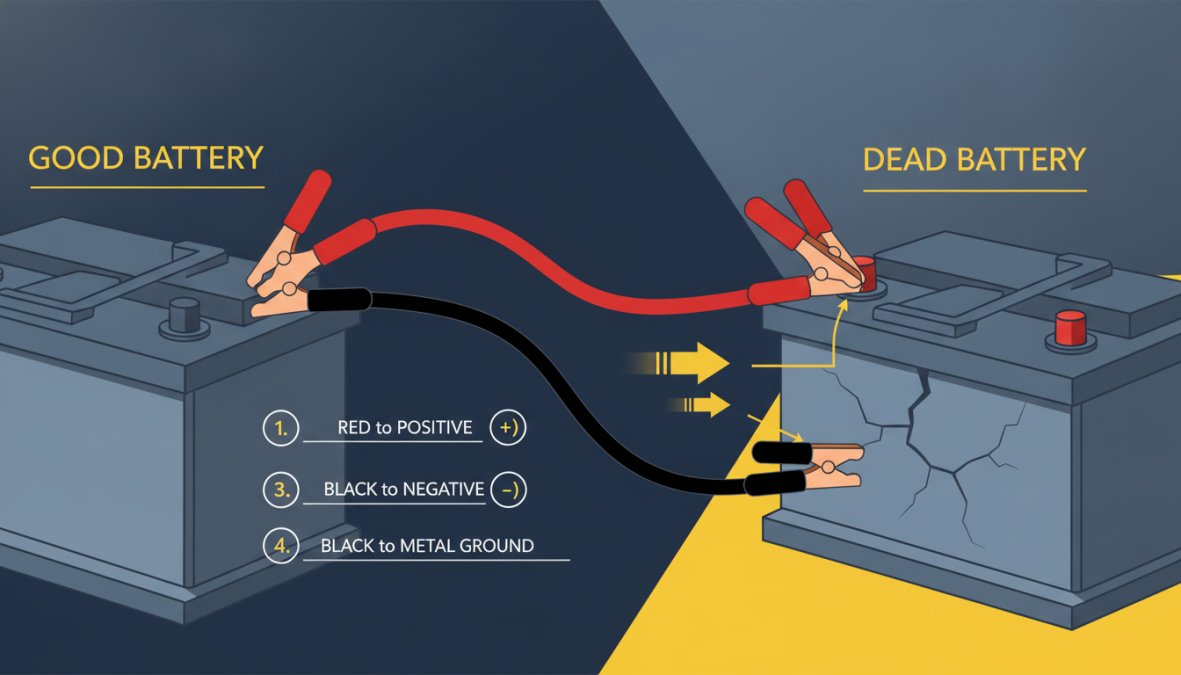
The positive terminal is marked with a plus sign (+) and typically has a red cover or red cable attached. The negative terminal is marked with a minus sign (-) and usually has a black cable. On some vehicles, there will be a dedicated jump point under the hood. Consult your vehicle manual if you cannot locate the battery directly.
Step 2: Connect the jumper cables in the correct sequence
Follow this sequence exactly:
-
Connect the red cable to the positive terminal (+) of the dead battery
-
Connect the other end of the red cable to the positive terminal (+) of the donor vehicle’s battery
-
Connect the black cable to the negative terminal (-) of the donor vehicle’s battery
-
Connect the other end of the black cable to an unpainted metal surface on the engine block of the dead vehicle, away from the battery. This grounding point ensures any spark happens away from the battery, reducing ignition risk.
Step 3: Start the donor vehicle and let it run
Start the donor vehicle and let it run for two to three minutes before attempting to start the dead vehicle. This allows the alternator to transfer charge to the dead battery.
Step 4: Start your vehicle and disconnect cables safely
Attempt to start the previously dead vehicle. If it starts, disconnect the cables in the exact reverse order of connection:
-
Remove the black cable from the engine block grounding point
-
Remove the black cable from the donor vehicle’s negative terminal
-
Remove the red cable from the donor vehicle’s positive terminal
-
Remove the red cable from the previously dead battery’s positive terminal
Never let the cable clamps touch each other while any end is still connected to a battery.
How Long to Drive After Jump Starting Your Car
Drive for at least 30 minutes after a successful jump start, preferably on a highway or at sustained speeds above 45 mph. The alternator recharges the battery most efficiently under load at higher RPMs.
A successful jump start does not mean the battery is fine. It restores enough charge to run the vehicle but does not diagnose why the battery died. If the battery died because of a genuine fault, parasitic drain, or aging, it will likely die again.
A battery load test at any auto parts store will tell you whether the battery holds a full charge. This test takes about five minutes and is typically free. If the battery fails, replacement is the right call.
Signs of a Bad Car Battery to Watch For
A dead battery rarely fails without warning. The signals are there before you are stranded.
Recognizing battery health issues and corrosion
The most common warning signs include:
-
Slow cranking: The starter motor turns the engine over slowly, especially on cold mornings.
-
Electrical gremlins: Flickering interior lights, a dim dashboard, or accessories that behave erratically under load.
-
Frequent jump starts needed: If you have jump started the same vehicle more than twice in a month, the battery is failing.
-
Corrosion on battery posts: Heavy buildup increases resistance and reduces the battery’s ability to deliver current.
-
Battery age: Most car batteries last three to five years. If your battery is approaching that range, proactive replacement is smarter than waiting for failure.
According to the Battery Council International’s battery maintenance guidelines, battery health degrades faster in extreme temperatures, making seasonal inspections particularly valuable in harsh climates.
What to Do If Your Car Won’t Start After Jump Starting
If the vehicle does not start after a proper jump attempt, work through these possibilities:
Troubleshooting common issues and electrical problems
The cables are not making good contact. Wiggle the clamps on the battery posts. Corrosion or a loose connection can prevent adequate current transfer.
The donor vehicle’s battery is also weak. Run the donor vehicle for five to ten minutes before reattempting.
The dead battery is too far gone. Batteries left dead for days or weeks may not accept a charge from a jump start. A battery charger connected for several hours may recover it.
The problem is not the battery. If the battery tests fine but the car still will not start, the issue may be the starter motor, ignition system, a blown fuse, or another electrical fault.
A parasitic drain is present. Some electrical fault is drawing power even when the vehicle is off. This requires a multimeter and systematic diagnosis.
As documented in NAPA Auto Parts’ battery troubleshooting resources, a no-start condition after a jump attempt indicates the issue extends beyond the battery itself.
Modern Vehicle Considerations: Electronics and Hybrids
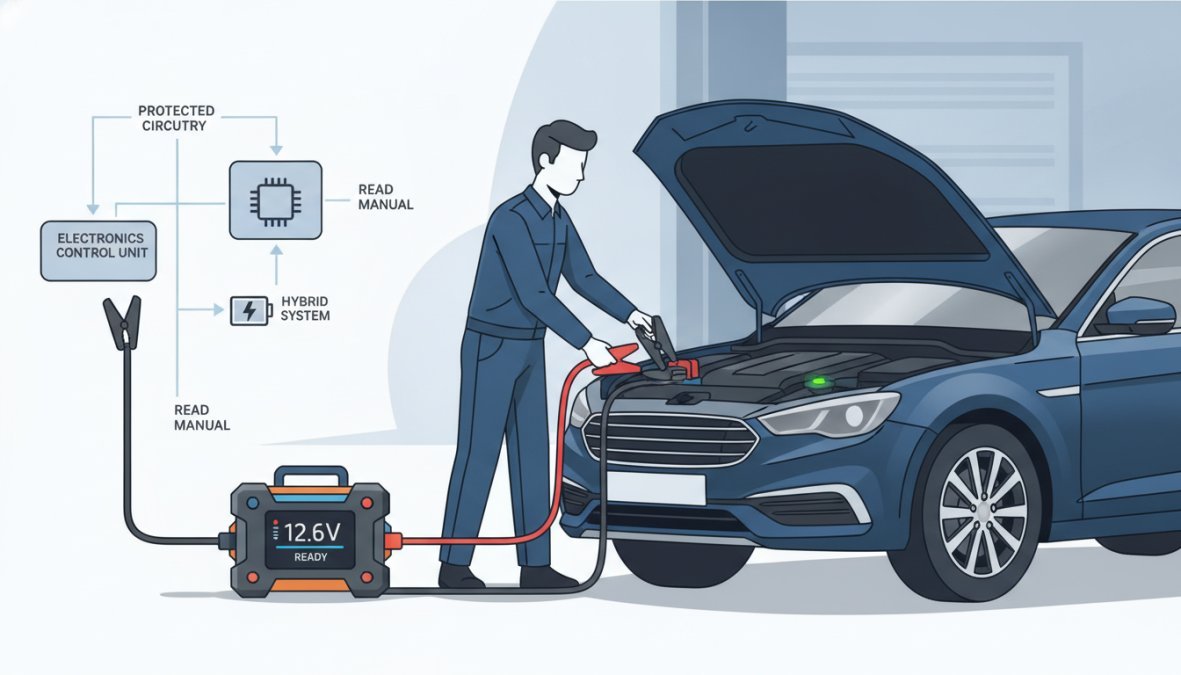
The standard jump-starting procedure was written for older vehicles with simple electrical systems. Modern vehicles contain dozens of electronic control units (ECUs) that are sensitive to voltage spikes. A sudden surge from a jump start can damage or reset these modules.
Jump starting hybrid and electric vehicles safely
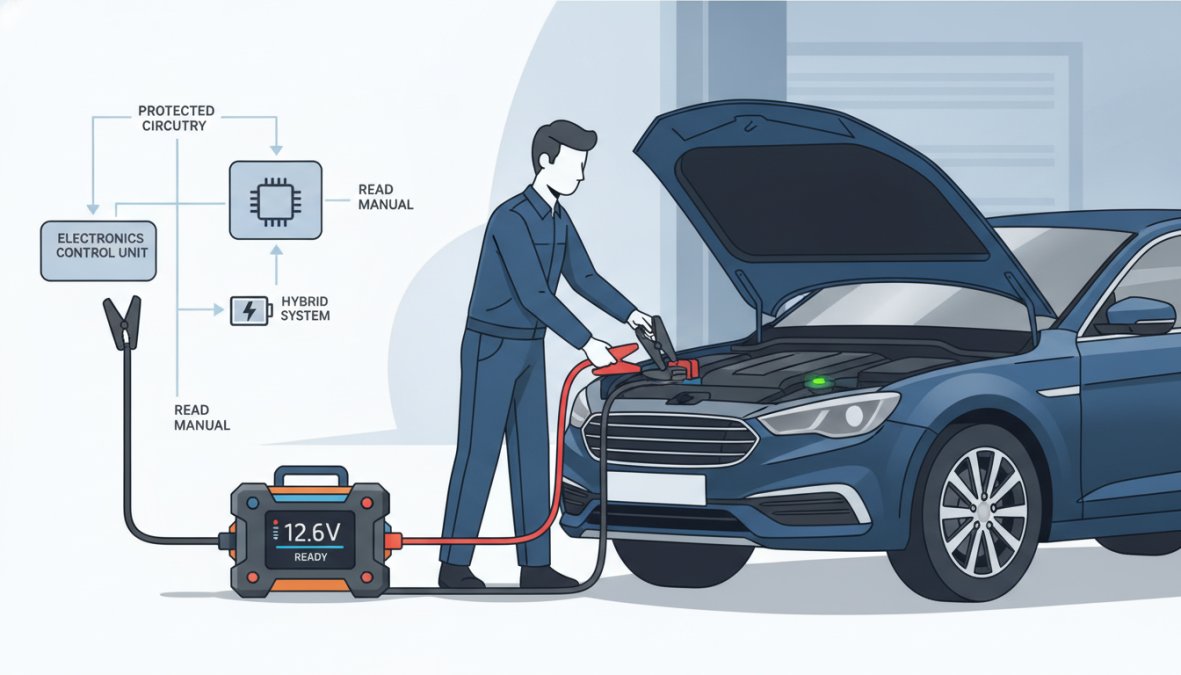
For modern conventional vehicles:
-
Use a quality portable jump starter with built-in voltage regulation rather than direct cable-to-cable connections where possible
-
Avoid revving the donor vehicle’s engine during the jump
-
Check your vehicle manual for manufacturer-specific instructions
For hybrid vehicles: Hybrids have two battery systems: a large high-voltage battery pack that powers the electric motor, and a smaller 12V auxiliary battery that powers the vehicle’s electronics. Jump starting a hybrid addresses only the 12V auxiliary battery. Never connect jumper cables to the high-voltage battery system. The 12V jump point is typically located under the hood and clearly labeled.
For fully electric vehicles: A traditional jump start does not apply to a fully dead EV traction battery. If an EV’s 12V auxiliary battery dies, that can be jump started using the same process as a conventional vehicle. If the main battery pack is depleted, the vehicle needs to be charged at a charging station or transported to one.
When to Call a Professional Towing Service
Call for roadside assistance when:
-
The battery is visibly damaged, cracked, leaking, or frozen
-
The vehicle still will not start after two proper jump attempts
-
Warning lights remain on after a successful start
-
You are dealing with a hybrid or EV and are unsure which battery system is involved
-
The vehicle is in an unsafe location, such as a highway shoulder or an unlit area at night
-
You do not have access to a donor vehicle or jump starter
According to the National Highway Traffic Safety Administration’s roadside safety guidelines, roadside breakdowns on high-speed roads carry significant injury risk. When in doubt, staying in the vehicle with hazard lights on and calling for professional help is the safer choice.
Neptune Towing provides 24/7 emergency roadside assistance throughout Tulsa, Broken Arrow, Jenks, Bixby, Glenpool, and surrounding communities. Whether the issue is a dead battery, a vehicle that needs towing to a shop, or a lockout situation, the team handles it directly, not through a call center. Every service call is handled by a local Tulsa professional who treats the situation with the urgency it deserves.
Frequently Asked Questions
What is the correct order to connect jumper cables when jump starting a dead battery?
Connect the red cable to the positive terminal of the dead battery first, then to the positive terminal of the donor vehicle. Next, connect the black cable to the negative terminal of the donor vehicle. Finally, connect the black cable to an unpainted metal surface on the engine block of the dead car—not directly to the negative terminal. This grounding point prevents sparks and protects your vehicle's electrical system. Always disconnect in reverse order.
How long should I drive after jump starting my car?
Drive for at least 20-30 minutes to allow your alternator to recharge the battery fully. Avoid turning off the engine immediately after starting, as this may cause it to stall again. If your battery continues to drain or the vehicle won't start the next time, the battery may be failing and need replacement. Consider visiting a mechanic to test your battery health and electrical system.
Can you jump start a car with a completely dead battery, and what are signs of a bad car battery?
Yes, you can jump start a completely dead battery if the terminals are clean and connections are secure. Signs of a bad battery include slow engine cranking, clicking sounds when turning the key, dim headlights, corrosion buildup on terminals, and the battery warning light on your dashboard. If your battery is more than 3-5 years old and frequently fails to hold a charge, replacement may be necessary rather than repeated jump starts.
What should I do if my car won't start after jump starting it?
First, ensure all cable connections are secure and try again after waiting 5 minutes. If it still won't start, the issue may be the alternator, starter motor, or a deeper electrical problem rather than the battery itself. Check for corrosion on battery posts and clean if needed. If the engine cranks but won't turn over, you may have a fuel or ignition system issue. Contact a professional mechanic or roadside assistance service like Neptune Towing for diagnosis and safe transport.
This article was written using GrandRanker